 The right filter for your aquarium
Suitable filtration is of particular importance for every type of aquarium. Besides the flow of water, the necessary breakdown of pollutants is above all important for keeping a closed system like an aquarium intact. There are many different filter models for various aquarium sizes. What do I fill the filter with? Is an internal filter, external filter or hang-on-back filter better? We explain all these questions in this article.
What is a filter for?
In an aquarium, the filter is responsible for several processes. For one, it provides the necessary flow and water movement. How much flow an aquarium needs depends primarily on the stock. Many animals from fast-flowing waters such as streams are quite used to strong current. Sometimes the aquarist can even support this more precisely with special circulation pumps.
Another important task of the filter is a biological one, because the filter materials in it clean the water. Suspended particles are retained, and pollutants are broken down by bacteria living in the filter (keyword: nitrogen cycle). Some filter media can even reduce water discoloration or certain parameters such as the nitrate or phosphate level, or serve to lower the pH. Filtration is of immense importance in an aquarium because, unlike a natural body of water, an aquarium is a closed system. Pollutants are not simply carried away, and new nutrients and fresh water are not continuously washed in. In flowing water such as a stream or river, however, this is the case. In an aquarium, these tasks have to be taken over partly by the aquarist (through maintenance work such as the water change) and partly with the help of technical equipment such as aquarium filters. You can learn more about this topic in this article.
Different filter materials
Through the filter material, the aquarist can have a certain influence on the water parameters and the substances in the water. In principle, the purpose of filtration in terms of water purity and pollutant breakdown in the sense of the nitrogen cycle should be fulfilled. Mechanical and biological filter media are above all decisive for this. The quality and quantity of these filter materials depend on the needs of the aquarium. An aquarium with many fish, prone to overstocking and heavy feeding, produces a lot of waste, so the biological filtration capacity in particular should be correspondingly high. A planted aquarium with only a few animals has very different requirements, though; here light filtration would be more appropriate, one that has hardly any influence on important plant nutrients.
There is also chemical filtration. This refers to materials that actively influence certain substances in the water. These include things like activated carbon and adsorbers, which can reduce the nitrate, phosphate or silicate level. Chemical filter media should be used with care and in a very targeted way, since the effect of such measures is quite large. You can find more detailed information on filter materials here.
What types of filters are there?
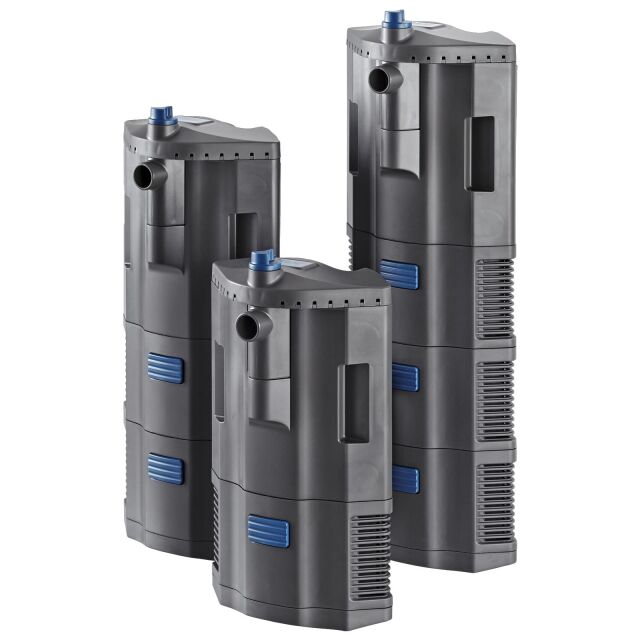
In principle, a distinction is made here between internal filters, external filters and hang-on-back filters. Internal filters, as the name suggests, are placed inside the aquarium. This takes up some space in the tank itself, but you don't have the important equipment outside the aquarium, so no cabinet is needed. Internal filters are therefore a good solution especially for small aquariums, for example ones standing on a desk.
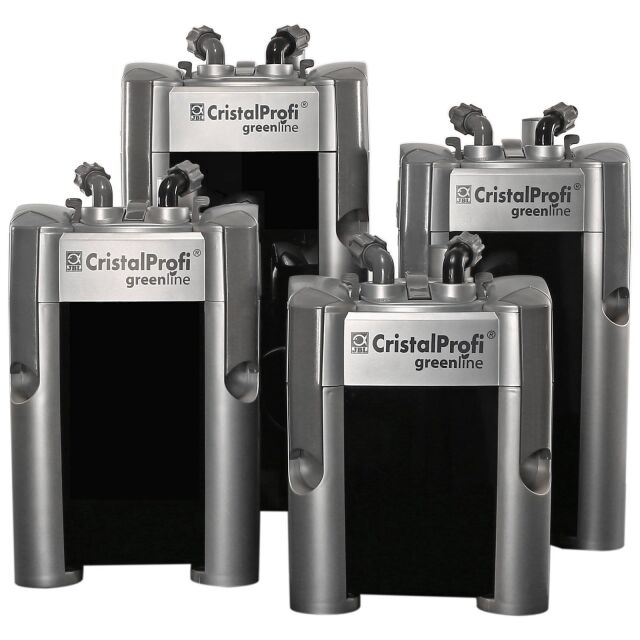
External filters move the filtration completely outside; the filter housing usually fits in a cabinet and is connected to the aquarium with hoses via the filter inflow and outflow. This leaves considerably more room in the tank itself for the layout, and in addition a piece of equipment that would otherwise be visible is eliminated. Aquascapers in particular therefore swear by external filters.

Hang-on-back filters (also called hang-on filters) are meant as a kind of in-between solution. The equipment is outside the glass tank, but not as far away as with an external filter. As a rule, a hang-on-back filter is hung over an aquarium pane. The filter thus stays quite close to the aquarium and the aquarium setup stays quite compact. A cabinet to house the equipment is therefore not necessary. In this article, we go into the different filter types in more detail.
Overview: filter types for common aquarium sizes
10 to 20 l nano aquarium:
For very small nano aquariums, it is not that easy to find a suitable filter because of their small size. There are no true external filters for such a small volume; here you can fall back on hang-on-back filters like the AZOO HangOn Filter MIGNON 150 and the Aquael Versamax Mini to move the equipment at least a little outside the aquarium. Internal filter models, on the other hand, are available in quite a variety for this aquarium size. Since such small nano aquariums are also often used as desktop versions on a desk or similar, this type of filtration is an obvious choice. As a rule, such aquariums are not stocked with fish, so a large filter volume is often not necessary. Shrimp keepers like to fall back on sponge filters or similar internal filters such as those from Dennerle or Aquael.
- Eheim miniUP, particularly small internal filter.
- Dennerle Nano Corner Filter, space-saving internal filter.
- Aquael Versamax Mini, small hang-on-back filter.
- AZOO HangOn Filter MIGNON 150, small hang-on-back filter.
- UP Aqua Sponge Filter, sponge filter for shrimp keeping, needs an air supply.
- Aquael Pat Mini, powerful sponge filter.
20 to 30 l nano aquarium, Dennerle Scaper's Tank 35 l or Nano Cube, ADA Mini M:
For nano aquariums between about 20 and 30 liters, the choice of filters is already somewhat larger. Popular internal filters such as the Aquael Pat Mini or Dennerle Nano Corner Filter can be used here as well. The Dennerle Scaper's Flow offers somewhat more flow and can be used both as an external filter and as a hang-on-back filter. The same applies to the Oase FiltoSmart 60, which is basically an external filter but can be converted into a hang-on-back filter with an optional accessory set. As a rule, however, only invertebrates, or, if at all, just a few very small fish, are kept in such small aquariums.
- Dennerle Nano Corner Filter, space-saving internal filter.
- Aquael Pat Mini, powerful sponge filter.
- Oase FiltoSmart 60, small external filter for 9/12 tubing, can also be converted into a hang-on-back filter (optional).
- Eheim classic 150, reliable external filter with 9/12 (pressure side) and 12/16 (suction side) tubing connection.
- Dennerle Scaper's Flow, powerful hang-on-back or external filter.
54 l standard aquarium (60x30x30 cm), Dennerle Scaper's Tank 50 l or ADA 60-P:
For aquariums with an edge length of about 50 - 60 cm, a substantial fish stock is possible. In terms of filtration, models with more filter volume should therefore be chosen if there is a heavier water load.
- JBL CristalProfi m greenline, energy-saving internal filter.
- Dennerle Scaper's Flow, flexible hang-on-back or external filter.
- Eheim Ecco pro 130, strong and energy-saving, for 12/16 tubing.
- JBL CristalProfi e402, energy-saving rectangular external filter for 12/16 tubing.
- Oase FiltoSmart 100, small external filter for 12/16 tubing, also available as a thermo version or convertible.
112 l standard aquarium (80x35x40 cm):
For larger aquariums up to 80 cm edge length, the selection of external filters in particular is much greater. Even so, there are also some usable internal and hang-on filters designed for an aquarium of this size.
- Oase Bio Plus 200, rectangular internal filter, can be retrofitted with a heating rod.
- Seachem Tidal Filter 35, practical hang-on-back filter.
- JBL CristalProfi e702, energy-saving rectangular external filter for 12/16 tubing.
- Eheim eXperience 150, quiet-running and energy-saving external filter for 12/16 tubing connection
- Oase FiltoSmart 200, external filter for 12/16 tubing, also available as a thermo version or convertible.
182 l standard aquarium (90x45x45 cm), ADA 90-P:
For a larger aquarium with a 90 cm edge length, the options for keeping larger ornamental fish naturally increase again, too. Powerful external filters with plenty of filter volume are a good choice here in particular. In the now larger glass tank, it is also important to choose a powerful filter so that all areas of the aquarium can be flushed with flow.
- Oase Bio Plus 200, rectangular internal filter, can be retrofitted with a heating rod.
- Seachem Tidal Filter 55, practical hang-on-back filter.
- JBL CristalProfi e902, energy-saving rectangular external filter for 12/16 tubing.
- Eheim eXperience 250, quiet-running and energy-saving external filter for 12/16 tubing connection.
- Oase BioMaster Thermo 250, practical thermo filter with an easily replaceable pre-filter and large filter volume.
250 l standard aquarium (100x50x50 cm) or 243 l ADA 120-P:
Now the magic limit of 1 m edge length is reached or exceeded. Hang-on-back filters are still available here, but because of the space saving, external filters are the right choice for such a large aquarium. If you want to keep larger cichlids or catfish with a correspondingly higher metabolism, you are well advised to choose a filter with a larger filter volume.
- Seachem Tidal Filter 75, practical hang-on-back filter.
- JBL CristalProfi e1502, energy-saving rectangular external filter for 16/22 tubing.
- Eheim eXperience 350, quiet-running and energy-saving external filter for 16/22 tubing connection.
- Oase BioMaster Thermo 350, practical thermo filter with an easily replaceable pre-filter and large filter volume.
- Oase FiltoSmart 300, external filter for 16/22 tubing, also available as a thermo version or convertible.
350 to 500 l aquarium:
Having arrived in the range of large aquariums, the aquarist can still choose from a good selection of external filters in particular. Especially with glass tanks that now have a substantial edge length of 1.5 m and up, and with the desire for enough flow in all areas, it can be worthwhile to add a second filter or to use circulation pumps.
- Seachem Tidal Filter 110, practical hang-on-back filter.
- JBL CristalProfi e1902, energy-saving rectangular external filter for 19/25 tubing.
- Eheim professional 3e 600T, large thermo filter with a double intake pipe.
- Oase BioMaster Thermo 600, practical thermo filter with an easily replaceable pre-filter and large filter volume.
- Oase BioMaster Thermo 850, practical thermo filter with an easily replaceable pre-filter and large filter volume. Sufficient for aquariums up to 850 liters.