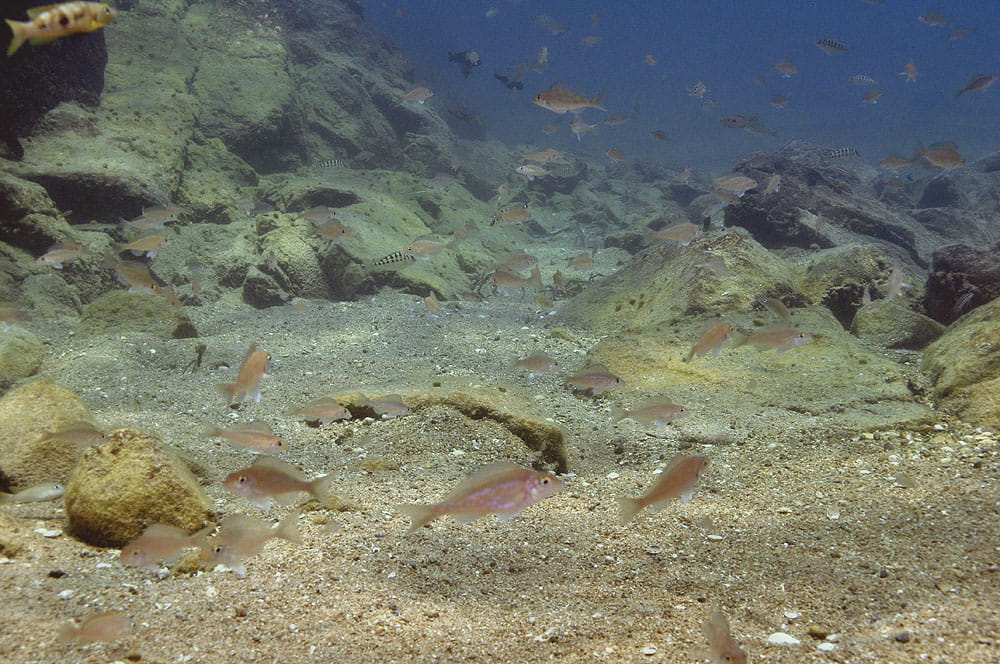
 The Tanganyika aquarium
Header photo credit: JBenoit via Wikimedia Commons (public domain), license information, source attribution.
Lake Tanganyika is a large African body of water and the second-largest lake on that continent. It extends across areas in the countries of Burundi, Tanzania, the Democratic Republic of the Congo and Zambia. The lake contains freshwater and is also notable for its exceptional depth, since it lies in a so-called rift valley. Lake Tanganyika is a home to many different fish species that mostly occur only in these waters. More than 300 species are known so far, including many cichlids, but also tetras, featherfin catfish and spiny eels. Similar to Lake Malawi, this lake is rich in minerals dissolved in the water, which is reflected in special water parameters with a high pH and corresponding hardness. In this article, we take a closer look at the cichlids living in this lake, which are very popular in aquarium keeping.
General information about the Tanganyika aquarium
A Tanganyika aquarium offers a suitable home for African cichlid species that occur endemically in this lake. The original habitat of these colorful and interesting ornamental fish has clear water with a warm temperature of about 23 to 28 °C and a high degree of hardness together with an alkaline pH. In principle, two different biotopes can be found here. First there is the rocky shore region, where most of the cichlids known in aquarium keeping live. These include typical rock-dwelling cichlids and the popular shell-dwelling cichlids. In addition, there are sandy zones that are partly interspersed with aquatic plants or algae carpets. Cyprichromis species are usually at home here.
In a Tanganyika aquarium, the aquarist can use rocky stone structures as decoration, for example to depict a riverbank biotope. Aquatic plants are not necessarily part of the design (if at all, rather for sand zone biotopes) but can help improve the water quality. For this, however, the plants should be cichlid-proof. Driftwood is rather not used as decoration. Since Tanganyika cichlids are fairly large aquarium animals, correspondingly large glass tanks of 500 liters volume or more are recommended. For smaller shell-dwelling cichlids, 100 liters of volume are sometimes sufficient.
Water parameters in the Tanganyika aquarium

Lake Tanganyika has very special water parameters because of its high mineral content. The pH is in the alkaline range of 8, the carbonate hardness is 15 and the general hardness is 10°. Temperatures are in the range of 23 to 28 °C. That the carbonate hardness is higher than the general hardness is unusual (the reverse ratio is the norm) and can hardly be achieved with average tap water. A suitable water-hardening salt can help raise the KH in a targeted way here. Because of the relationships in the carbonate-carbonic acid equilibrium, this is also helpful for keeping the pH around 8. The carbonate hardness serves as an important buffer here. In addition, the pH should be supported with appropriate movement of the water surface (for example with an air stone) in order to drive out the CO2 contained in the water, which can lower the pH. This also increases the oxygen content, which the ornamental fish appreciate.
Alternatively, you can also use water whose general hardness is higher than in the original habitat. Values of 10 to 20 (or sometimes even 30) °dGH are often still tolerated well, so very hard tap water can sometimes be used here without much treatment. Here too, a correspondingly high KH and an alkaline pH of at least 7.5 to 8 should be achieved by aeration in order to reach the necessary values.
Besides suitable water parameters in terms of temperature, hardness and pH, the aquarium water should also be clean, clear and as free of germs as possible. Besides appropriate filtration with matching high-performance filter media that break down pollutants, the system can also be supported with sterilizers or oxydators.
Regular maintenance such as a generous weekly water change is also important in order to remove unwanted substances to a high degree. The aquarist can keep an eye on the water parameters phosphate and nitrate and try to keep them as low as possible. High concentrations of nitrate and phosphate are then often an indication of too great a water load.
Aquatic plants in the Tanganyika aquarium
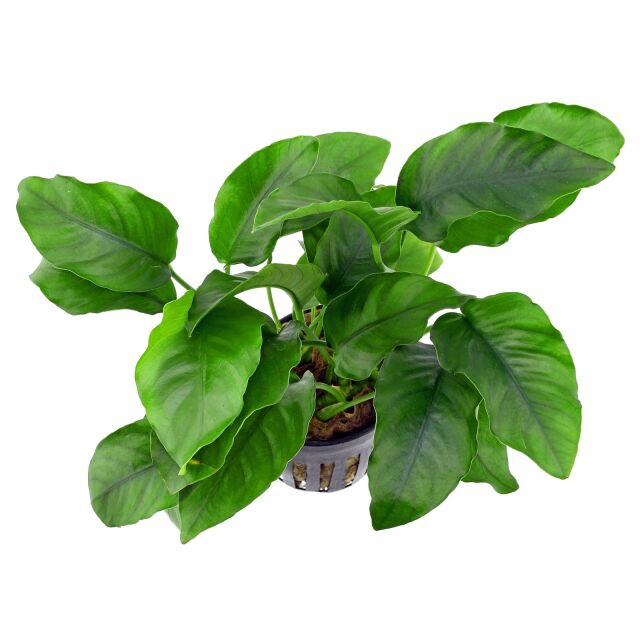
Aquatic plants are not necessarily present in the African habitats of the cichlids of Lake Tanganyika. The rocky shore zones in particular are rather free of plants, which occur more in the sandy zones. Nevertheless, the aquarist can use aquarium plants for purely decorative reasons. This also offers biological advantages, since the plants provide oxygen, serve as hiding places and can break down excess nutrients such as nitrate and phosphate. However, the aquarium plants also have to be cichlid-proof, since there are quite a few cichlids that go after plants. For greening rocky structures, epiphytes that are also hard-leaved are particularly well suited. The genus Anubias in particular is very suitable for this, especially since these are aquatic plants that are quite easy to keep. You can find more information on cichlid-proof aquariums here, by the way.
In the sandy zones of a Tanganyika biotope, Vallisneria species in particular can be found. The stands can form large underwater meadows and even occur at depths of up to six meters. In strong current, the plant grows low with resilient leaves bent downward. In more sheltered spots, Vallisneria grows considerably taller. Coontail (Ceratophyllum demersum), on the other hand, occurs in Lake Tanganyika at depths of up to ten meters. It grows very compactly there with a hard leaf structure. Milfoils such as Myriophyllum spicatum are also found in the upper shallow sand zones, but only at shallow depths, since the plant needs more light. Besides pondweed species such as Potamogeton pectinatus and schweinfurthii, Hydrilla verticillata also appears in Lake Tanganyika, but rather rarely. Sometimes there are also naiads such as Najas marina and Najas horrida. These species too have exceptionally hard leaves because of the harsh conditions.
Decoration items in the Tanganyika aquarium
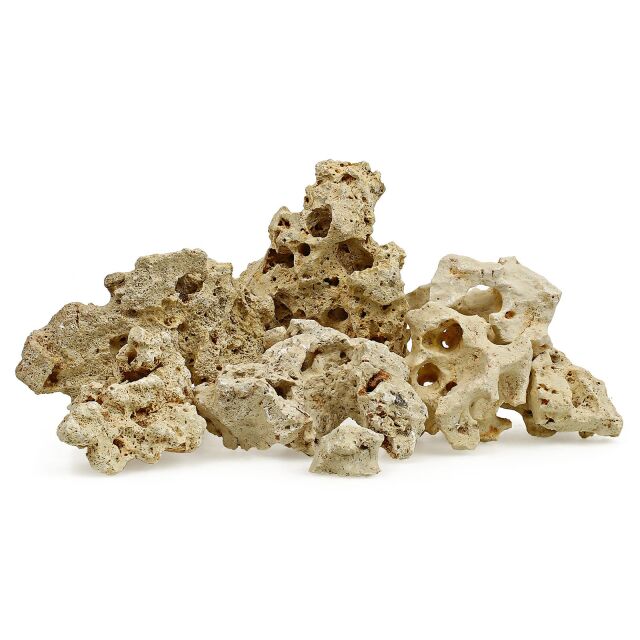
In a Tanganyika aquarium, the rocky shore zone of the lake is very often recreated. While driftwood and aquatic plants are rather not found there, the biotopes can be implemented well with stone structures. Stones that can harden the water are gladly used for this, in order to get closer to the water parameters of the original habitat. Holey rock is very popular here, but Moon Stones or Mini Landscape are also possible.
Since the tanks in a Tanganyika aquarium are quite large because of the stocking, quite a lot of stones with corresponding weight are sometimes used. It therefore makes sense to rely on rather light stones such as the holey rock mentioned. Rock back walls with tall structures along the rear pane of the aquarium are very popular. This lets you create a rocky shoreline landscape that looks natural and offers many great hiding places and retreats for the fish. A great alternative for saving weight is artificial rocks and back walls, such as those from the renowned manufacturer Back to Nature. It offers an enormous range of artificial stones and back walls that still look attractive and natural.
Substrate in the Tanganyika aquarium

Types of sand or gravel with a grain size of about 0.2 to 2 mm are suitable as substrate for a Tanganyika aquarium. Even finer sand can otherwise lead to cloudy water and should be avoided. This applies especially if fish species that also dig up the substrate are kept in the aquarium.
The color of the substrate should also be chosen deliberately in a Tanganyika aquarium. The shade of the sand should not be too light, since shy animals can otherwise become skittish. Their coloration is also often worse and the fish become paler. Bright snow-white shades are therefore not ideal; a natural off-white or beige is better.
Stocking in the Tanganyika aquarium
As already described in the introduction, there are mainly two biotopes in Lake Tanganyika that you can recreate in the aquarium. First, there are the rocky shore zones, which are gladly populated by fish of the genera Tropheus, Chalinochromis, Julidochromis, Lamprologus, Lepidiolamprologus and Neolamprologus. For the rather sandy zones, genera such as Callochromis, Ectodus, Enantiopus or Xenotilapia are suitable. All of these fish species grow quite large, so a Tanganyika aquarium should have a volume of 500 liters as a rough guideline.
Shell-dwelling cichlids take on a special role. These interesting animals are somewhat smaller and can sometimes be kept in aquariums of 100 liters or more. Lamprologus genera are very popular here. Empty, larger snail shells that the animals use as hiding places are then also important as decoration.
Some examples of ornamental fish for the rock zone
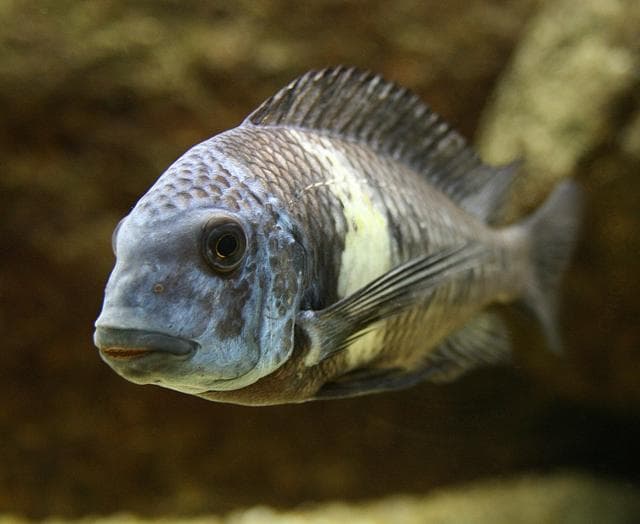
Image credit: Manfred Werner via Wikimedia Commons (public domain), license information, source attribution.
Tropheus duboisi is a species of Tropheus that grows to around 12 cm. The base color is dark bluish, and the light crossband, which stands in clear contrast, is striking. This cichlid feeds on plants by scraping the algae growth off stones and rocks. Tropheus duboisi lives rather singly or in pairs.
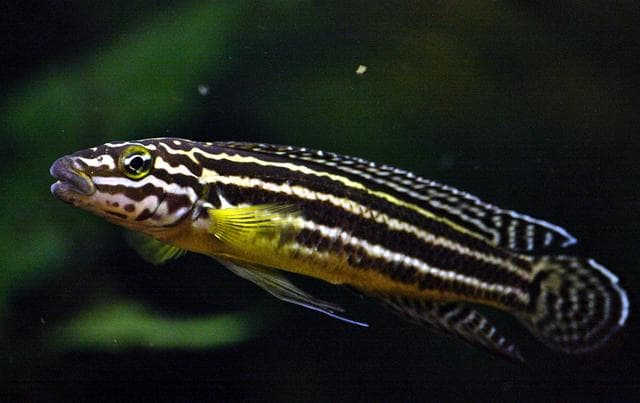
Image credit: Regani via Wikimedia Commons (public domain), source attribution.
The four-striped julie (Julidochromis regani), which can be kept in pairs, offers an interesting pattern. This cichlid stands out with its four dark horizontal stripes and grows to about 13 cm. As hiding places, the animals like rock crevices and caves where they can withdraw. A sandy bottom for sifting is also needed. They mainly need meaty food.
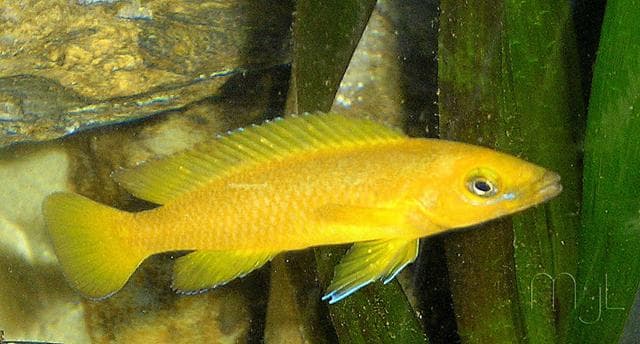
Image credit: Vivienne Harper via Wikimedia Commons (public domain), license information, source attribution.
The Tanganyika golden cichlid, or lemon cichlid (Neolamprologus leleupi), is a really beautiful splash of orange-yellow color for an African cichlid aquarium. The animals grow to around 10 cm. In nature, these ornamental fish are rather loners and only come together for mating and brooding. They are cave brooders that also guard their brood site very well.Neolamprologus leleupi is very simple in its diet and gladly takes live, frozen and dry food.
Examples of ornamental fish of the sand zone
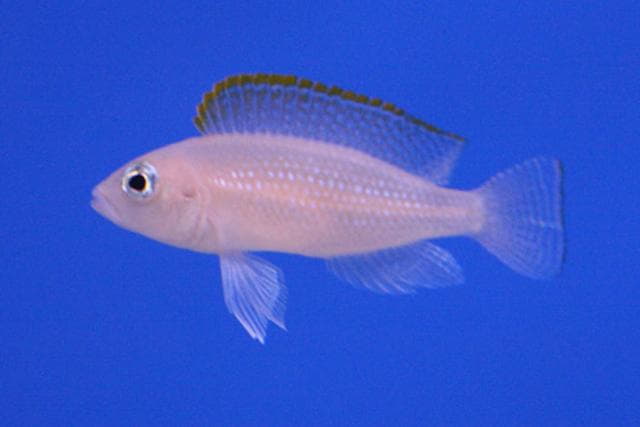
Image credit: Melanchromis via Wikimedia Commons (public domain), source attribution.
Neolamprologus caudopunctatus comes from the southern shore of Lake Tanganyika. The cichlids grow to approx. 9 cm, and the females stay somewhat smaller. The silvery-beige colored body has some beautiful glittering spots. The dorsal fin is red-orange. It lives in the sand zone and in the transition area to the rock zone. Neolamprologus caudopunctatus feeds mainly on zooplankton.
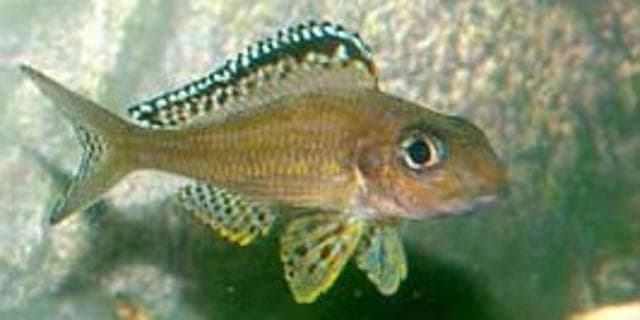
Image credit: unknown via Wikimedia Commons (public domain), source attribution.
Xenotilapia papilio is also called the sand cichlid. As the name already suggests, it inhabits the sandy zones and the transition zone to the rocky area of Lake Tanganyika. A beige-brown base coloring, combined with fins patterned in light blue and black, makes this fish attractive. It grows to up to 9 cm and can be kept in a group. This ornamental fish is a mouthbrooder, which is of course a breathtaking spectacle.
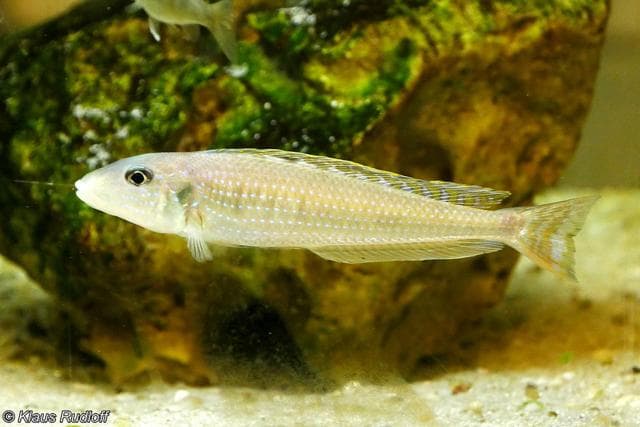
Image credit: Klaus Rudloff via Wikimedia Commons (public domain), license information, source attribution.
Xenotilapia melanogenys was formerly also called Enantiopus melanogenys and stands out with its elongated body shape. The cichlid grows to about 15 cm. It is a typical sand zone inhabitant that lives in groups in nature and is a mouthbrooder. On a yellowish base color, there are some light glittering spots on the body. Depending on its mood, some dark spots can also show on the upper half of the body.
Examples of shell-dwelling cichlids
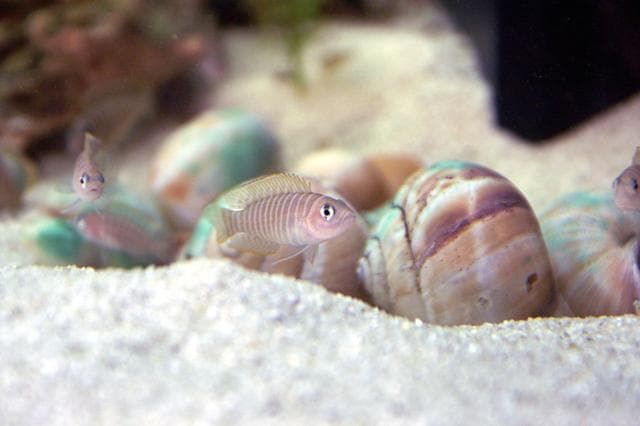
Image credit: berzentei, Yvonne Turkans via Wikimedia Commons (public domain), license information, source attribution.
Neolamprologus similis is the broad-striped shell dweller, a prettily striped shell-dwelling cichlid that inhabits Neothauma snail shells in nature. The males only grow to around 4 cm, and females stay even smaller. These ornamental fish feed mainly on meat. Their brooding behavior is of course of great interest. Sand walls are built around the snail shells, and these territories are also defended.
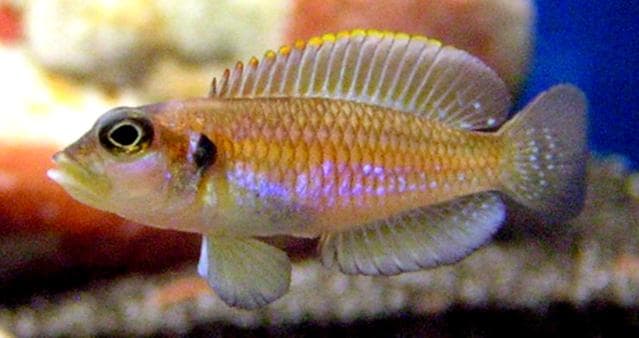
Image credit: Regani via Wikimedia Commons (public domain), source attribution.
The Tanganyika shell-dwelling cichlid (Lamprologus ocellatus) is a colorful cichlid with a maximum size of 6 cm (for males). Females stay somewhat smaller. The ornamental fish have some glittering spots and a black eye spot on a golden-yellow base color. They feed on meat from small organisms such as zooplankton. Empty snail shells must of course not be missing as furnishings for Lamprologus ocellatus.
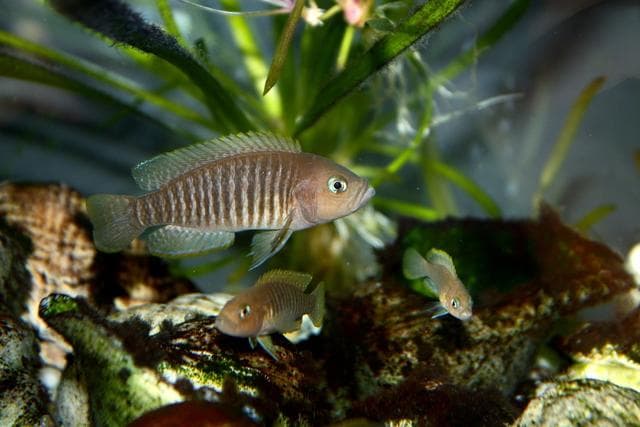
Image credit: Richard A. Ingebrigtsen via Wikimedia Commons (public domain), license information, source attribution.
The many-banded shell dweller (Neolamprologus multifasciatus) is a pretty little cichlid with a final size of 3 or 4 cm. It inhabits snail shells in the sand zone but also feels at home in rock crevices. The light blue fins and the beige-brown stripe pattern provide an attractive look. The animals need meaty food. Because of its small size, it can also be kept in standard aquariums of 54 liters volume or more.