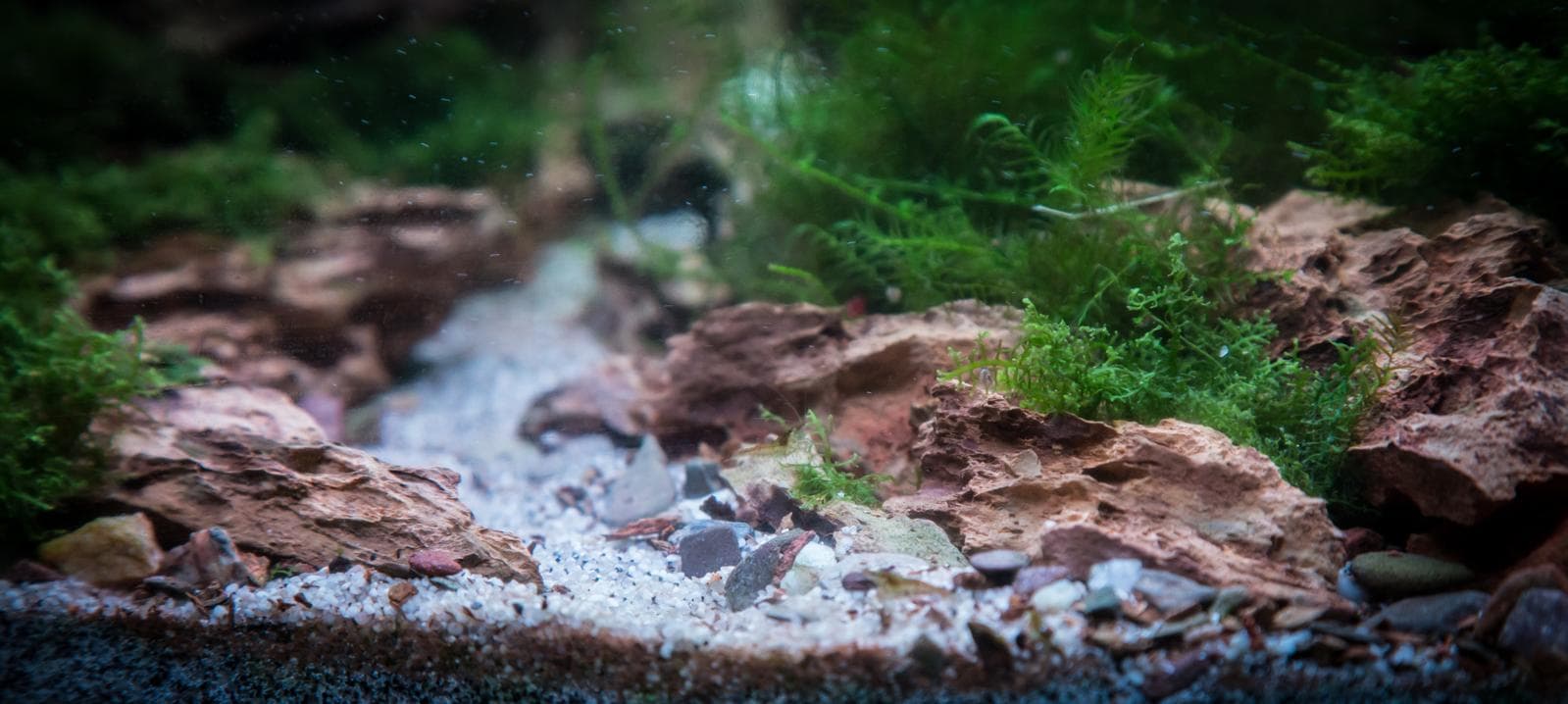
 Maintaining a sand path
Sand paths are a popular design element in aquascaping for enhancing the sense of depth in an aquarium layout. They often resemble gorges, trails or rivers winding through the landscape and are often full of tiny details. As great as these sand paths look, they are just as hard to maintain. Here are some important tips.
Restoring the slope
One key aspect of sand path maintenance is restoring the slope. To create a good sense of depth, the substrate in aquascaping is piled up so that it rises toward the back, and this also applies to decorative zones made of gravel or sand. Natural erosion, but above all shrimp and other animals that dig through the substrate, cause these areas to level out more and more over time. If the aquascaper wants to preserve the layout, suitable maintenance measures are necessary.
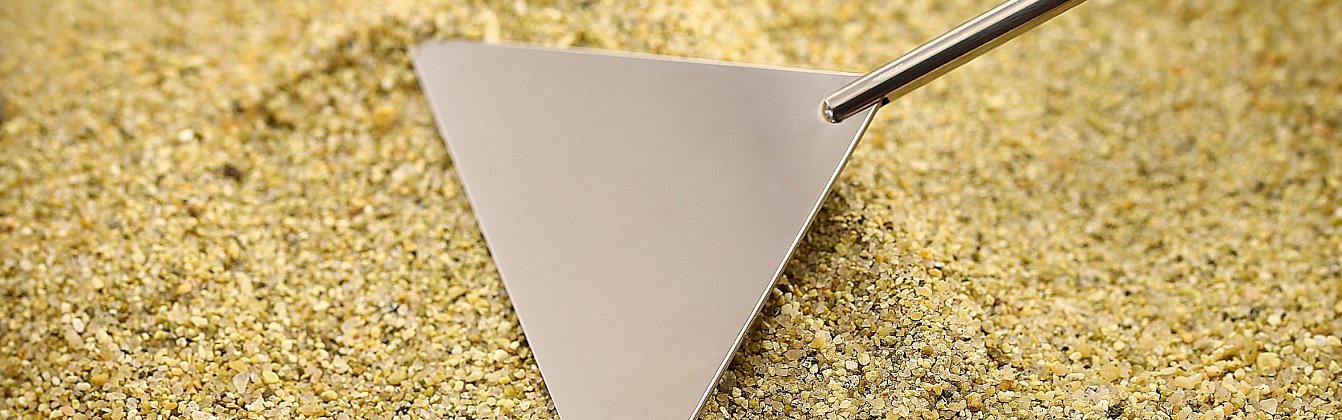
Over a longer period, the sand slides down the slope. This means that substrate is missing at the back/top while it piles up at the front/bottom. With a Sand Flattener, you can sometimes restore a sand zone including its slope by carefully stroking the material upward with the tool. If this is not possible or only barely possible, it makes sense to simply vacuum the excess sand out at the front with a hose during the weekly water change. If you want to reuse it, you should lead the end of the hose into, for example, a fine sieve or a fish net that you hold over the container collecting the old water. This way, sand and water can be separated and the substrate can be reused. However, if the sand is too dirty or covered in algae, it can sometimes be better to use fresh new sand. This is especially advantageous with very light colors.
To pile the sand back up in the rear and higher areas of the aquarium, a very small container such as a measuring cup is very helpful. The reason is that sand paths narrow sharply toward the back for visual reasons. There is therefore a big risk of pouring on too much sand and making it too wide. A small container is a great advantage here. If some sand does end up in the wrong place and lands on nearby plants or hardscape, for example, that is no big deal. Such small residues can often be wafted away by hand underwater. If necessary, you can vacuum these areas again with a thinner hose.
Trimming runners
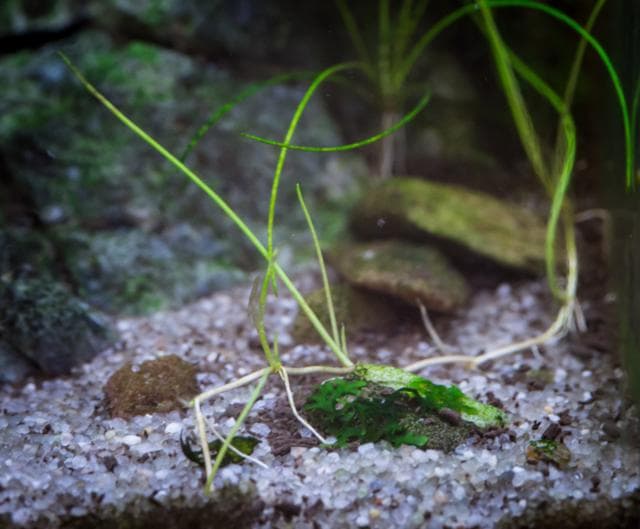
In particular, ground cover plants that spread across the surface and multiply via runners can reach such decorative sand zones after a certain time. If you want to preserve the plant-free look of these areas, it is not enough to just trim the plants back. It is better to pull out the runners together with their roots and remove them, since otherwise they will keep growing back in these spots. Some caution is advised here, because the roots can sometimes pull up larger connected areas and even smaller pieces of hardscape. Cutting through the runners in the substrate with scissors is not recommended with sand and gravel, as the particles block the blades. By the way, soil is very soft, so you can certainly cut through it with scissors.
Preserving details
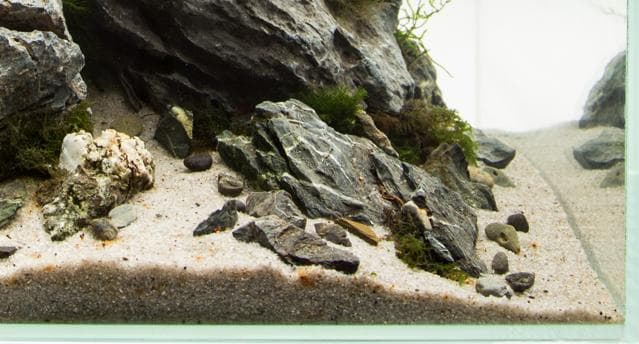
Sand paths in particular are often enriched with the finest details that can occur in an aquascape. For this, other types of substrate (such as coarser gravel), small stones, fragments of hardscape or very small roots are used, for example. Keeping these details intact over a long period is one of the challenges of aquascaping. Many aquascapers who steer a layout toward a specific point in time (final shot) add such details only in the late phase shortly before completion; before that, they are left out for practical reasons.
If such details are present, you have to uncover or renew them from time to time. Smaller pebbles or stones in particular sink into the sand over time, simply because they are heavier. With tweezers or by hand, you can bring them back out of the sand, or simply pour new little stones on top again.
Cleaning sand areas
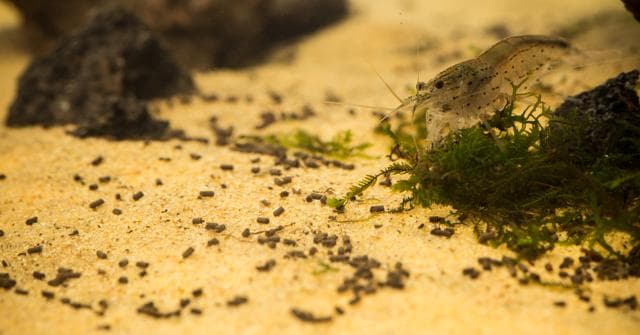
Since sand surfaces are quite dense, detritus, waste and plant debris settle on top of them instead of seeping into the substrate. This often happens in the same places, for example in the foreground or wherever there is a low-flow zone. For the sake of cleanliness, but also to preserve the visual appeal, this dirt should be removed regularly. This can be done easily together with the weekly water change. You can simply vacuum the dirt up with a hose. If you hold it carefully above the sand surface, hardly any substrate is removed along with it, only lighter particles such as detritus, excrement and plant remains. Soil granules that have landed on the sand path can also be removed very quickly this way. Be a little careful that smaller stones or pebbles do not get into the hose. They can clog it, which greatly reduces the water flow.
For very fine work, you can then use a correspondingly smaller hose (down to the 4/6 mm CO2 tubing). However, the smaller the diameter, the higher the risk of clogging.
Stabilizing a sand path with super glue
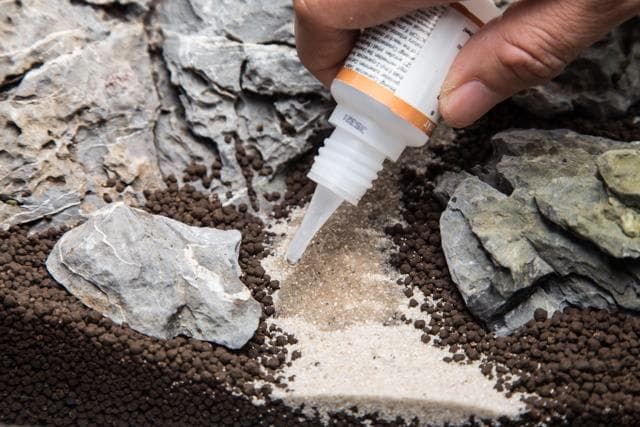
A technique practiced in part by Indonesian aquascapers involves fixing hardscape and also sand zones with super glue. Especially for sand paths with steep slopes, this eliminates certain maintenance measures to a large extent. However, such a glued zone can no longer be regarded as loose substrate, since it becomes hard once the glue has cured. You can find more detailed information, safety notes and a disclaimer on this topic here.