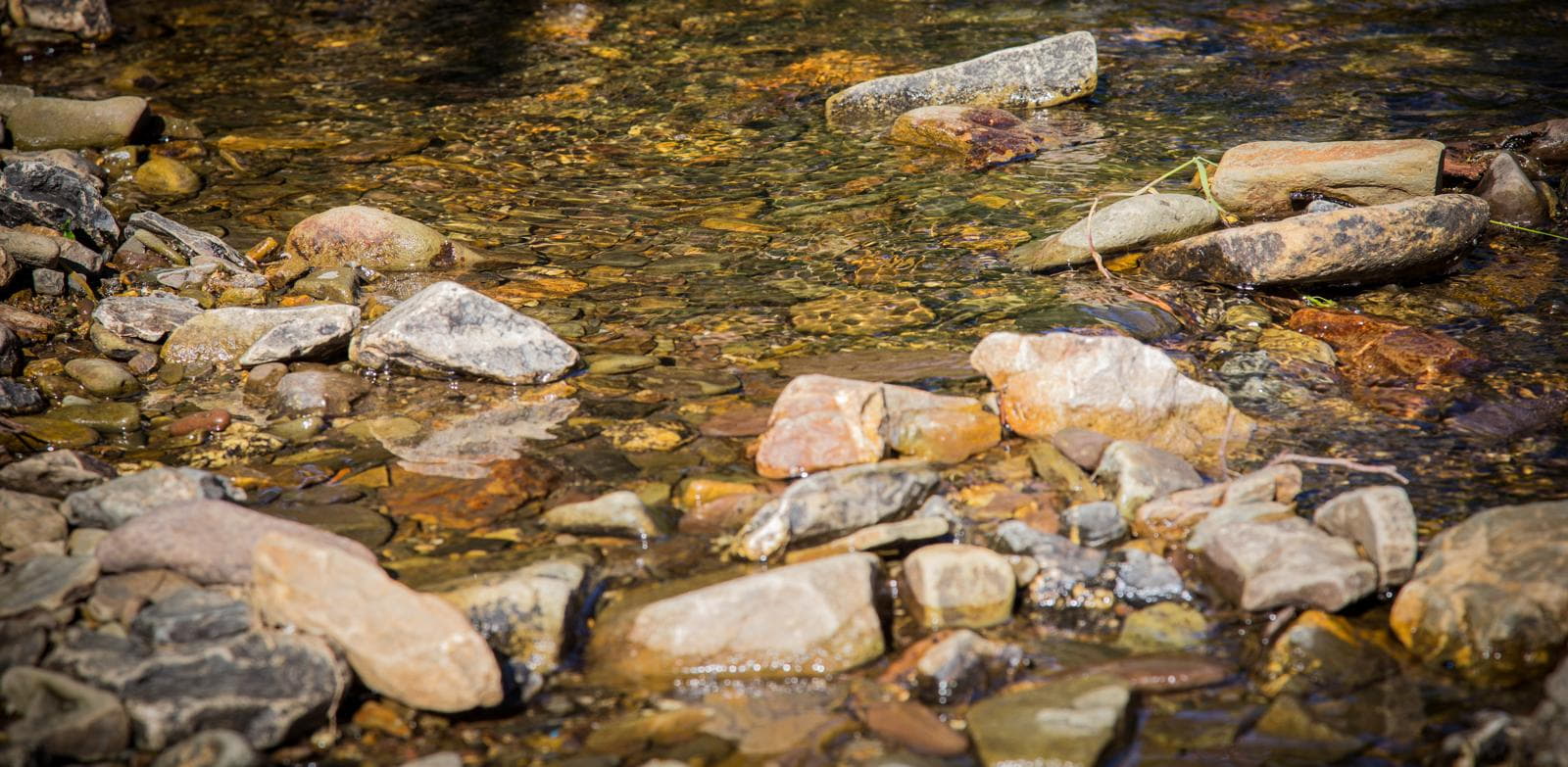
 The stream aquarium
A stream aquarium is, in principle, a biotope aquarium that simulates the conditions of a body of water that usually flows quickly. Loaches or gobies are often at home in such fast-flowing waters. The temperatures here are often somewhat lower than when keeping tropical ornamental fish, which is why there are also many similarities with a coldwater aquarium.
If a lot of current is indeed required for the inhabitants, you should choose a powerful filter. Water movement can be achieved in a much more targeted way, however, with a circulation pump, which in a stream aquarium is often placed near the substrate. For bottom-oriented fish such as gobies or hillstream loaches, the necessary current can thus be created in this zone. In aquariums, formats with a considerable length but only a low height are particularly suitable for imitating a stream. The current is then directed from one side of the aquarium to the other.
Here we present the stream aquarium (often also called a flow tank) in more detail.
Water parameters in the stream aquarium
In the aquarium hobby, Asian clear-water biotopes are mostly recreated to represent a stream aquarium. The water in these habitats is often rather cool (hence the connection to the coldwater aquarium), rich in oxygen and low in germs and pollutants. A stronger current is generally necessary, as we already described at the beginning. A correspondingly powerful filter provides the necessary water movement on the one hand and clean, clear water on the other. This should be supported by regular maintenance work such as large water changes. How exactly you settle on parameters such as the pH value, carbonate hardness and general hardness then depends more precisely on the individually chosen stock. For many Asian gobies, loaches and hillstream loaches, the water here is rather soft to medium-hard, with a pH around 7. What is important for such stream dwellers, however, is the right keeping temperature, which is often below 25 °C. In summer, appropriate cooling of the aquarium is then sometimes necessary. Some species also tolerate seasonal fluctuations, or these are even necessary to stimulate the animals' reproduction.
Aquatic plants in the stream aquarium
As a rule, such fast-flowing biotopes have few or no aquatic plants. A stream aquarium therefore does not necessarily need aquarium plants, although they can of course enrich the aquarium greatly. In this type of aquarium, too, aquatic plants can take on an important biological role. They improve water quality by breaking down nutrients, supply oxygen and offer the animals good hiding places. If you are thinking of putting aquarium plants into such a stream, you need to make sure the plants cope well with the conditions. In particular, the sometimes low temperatures and the strong current should be taken into account when choosing plants. Often no CO2 system is used in such aquariums either, so as not to make breathing needlessly difficult for the animals. Moreover, such flow tanks are also rather sparsely planted, with rather undemanding plants.
Mosses, for example, are very well suited and also cope very well with the cooler temperatures. These include, for example, the so-called sickle moss (Drepanocladus aduncus), which also occurs in Central Europe and therefore tolerates cooler temperatures well. The moss can be fixed well to stones in order to withstand the current. It is a rather elongated moss with few branches and a rather upright growth habit.
Riparia moss (Leptodictyum riparium) is a moss that attaches very well and is therefore ideal for a flow tank. It is easy to keep and has no problem with colder temperatures. This pretty moss grows with fairly elongated green shoots.
Some vallisneria species, such as the giant vallisneria,Vallisneria australis, can also be used well in a flow tank or stream aquarium. This aquatic plant is quite easy to keep, fast-growing and can reach quite considerable heights. The elongated, grass-like shoots sway beautifully in the current and create a natural impression of the planting.
The so-called moss balls are actually a kind of green algae that is often used as a decorative element in freshwater aquariums. It is said that their round shape forms in nature through the shaping current of a flowing water body. In addition, moss balls are extremely undemanding and therefore ideal for a stream aquarium.
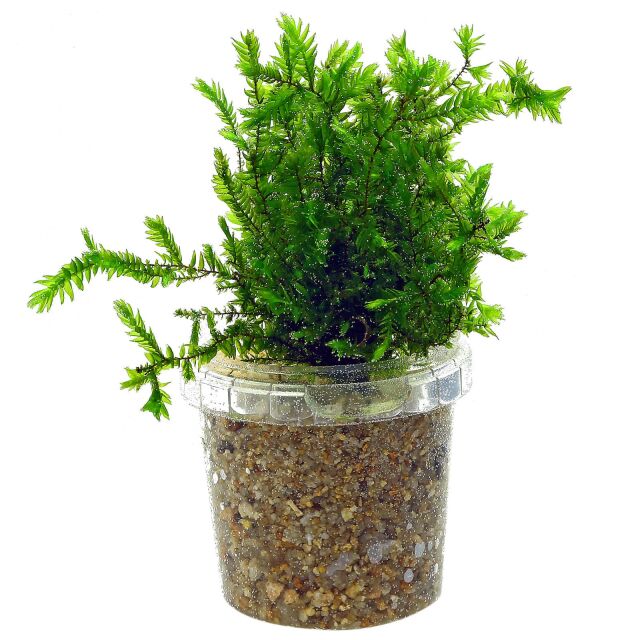
So-called spring mosses such as Fontinalis antipyretica or Fontinalis antipyretica var. gigantea are also a good fit for a stream aquarium. They tolerate colder temperatures well and are robust and undemanding.
You will find further tips on planting a stream aquarium in our article on coldwater plants as well.
Substrate in the stream aquarium
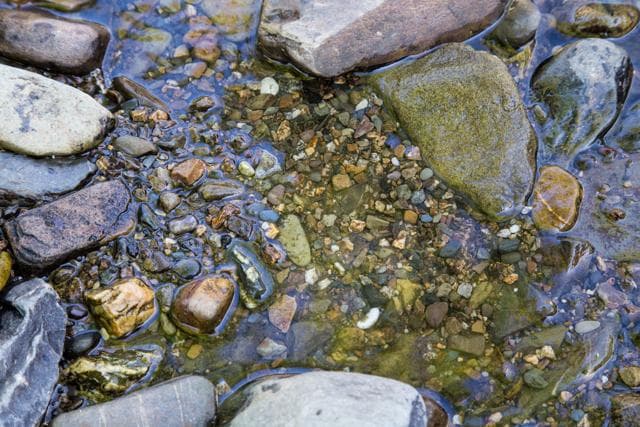
In the typical stream biotopes of fast-flowing waters, the bottom is often sandy to gravelly. Depending on the current, zones with different grain sizes form. A stream aquarium that works with different grain sizes here therefore often looks very natural. The range extends from fine sand (especially for calm zones) through gravel to coarse gravel and small stones that are already a few centimeters in size. The aquarist can draw on various sands and gravels, as well as smaller hardscape, to create a natural-looking setup.
Decoration in the stream aquarium
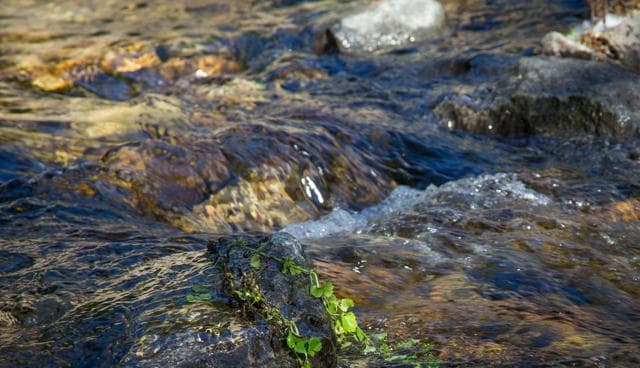
Based on the clear-water streams of fast-flowing Asian waters, driftwood does not play a big role in the choice of decoration here. Instead, in the design you can put the focus on rock to recreate such a biotope naturally. Flat stones in different sizes and grain sizes offer a nice transition to the actual substrate and can represent the zone of the stream bed. Larger stones at the edges and placed solitarily direct the flow of the water, but also create natural eddies as well as calm zones with less current. For very lavish stone structures in large aquariums, artificial rock can be used (for example from Back to Nature), above all to save weight.
Inhabitants of the stream aquarium
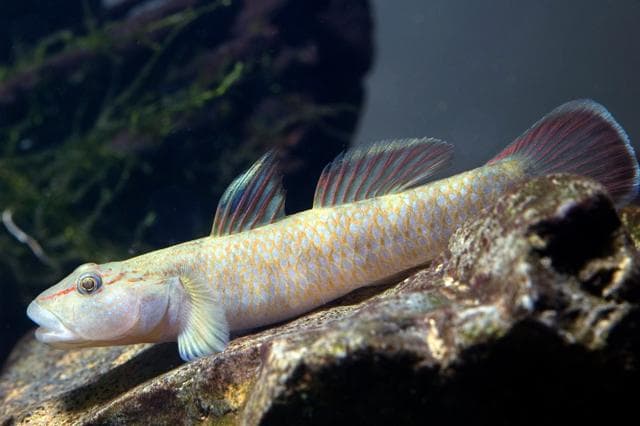
Rhinogobius mizunoi, source and copyright: Seotaro via Wiki Commons - Own work, License: CC BY-SA 3.0.
Freshwater gobies in particular are ideal and interesting inhabitants for a flow tank. Species from Asia are common in the aquarium hobby here, such as gobies of the genera Rhinogobius or Stiphodon. They are often very colorful animals with an elongated, thin body. They also have interesting social behavior. Gobies are often territorial and watch their surroundings from an exposed stone. With conspecifics in particular, there are sometimes a few disputes. For a group of these animals, the aquarium should therefore be sufficiently large and well structured. Gobies are often biofilm grazers but also need some meaty supplementary food, since they are not typical algae eaters.
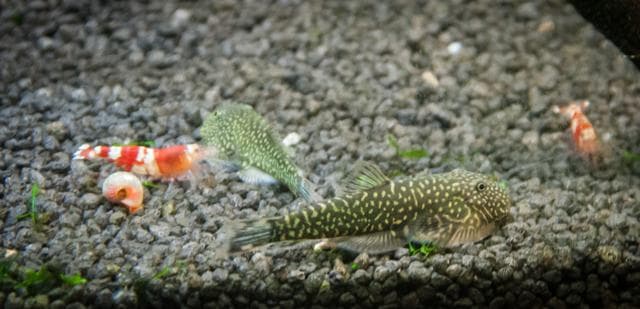
Splendid-looking group animals are the so-called hillstream loaches, which are fairly flat flat-loaches with broad fins oriented toward the bottom. The strong sucker mouth provides the necessary hold in the current and serves for feeding by scraping off the biofilms on, for example, flat stones. Hillstream loaches are not algae eaters, though, but feed rather on the tiny organisms that live in the biofilms. They are sociable animals that should be kept in a group. Rather cooler keeping temperatures and a good current in the aquarium are good conditions for these cute bottom dwellers.
Recently, the high-contrast panda loaches in particular have become popular in the aquarium hobby. These too are fairly flat and slim bottom dwellers that are also very sociable. The typical black-and-white coloring of Protomyzon pachychilus is very striking but is usually only present in juvenile animals. With age, this coloring fades a little. Panda loaches can be kept in a group and need clear, oxygen-rich water with plenty of current. They are therefore an ideal cast for a flow tank. Sandy to fine-gravel substrate as well as many hiding places offer the animals an optimal environment. They usually feed on biofilm but also love to eat meaty food in the form of live or frozen food.
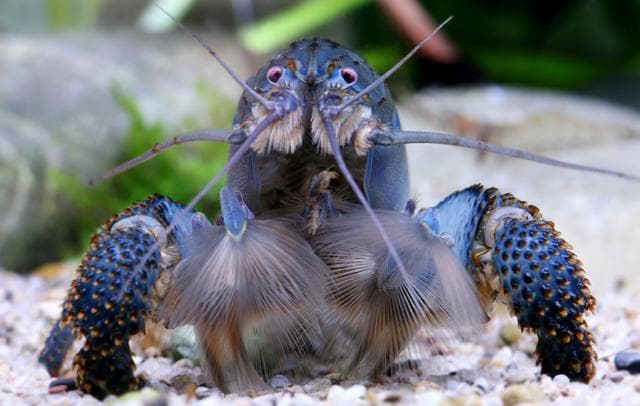
Fan shrimp (Atya gabonensis). Copyright by Chris Lukhaup.
Among invertebrates, too, there are interesting inhabitants for a stream aquarium. These include, for example, fan shrimp such as Atyopsis moluccensis, the Moluccan fan shrimp. At a length of 10 cm, they can also grow quite large. Their feeding is quite significant, because fan shrimp are so-called filter feeders. With their fans they catch food particles from the water with its strong current. A strong current in the aquarium is therefore of great importance for these animals. Suitable powder food is a good choice. Breeding them is unfortunately not easily possible, as the larvae need brackish water for it.