 Soil and hard tap water
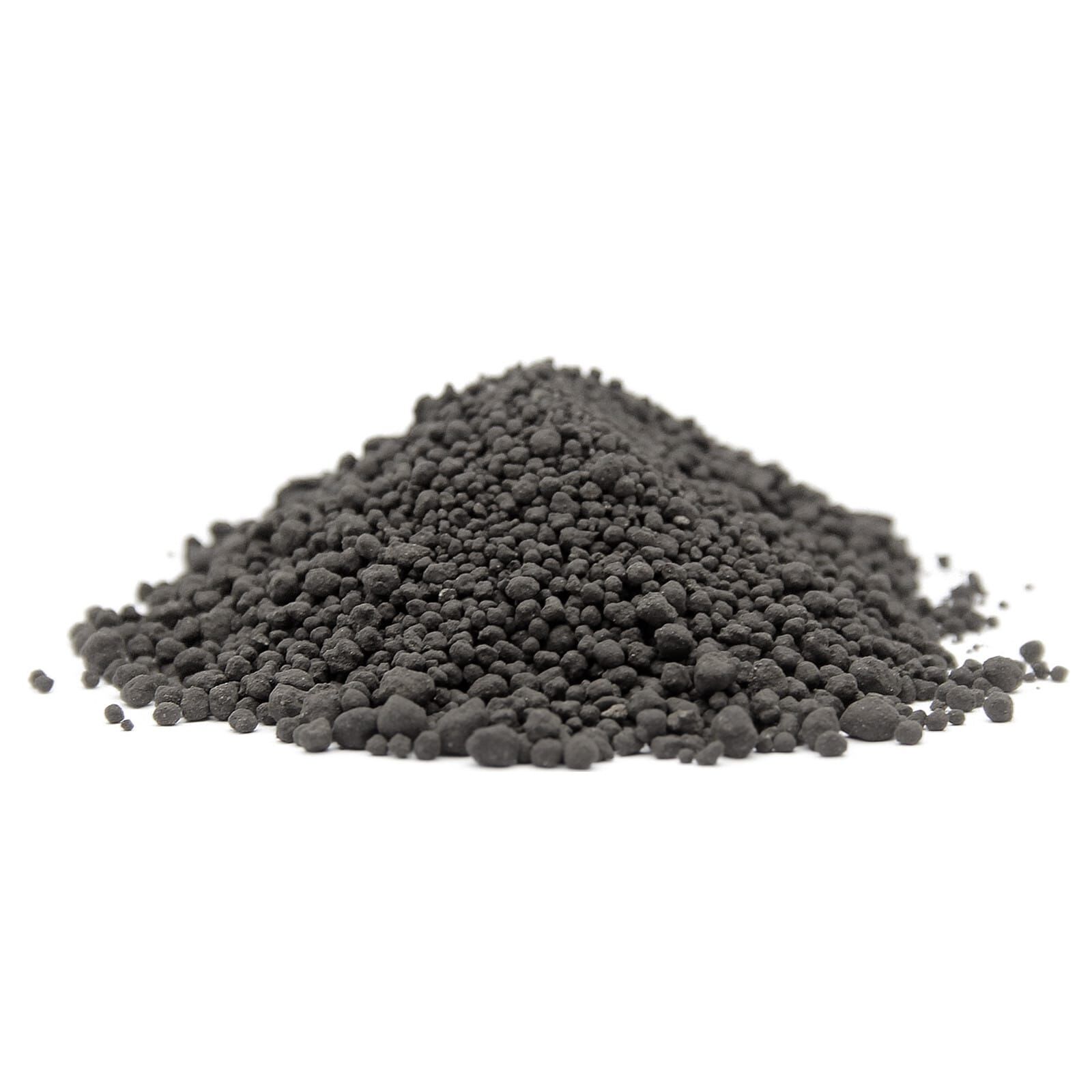
Active soil substrate originally comes from Japan and is often used in soft-water shrimp breeding or in planted aquariums and aquascapes. For both purposes, acidic and soft water parameters, in the form of a slightly acidic pH value and low water hardness, are decisive, and soil is designed to reach these water parameters and hold them at that level. But what happens when such a soil substrate meets German tap water? Read more in our article here.
What soil is and what soil can do
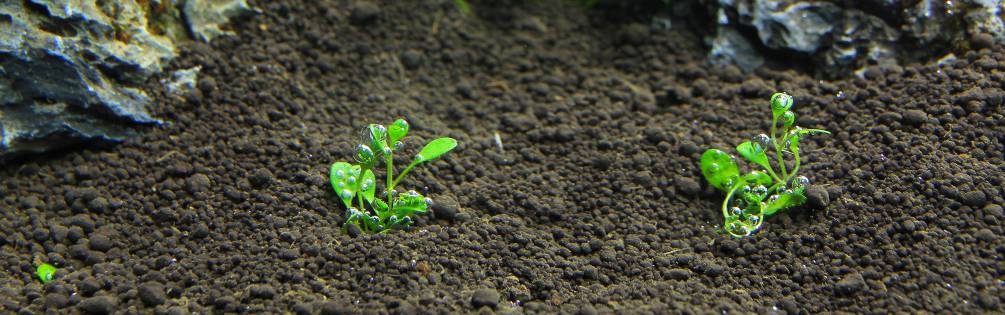
In our article about soil, we have already explained what these special aquarium substrates are all about. The defining features are those of an active substrate, which, through its cation exchange capacity, is able to actively influence the water parameters in the aquarium. Softening takes place through the uptake of calcium and magnesium. As a result, the general hardness (GH) of the aquarium water drops. Through the release of hydrogen ions, the pH value settles in an acidic range, and the carbonate hardness (KH) is additionally brought to a lower level.
With soil, the aquarist thus gets soft and acidic water parameters, which create optimal conditions for many aquatic plants as well as soft-water fish and shrimp. In addition, soils enriched with nutrients also supply the aquarium plants with important nutrients.
Longevity of soil
In principle, the long-term effect of soil depends on the nature of the water. If it contains many cations (such as K, Mg2+, Ca2+), exchange processes in the soil spheres also take place to an increased extent. The substrate is then depleted of nutrients more quickly and takes up many hardness-forming ions such as calcium and magnesium. Consequently, the long-term effect of soil is significantly longer with soft water than with aquarium water that has a high general hardness.
Soil and hard tap water
German tap water certainly cannot be lumped together; the regional differences are simply too varied. Very broadly generalized, however, the water in Germany is rather medium hard to hard, so it has a high general hardness (GH) and carbonate hardness (KH). It is therefore very rich in minerals such as calcium and magnesium, as well as carbonates.
For comparison: the water in Niigata, Japan, the location of the ADA Gallery, is very soft and acidic. An older water analysis from Niigata is listed here as a reference:
- pH: 6.8
- TH: 20 mg/l (corresponds to approx. 1.12 °dGH)
- NO3: close to 0 (0 – 0.2)
- PO4: close to 0 (0 – 0.2)
- NH4: close to 0 (0 – 0.2)
(Source: Sayuri Amano)
If water rich in minerals now meets a soil that has been lavishly loaded with nutrients, cation exchange processes take place here in a short time and on a large scale, although they were actually designed only for small amounts and over a longer period. The soil then takes up the many minerals from the water but, because of the exchange principle, also releases the nutrients it contains on a large scale. Especially in freshly set up aquariums with little plant density, unwanted algae growth can therefore occur.
A remedy here is greater maintenance effort with significantly more and larger water changes, using bacteria products, or installing an already cycled filter. Even so, the soil gets "used up" in a fairly short time in these cases, the nutrient reserves are quickly depleted, and the substrate loads up with minerals such as calcium and magnesium from the water.
An example
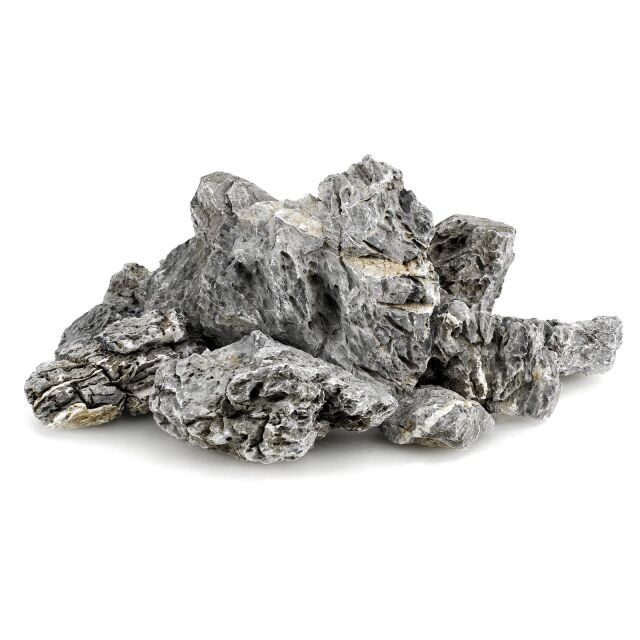
Let's take a fairly typical example of an aquascape: here the aquascaper wants to use the very popular Seiryu stones for an Iwagumi layout. These stones have a great grain pattern and look really beautiful. Unfortunately, they also contain lime inclusions and therefore harden the water. To support plant growth, the very nutrient-rich and equally popular Aqua Soil Amazonia is used, and a CO2 system is also connected. The planting is typical for an Iwagumi, rather sparse and consisting of only a few slow-growing ground cover species. In addition, the tap water used in our example is very hard, with a carbonate hardness above 10 °dKH and a general hardness above 15 °dGH. The combination of carbon fertilization and the use of lime-containing rock causes the water to harden further, since the carbonic acid that forms reacts with the lime in the stones. Because of the now extremely hard water, a lot of cations are present, which prompts the nutrient-rich soil to exchange. It lowers the pH value and reduces carbonate and general hardness. In return, many nutrients are released, including a lot of ammonium (NH4). Since the lavish nutrient supply meets rather little planting, a clear imbalance arises here, which ends in an algae plague. The aquarium owner is of course very frustrated here, even though he or she used only top-grade products to create the layout. The cause here, however, lies in the source water used.
Suitable measures
It is therefore more sensible to use soft water from the start in order to significantly extend the longevity of the soil. This can be done with rainwater or demineralized water from a reverse osmosis system or a deionizer.
Doing without water-hardening rock can also already produce a very large effect. Here we have listed an overview of all types of stone and describe again in detail for each type whether or not it contains lime.
If the planting is not a particular focus, you could also do without the CO2 system when using water-hardening stones. Easy plant species such as mosses, ferns, Anubias and cryptocorynes are very robust and do better without carbon fertilization than demanding stem plants and ground cover plants, for example.
Of course, in these cases you can also resort to certain aquaristic care products that lower the pH value and water hardness, for example. We have described in more detail which products make sense here in our article "Lowering the pH value".
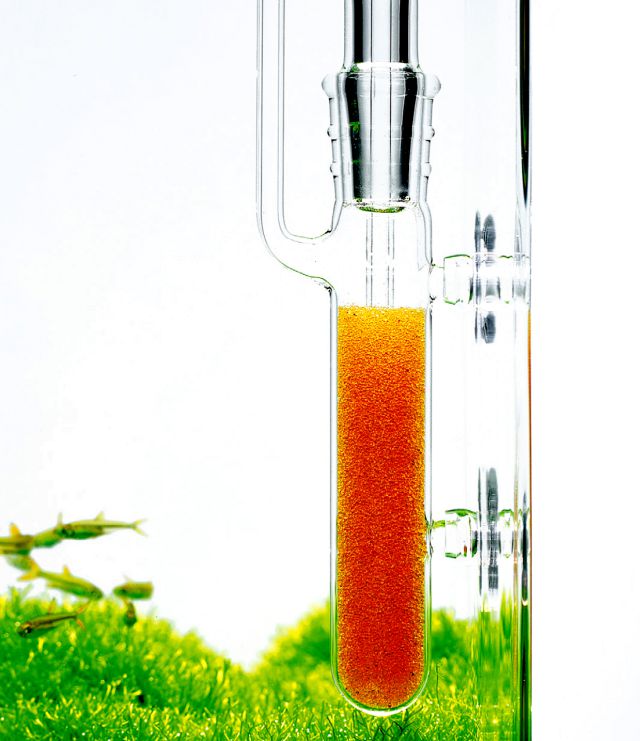
Photo copyright - Aqua Design Amano - ADA.
Another solution, and one that is also very visually appealing for live operation, is the Softenizer from ADA. This pretty glassware is filled with a resin and installed in the aquarium. The product thus continuously softens the water through a cation exchange principle.