 The path to the optimal fertilization system
This article was published by Aram Schneider on 04.07.2013 in the Flowgrow Aquascaping Network. The author has now adapted it a little to today's situation and published it in our Aquascaping Wiki:
In the Flowgrow forum, there are many similar questions and problems, especially from beginners, about fertilizing aquatic plants and about the right fertilization systems. This led me to write this article in order to simplify a few matters and shorten the path.
For this I would like to include the greatest possible overlap of experience from the forum. I also don't want to go into milliliter-exact fertilizer figures much, because that depends too much on the individual case. But let's start from the beginning:
Which nutrients are important for aquarium plants?
As someone inexperienced in fertilization, at first you don't really know how to start fertilizing in your plant-focused aquarium. Once you have read up well, you learn about micro- and macronutrients and stumble across fertilization concepts such as the Estimative Index or the PPS Pro system. Both systems are good, but in my opinion also somewhat outdated.
The first key question that probably crystallizes sooner or later is: of the countless supposedly important nutrients (CO2, Fe, PO4, NO3, K etc.), which are the most important? Or, better put, which missing nutrient is responsible in most cases for excessive algae growth or poor plant growth?
For this I am putting together a short ranking of what I consider the most important growth factors and nutrients:
- Light
- CO2
- Nitrogen (usually as nitrate, NO3)
Only after that come other nutrients such as iron (Fe) and other trace elements, phosphate (PO4), potassium (K) and more. If you assume sufficient light output from LED lighting of at least 30 lumens per liter (see position 1) and a good CO2 supply of 20-30 mg/l monitored with a drop checker (see position 2), then it is usually missing or insufficient nitrogen (see position 3) that is the crux of the matter.
So what do you do as a beginner? If you assume that light and CO2 are sufficient and you already own a complete iron fertilizer, you first come up with the idea of buying an NPK (nitrogen/phosphorus/potassium) fertilizer. This fertilizer combines the most important macronutrients in one bottle. That means the fertilization concept initially looks like this:
Basic fertilization system
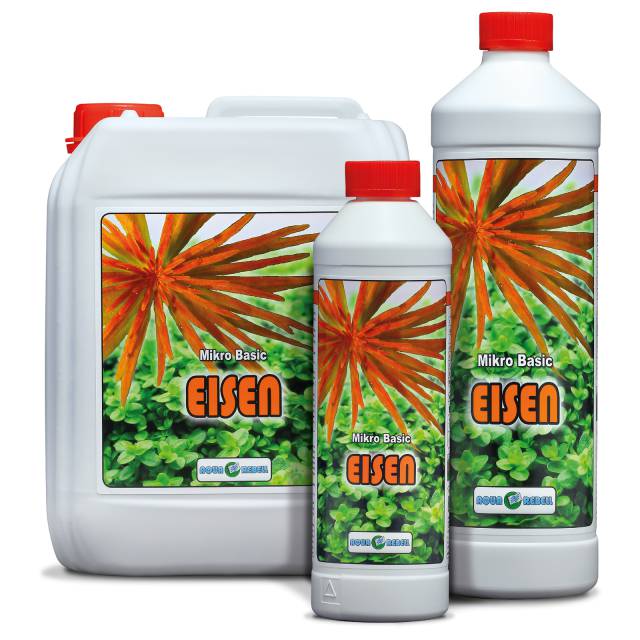
- Iron (Fe) and other trace elements are added via the complete iron fertilizer. For dosing, I recommend using the respective manufacturer's specification as a rough guideline. This is usually given as 10 ml of fertilizer per 100 l of aquarium water as a weekly dose.
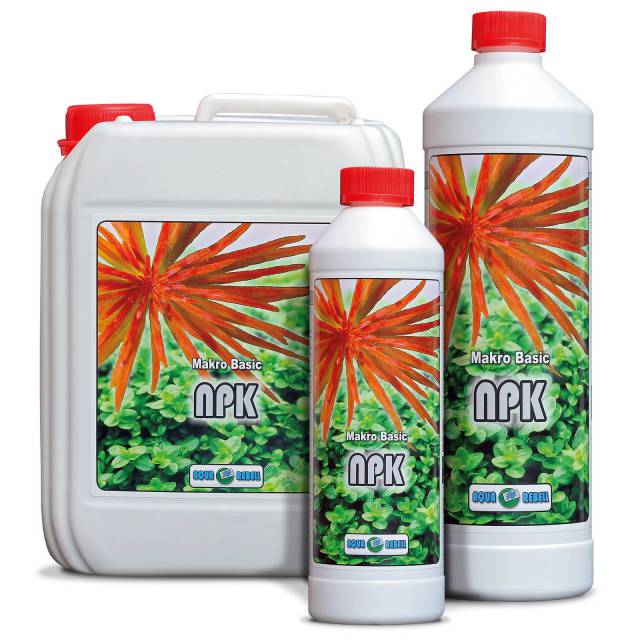
- Nitrate (NO3), potassium (K) and phosphate (PO4) are added via the NPK fertilizer
An optimization of this concept would be daily fertilization with 1/7 of the weekly amount. If you want to be very precise, you add the complete iron fertilizer in the morning and the NPK fertilizer in the evening, so that possible iron phosphate precipitation doesn't occur.
Advantages:
The effort is low, since you only use two fertilizer bottles.
Disadvantages:
I would say that in planted aquariums with many aquatic plants, a CO2 supply and moderate to high light intensity, this concept ensures good plant growth and little algae in only a few cases. Most of the time, the nitrogen concentration of these fertilizers is not enough to meet the tank's consumption. Phosphate (PO4) and especially potassium can accumulate, and sometimes increased green algae growth as well as green glass (dust algae) occurs.
Conclusion:
It is a good basic concept, but it can be improved. As already mentioned, in most cases there is a problem in the area of nitrogen.
Concrete solution proposals:
In principle, there are two simple solutions. The first builds on the fertilization concept described above; the second takes a different approach.
Solution 1 - Basic fertilization system + nitrogen
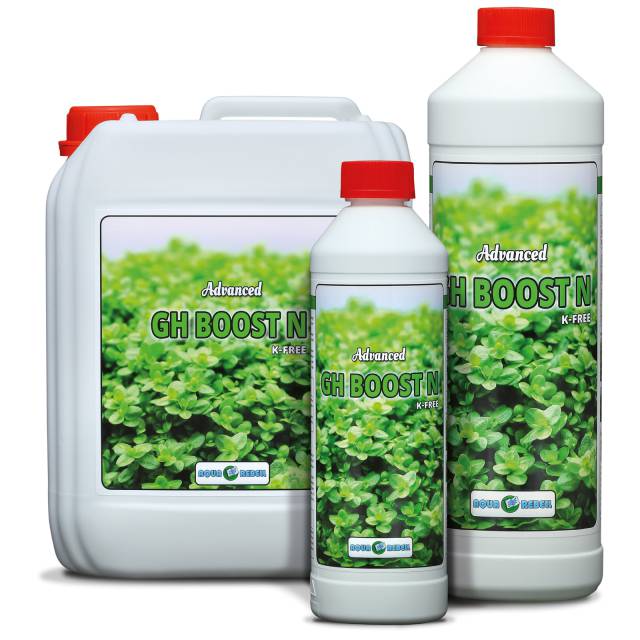
- Fe and other trace elements are added as before via the complete iron fertilizer.
- NO3, K and PO4 are supplied via the NPK fertilizer. In this case, however, you use this fertilizer primarily to supply your tank with potassium and phosphate!
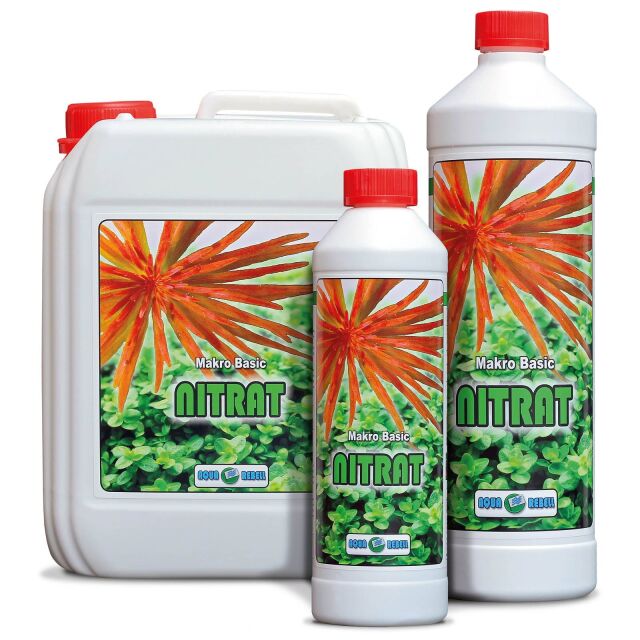
- You use an extra nitrogen fertilizer to keep the NO3 level in the aquarium, through daily fertilization, ideally above 10 mg/l. Values around 15-20 mg/l are even better, especially with a lot of plant mass. This can be a KNO3-based fertilizer (for example Aqua Rebell Macro Basic Nitrate). But since these fertilizers still add potassium on top, and it can accumulate, I recommend a low-potassium nitrogen fertilizer for daily fertilization. You can fertilize with magnesium nitrate, calcium nitrate and/or urea, for example. A fertilizer that combines all of these is Aqua Rebell Macro Special N. If you want even less potassium, the completely potassium-free GH Boost N is recommended. For a modern, potassium-reduced fertilization concept, GH Boost N is my clear recommendation.
Advantages:
With just three fertilizer bottles, it is still low-effort and promises a high success rate.
Disadvantages:
Depending on the nitrogen fertilizer, potassium accumulation can still occur. By now, however, plenty of products are available with differing potassium content.
Conclusion:
A really good and simple basic concept with a high success rate. Now you can work on the fine points.
Solution 2 - Basic fertilization system using individual components
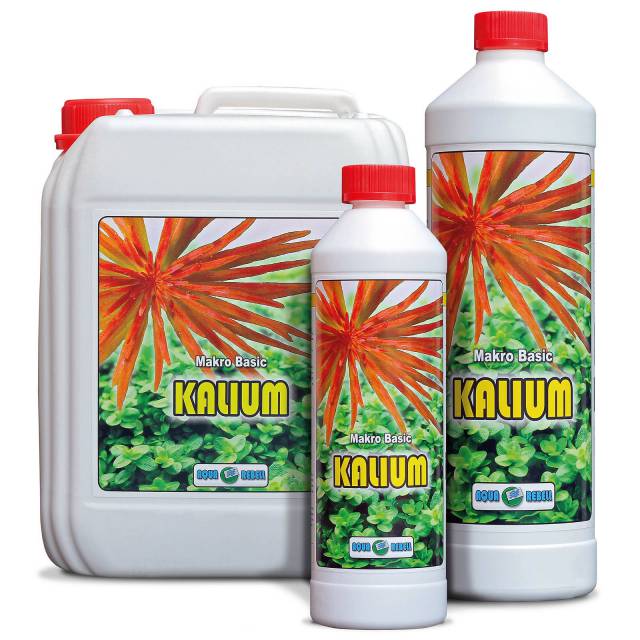
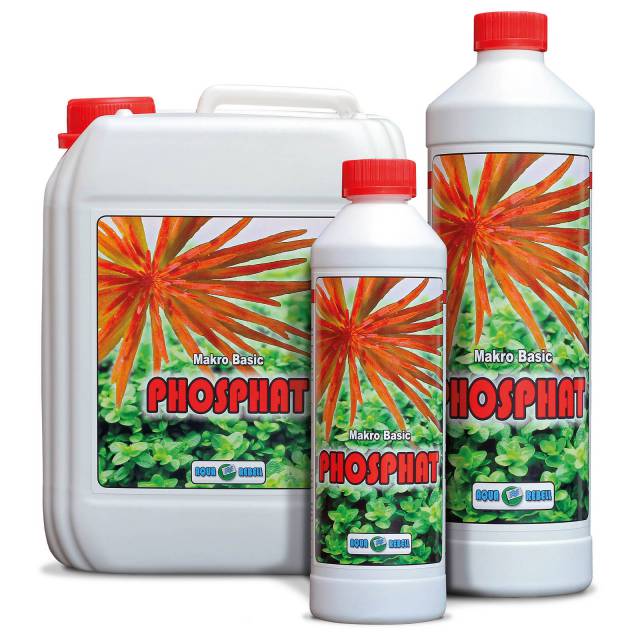
- Fe and other trace elements are added as before via the complete iron fertilizer.
- NO3, K and PO4 are now supplied individually via the respective single fertilizers. That means you take one fertilizer for phosphate, one potassium fertilizer and one nitrogen fertilizer. I recommend, however, combining the last two components into one KNO3-based fertilizer (Aqua Rebell Macro Basic Nitrate) and additionally getting a low-potassium nitrogen fertilizer (GH Boost N). That way, you can, for example, use Aqua Rebell Macro Basic Nitrate to fertilize the water to the desired values as a weekly bolus dose and cover the daily pure nitrogen consumption with the low-potassium nitrogen fertilizer. Bolus dosing makes sense above all at the water change. You simply calculate the replacement water to the desired values. For the low-potassium fertilizer, as in the first solution, I recommend Aqua Rebell Macro Special N or GH Boost N. This concept of bolus-dosing potassium and fertilizing nitrogen daily makes sense because, in experience, potassium is consumed far less than nitrogen.
If there is already a usable amount of potassium in the source water, or if a hardening salt containing enough potassium is used in combination with demineralized water, a potassium nitrate-based nitrogen fertilizer can sometimes be dispensed with. In these cases, a potassium-free nitrogen fertilizer like GH Boost N would also be used for any bolus dosing after a water change.
Advantages:
This is a very balanced fertilization concept that, by handling individual components, can be tuned very flexibly to specific deficiency symptoms and/or specific algae growth.
Disadvantages:
It is of course relatively laborious, since you have to work with several fertilizer bottles, which is also a cost factor. You also need a bit more experience to recognize the right ratio of the individual components from measurements, particular algae growth and/or particular deficiency symptoms.
Conclusion:
It is somewhat more laborious, but very good. Recommended for planted-aquarium keepers with a bit more experience.
With the last two fertilization systems, you can already coax quite a lot out of your aquascape or planted aquarium. It can certainly happen, however, that the plants "turn on the turbo," so to speak, because of the abundant nitrogen supply and fertilization of the other macronutrients, and the result is a higher consumption of all other nutrients. That means that, if necessary, you additionally have to adjust the micronutrient fertilization and/or the CO2 supply to the situation.
That is why I would like to present one last fertilization concept that also covers the fine points of fertilization and is surely practiced in this or a similar form by most of the more experienced members of the Flowgrow forum.
Flowgrow Special fertilization system
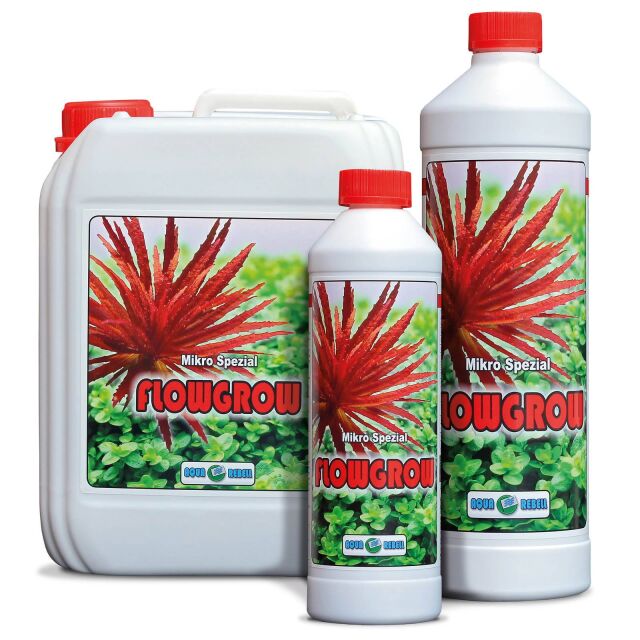
Besides daily fertilization, this system is also based on a weekly fertilization of the fresh water at the water change.
Bolus dosing with the water change:
- Fe and other trace elements are added with a weekly ration of a strongly chelated complete iron fertilizer (e.g. Aqua Rebell Micro Basic Iron).
- The replacement water is fertilized with a KNO3-based fertilizer so that the weekly potassium consumption is covered and a base supply of NO3 is present.
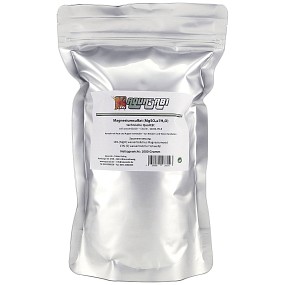
- Optional: With soft water, you can harden the replacement water further with hardening salts such as PMS (Preis Mineralsalz) with trace elements or, if you want to steer the Ca:Mg (= calcium-magnesium) ratio toward 4:1 to 3:1, with Epsom salt.
- Optional: For phosphate-limited fertilization, a bolus dose of PO4 at the water change is a good option, letting the value run toward zero over the course of the week. Any other type of phosphate fertilization is then of course omitted.
Daily fertilization:
- Fe and other trace elements are supplied via a weakly chelated complete iron fertilizer (here I recommend Aqua Rebell Micro Special Flowgrow). Because the fertilizer is more weakly chelated, the nutrients are available to the plants faster and are therefore often no longer detectable in the water after just a few hours. This is not a problem; a permanently detectable iron level of 0.05-0.1 mg/l is not a must here.
- PO4 is added via a single-component fertilizer, and nitrogen via a low-potassium nitrogen fertilizer (for a more detailed description, see Solution 1).
- Optional: If the plants still show the typical iron deficiency symptoms, additional daily fertilization with a pure iron fertilizer is a good option (e.g. Aqua Rebell Special Iron).
Ideally, you fertilize phosphate and iron-containing fertilizers at different times to avoid possible precipitation. The method "iron in the morning, phosphate in the evening" has proven itself here, but is not strictly necessary.
It is ideal to know the water values of your drinking water supplier and, if necessary, include them in your calculations. These can usually be "googled" very easily on the internet.