 Aquarium: Liquid CO2?
By now almost every renowned aquaristics manufacturer offers care products that often have "Carbo" in the name and are sold as liquid carbon fertilizers. Can these products really replace a CO2 system? How do they work? Are they safe for the livestock in the aquarium? We answer all these questions in this article.
What are liquid carbon fertilizers made of?
Most care product manufacturers are rather reticent about declaring the ingredients of their "liquid carbon". These are often products based on glutaraldehyde or similar base substances. In itself, glutaraldehyde is a disinfectant and is also used as such in various areas such as medicine and industry. A rather sharp smell of this liquid is also characteristic, for example. However, glutaraldehyde also has other properties, because it is in principle a molecule consisting of a longer carbon chain (C5H8O2), more precisely, according to its molecular formula, of five carbon atoms and eight hydrogen atoms.
What can liquid carbon fertilizers do?
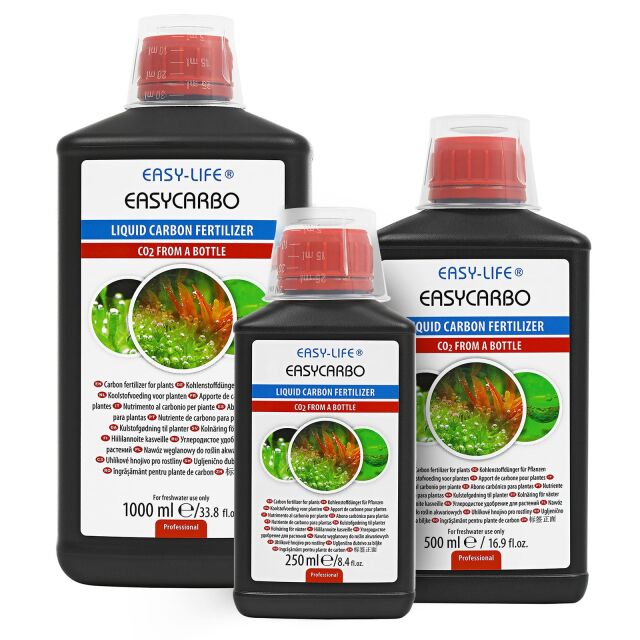
Since glutaraldehyde is a longer carbon chain, it can be offered to aquatic plants as an alternative carbon source for the citric acid cycle. Plants produce longer carbon chains that act as intermediate products during photosynthesis and generally have a structure of five carbon atoms. Since glutaraldehyde has exactly such a structure, aquatic plants can, so to speak, use it as an alternative building block in the citric acid cycle. Through simple chemical or enzymatic processes, glutaraldehyde can then be converted into other required carbon chains such as ribulose-1,5-bisphosphate or other forms (source: Seachem).
The longer carbon chains offered by the liquid carbo fertilizers can not only be used "directly" by the plants; the breakdown of the active ingredient by bacterial activity also actually produces carbon dioxide (CO2). However, this is only on such a small scale that one cannot really speak of a replacement for a proper CO2 system. A system supplies significantly more and more constant CO2. It is also worth mentioning that the breakdown of glutaraldehyde causes strong oxygen depletion. Normally this should not be a problem. But if the product is overdosed, sensitive animal species are present in the aquarium, or there is already a certain oxygen shortage, this can sometimes show in the livestock. The aquarium animals then show typical breathing problems, for example fish hanging at the water surface gasping for air. In such cases, additional aeration of the aquarium is advisable to ensure enough oxygen.
It should also be mentioned that using such products, and probably also the bacterial activity associated with it, can sometimes cause increased biofilm.
These care products cannot, however, be regarded as a replacement for a complete CO2 system, but rather as a supplement to support plant growth. Products such as Seachem Flourish Excel or Easy Life Easy Carbo can also be used excellently to combat red algae. This makes use of the disinfecting effect of these care products. We will now introduce this process in more detail.
Carbon fertilizers for combating red algae
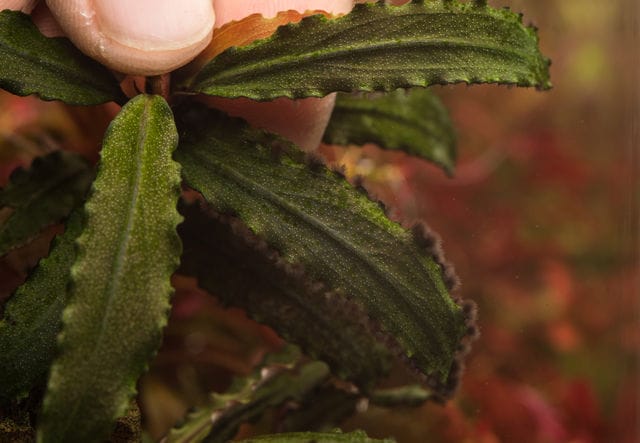
Liquid carbon based on glutaraldehyde is an excellent anti-algae agent against various species of red algae. These include above all beard algae, but also black beard algae. While with an infestation of beard algae the normal dose added directly to the aquarium water is often enough to get rid of them, black beard algae are somewhat harder to deal with. Here the so-called spot-treatment method is especially suitable, in which you draw the product into a syringe and then treat the algae locally under water. In this article we have explained this method in more detail.
Once such a treatment has taken effect, red algae turn whitish-gray to pink within a few days and then die off. However, you have then only eliminated the problem (the algae), not the cause. Depending on the type of algae, the causes are to be sought, for example, in the addition of complete iron fertilizer, filtration or organic load. To keep the algae from reappearing later, these causes have to be tackled so that a longer-term effect also sets in.