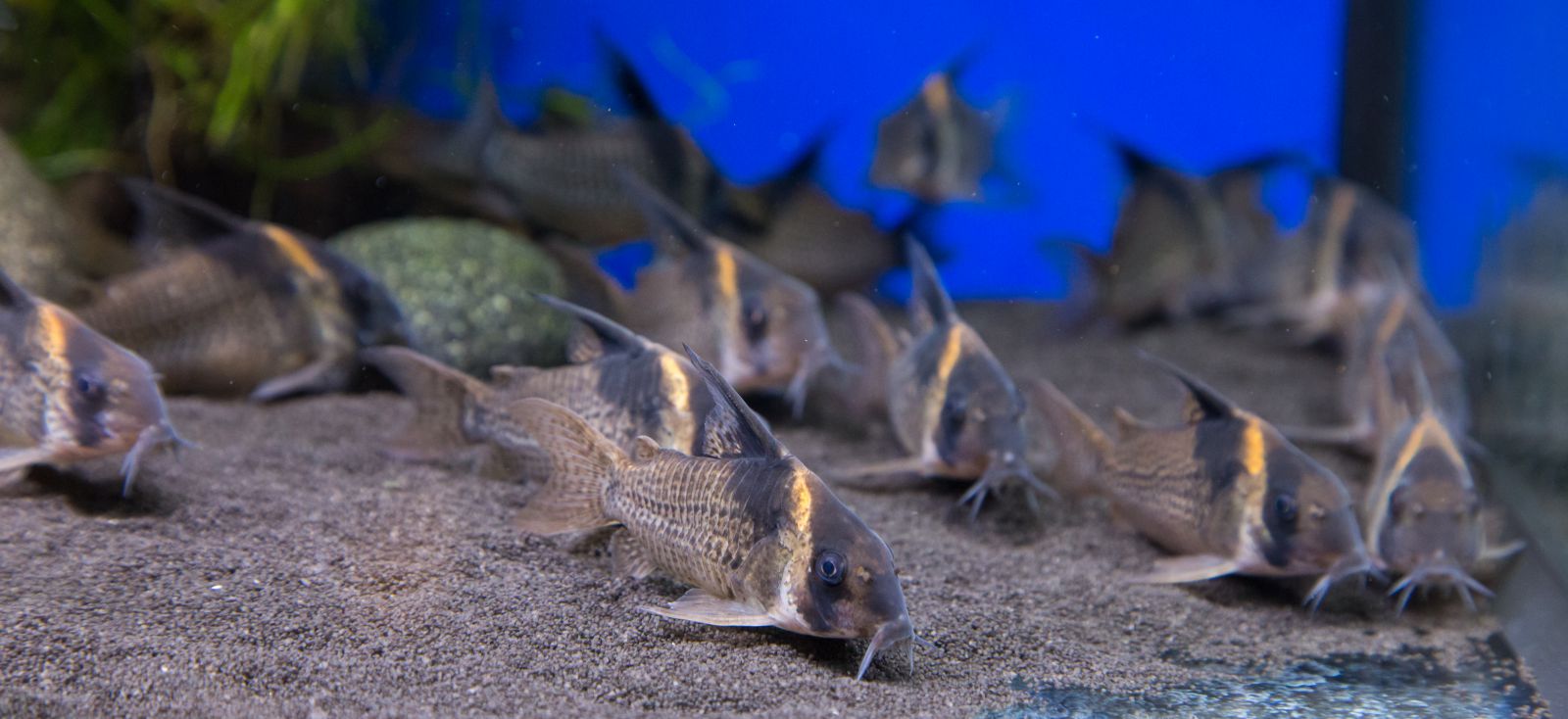
 Corydoras catfish in the aquarium
Corydoras catfish are a true classic in aquarium keeping. Not only in South American aquariums but also in a community aquarium, these busy and peaceful bottom dwellers are a welcome addition to the stocking. Under the genus Corydoras but also Aspidoras, more than 150 different species of armored catfish are now known. Many of these species come from South America, where they occur in countries such as Peru, Brazil or Venezuela. Depending on the species, they grow to between 2 and 8 cm.
Corydoras are quite robust and adaptable. This makes them very capable inhabitants for a freshwater aquarium. In nature, they populate all kinds of waters. Even still lakes with a low oxygen content are not a big problem for these animals, because all Corydoras are able to breathe atmospheric air. To do this, the ornamental fish swim swiftly to the water surface, gulp air briefly there and quickly dive back down to the substrate. They are mainly active at dusk and prefer rather dim lighting conditions.
Keeping Corydoras in the aquarium
Corydoras are typical bottom dwellers that like to sift through the substrate and glide across it. They have sensitive barbels with which they might injure themselves on sharp material. For this reason, sharp-edged substrate should be avoided; fine sand or rounded gravel would be more suitable. A few solitary stones or driftwood round off the decoration and provide the necessary structure in the aquarium.
Aquatic plants can be present but do not have to be. Large-leaved aquarium plants such as Echinodorus are quite often used as resting places, though. In a densely planted layout with a carpet of ground cover plants, it is even advisable to keep a certain area free with fine substrate so that the animals can sift through it undisturbed. The somewhat smaller species such as Corydoras hastatus or pygmaeus only grow to 2 cm and can even be kept in an aquarium with an edge length of 60 cm or more. Another striking feature of these "dwarf Corydoras" is their swimming behavior: they move more often in open water and in the middle water zone than their larger brothers, which are much more bottom-oriented.
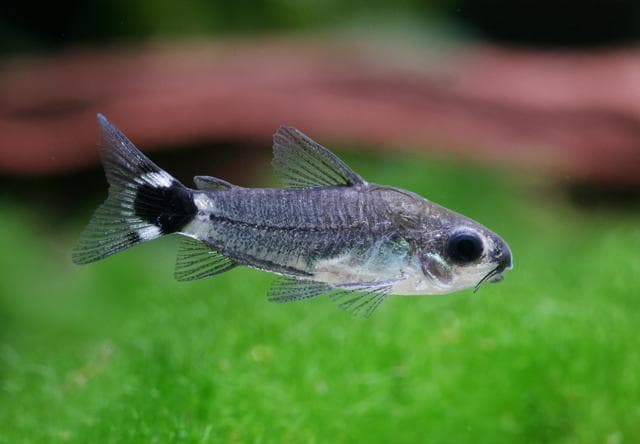
Corydoras hastatus - Copyright by Chris Lukhaup.
Corydoras are very sociable aquarium inhabitants that also behave extremely peacefully. They should preferably be kept in a group of about 10 individuals, since they are indeed schooling animals that glide over the substrate together in loose groups. Depending on the species and size of the animals, the aquarium should have a correspondingly large volume and a sufficiently generous floor area for these bottom-oriented catfish.
As a rule, South American Corydoras are used to soft and slightly acidic water parameters, depending on their habitat. This includes a rather low general hardness and a pH in the slightly acidic to neutral range. Corydoras are very robust and adaptable here, however. As an average water temperature, you can give a range of approx. 22 to 27 °C. It depends a lot on the respective species and the exact area of origin. There are definitely some Corydoras species that come from higher altitudes and are therefore used to rather cooler temperatures.
To lower the pH, the aquarist can use a variety of aids. Alder cones, but also leaves, can help lower the pH slightly. In addition, they release humic substances and create a natural environment and a food base for tiny organisms that the Corydoras eat. Such natural materials are therefore very welcome in a Corydoras aquarium. Above all, material that has a slightly antibacterial and fungicidal effect helps improve the water quality. Clean and, as far as possible, germ-free water is important for keeping Corydoras and co. Good care, meaning regular water changes, as well as a filter with sufficiently strong biological filtration, are important cornerstones of keeping them.
Corydoras can often be kept very well together with tetras and cichlids in the aquarium. Other species from South America, which prefer similar water parameters, are particularly suitable for this. While the catfish stay more at the bottom, tetras and dwarf cichlids then populate the upper and middle water region of the aquarium. This way, the ornamental fish do not get in each other's way too much, and the limited space of an aquarium is divided skillfully among all animals.
Feeding Corydoras correctly
This ornamental fish likes to feed on a mainly meaty (carnivorous) diet. In nature, the animals eat small crustaceans, worms, and single-celled and multicellular organisms that stay on the bottom. They are definitely not algae eaters and should therefore not be kept in the aquarium for this purpose. As such, Corydoras are uncomplicated in their nutrition. Besides live and frozen food, dry food such as granules, tablets or sticks is also accepted very gladly. The food should preferably sink to the bottom, since the catfish have a downturned mouth.
Very rich types of food such as white worms (enchytraeids) and tubifex should only be fed rarely, however, so that the animals do not become fat.
Breeding & reproduction
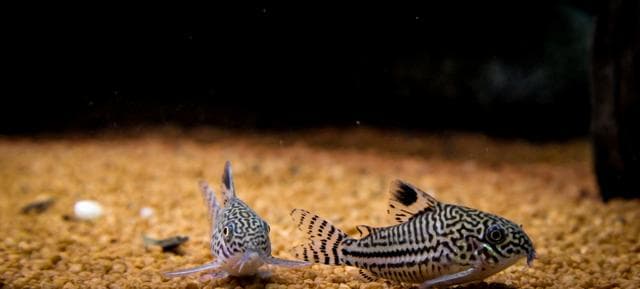
As with many ornamental fish species, with Corydoras too: for breeding success, it is considerably more promising to get as close as possible to the parameters of the original habitat in terms of water values such as hardness and pH. For this, it may be necessary for the water to be much softer and more acidic than in normal Corydoras care. The animals are so-called substrate spawners, and breeding success depends, among other things, strongly on the respective Corydoras species as well as on the season and the age of the animals. Quite a few Corydoras need a certain stimulation to spawn, which can often be triggered by slightly cooler temperatures through a partial water change. Sufficient and varied food is just as important. For this, live and frozen food can be fed more often.
For breeding, depending on the species, it can sometimes be more promising to add somewhat more males to the females so that they are "driven" enough.
Courtship behavior in Corydoras shows itself through a corresponding group dynamic; the animals swim through the aquarium in excitement. In the so-called T-position, mating takes place, followed by egg laying. The sticky eggs are then often glued to aquarium panes or aquatic plants. Up to 25 eggs can be produced per spawning, which are round and often cream-colored. Unfortunately, Corydoras are egg predators and eat their own clutches. Other aquarium animals can also sometimes go for Corydoras eggs. It is therefore worth separating the adult animals from the eggs or moving the clutches out of the aquarium into a separate rearing tank. You can roll the eggs off well by hand or separate them very carefully from the original substrate with a scraper.
Depending on the water temperature and Corydoras species, it often takes two to seven days until the larvae hatch. In the first 1 to 3 days, the young feed on the yolk sac. After that, the juveniles can be fed with infusoria, powder food or other foods that fit their mouths. Sometimes an aquarium that has already been running for a longer time and has detritus provides enough tiny organisms for the first period.