 Solenoid valve humming?
A humming solenoid valve (night shut-off) can point to various causes – from harmless vibrations to serious defects. Here is a structured overview of how you can narrow down the cause and fix the problem:
Typical causes of humming in the CO2 solenoid valve
Here you basically have to distinguish between solenoid valves that run on 230 V alternating current (AC) and DC solenoid valves. The latter need significantly less power and usually also have a smaller power supply. An AC solenoid valve normally has the typical Schuko plug.
1. With alternating current operation (AC)
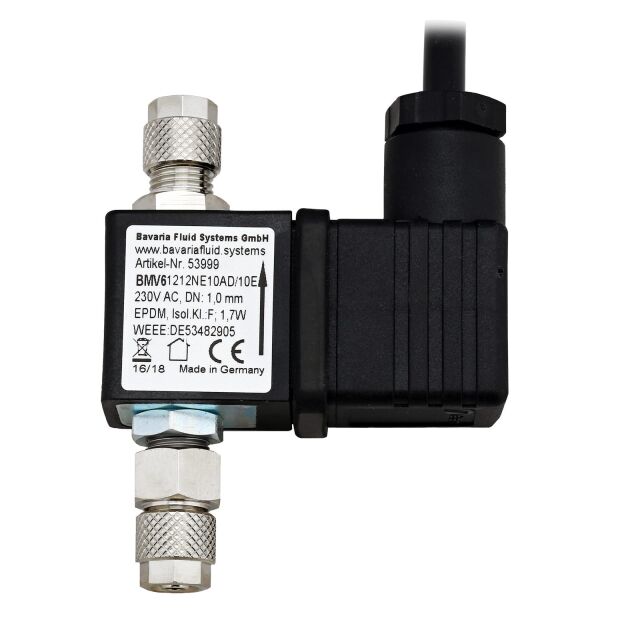
Many 230 V AC solenoid valves tend to hum slightly, especially if no anti-hum plate is installed. The humming is caused by the 50 Hz alternating current field and is often design-related – it is often more audible on cheap or older models.
2. With direct current operation (DC)
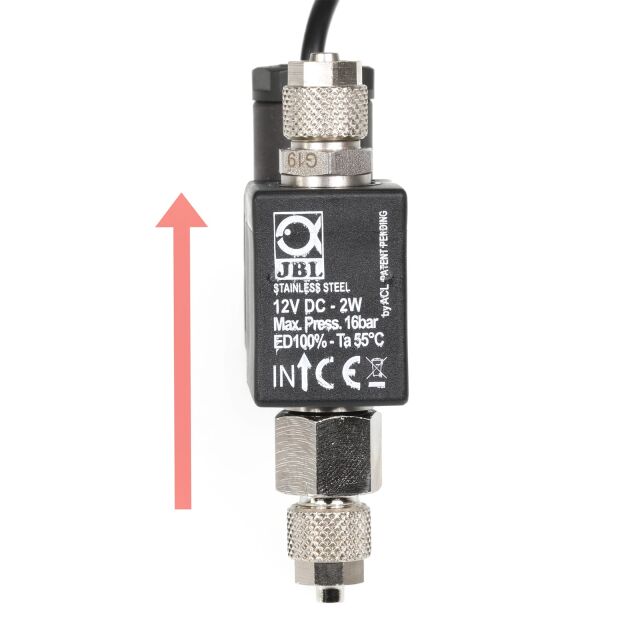
With 12 or 24 V DC valves, humming is rather atypical – if it occurs, it is often due to undervoltage, for example from a power supply that is too weak.) Unstabilized voltage can also be a cause. This can happen if, for example, an unstabilized transformer is used instead of a regulated power supply. Loose contacts (for example at terminals or adapters) can also lead to this problem.
3. Mechanical transmission
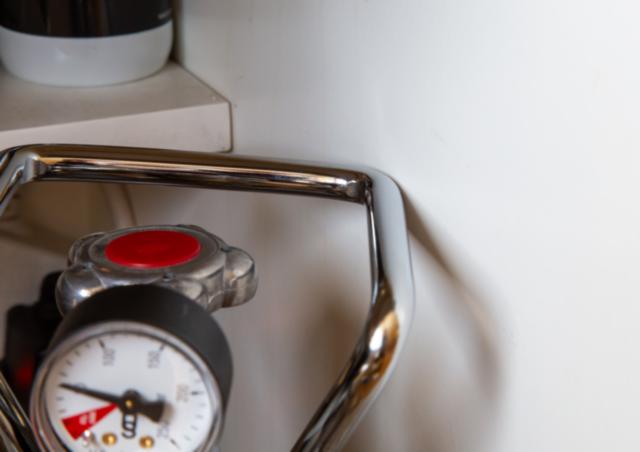
The solenoid valve or the CO2 system is resting against something, such as glass or wood. If it is not decoupled, even slight vibrations can become noticeably audible.
Solutions for CO₂ solenoid valves
Check the power supply
If your valve runs on an external power supply, make sure the direct voltage (DC) exactly matches the coil voltage. If possible, use a regulated power supply – not a cheap "universal adapter". If necessary, measure the voltage. If it delivers only 9 V instead of 12 V, for example, the magnetic force may not be sufficient. This can lead to the humming.
Decouple the mounting
Place rubber feet, foam rubber or a foam pad under the CO2 cylinder. Make sure the whole system does not touch other objects at the sides or on top either. A good alternative is to mount the solenoid valve hanging as an inline version (using pressure-resistant CO₂ tubing). This reduces the transmission of structure-borne noise.
Consider replacing it
If the valve gets very hot, hums loudly all the time or switches unreliably, the coil could also be defective or worn out. In that case it is better to replace the valve. A branded valve with a DC coil is often quieter and longer-lasting than no-name AC models.
Recommendation for quiet CO₂ valves
If you want long-term peace and quiet, choose a 12 V DC solenoid valve with a regulated plug-in power supply and vibration-damping mounting.