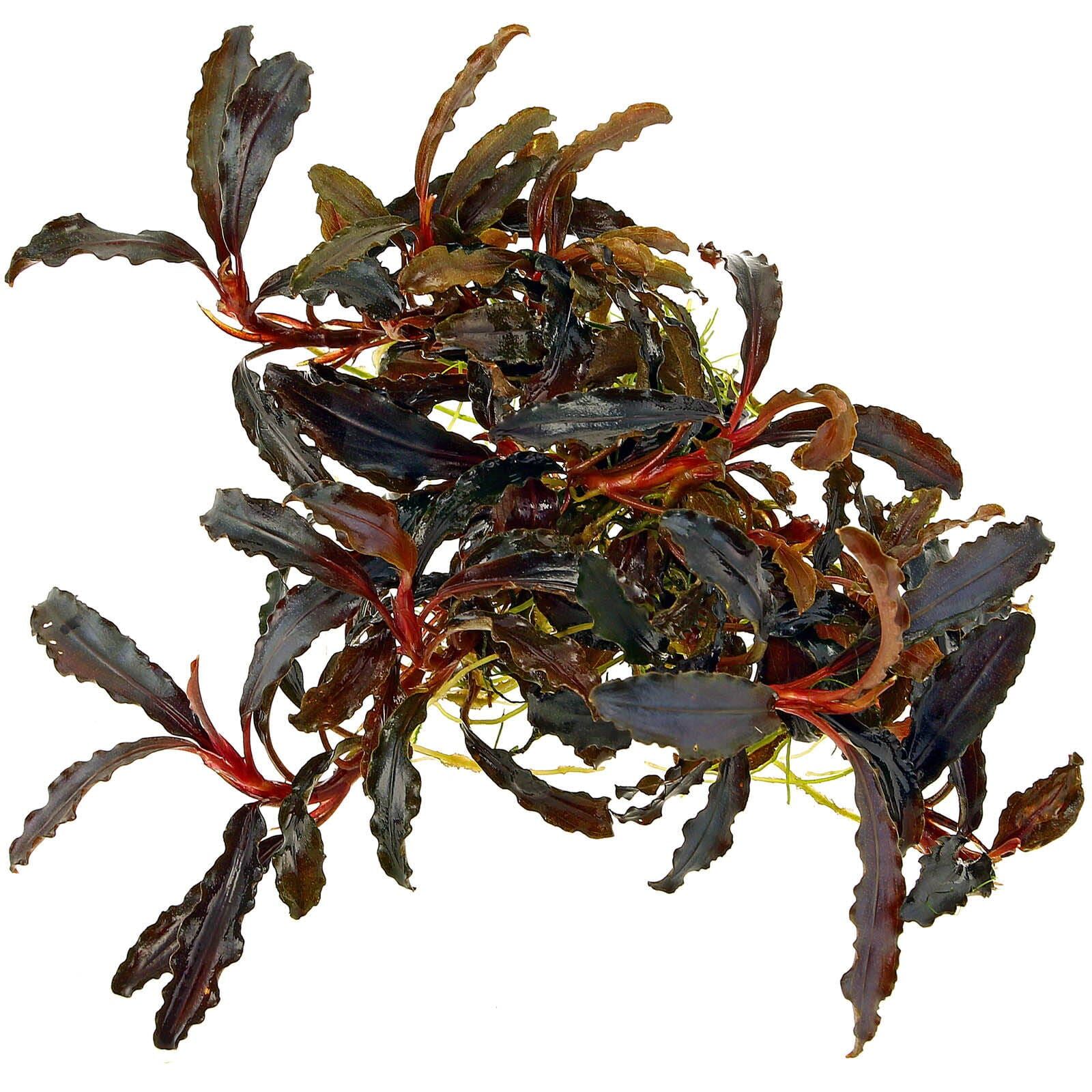
 Bucephalandra: many new species?
This article was published by Heiko Muth on 02/26/2014 in the Flowgrow Aquascaping Network. At that time, five Bucephalandra species were still recognized. In the meantime, the number of scientifically described species has grown to 31 (as of January 2020).
In the aquarium hobby, countless Bucephalandra forms in fascinating diversity are now known. Botanists have known the diversity of forms of this genus, described more than 150 years ago, for longer than hobbyists have, yet they currently distinguish only a few species. Here I would like to report in considerable detail what is known about these plants from the scientific side so far.
General information and history
The plants of the genus Bucephalandra are endemic to Borneo and widespread on this island: in Sarawak (= East Malaysia), Kalimantan (the Indonesian part of Borneo) and in the Sultanate of Brunei. The species B. gigantea was found at 700 m above sea level; the collection sites of the other Bucephalandra plants are mostly at an elevation of 350 m or less, occasionally up to 500 m and in one case at 1,200 m (Bogner & Hay 2000). Bucephalandra grows as a rheophyte (more on this below) on rock in and along rocky rainforest streams and rivers.
This genus is counted among the arum family (Araceae). Within this family it belongs to the subfamily Aroideae and to the tribe Schismatoglottideae (the tribe is a taxonomic rank between subfamily and genus); more on this below, too. On Borneo there are also plants from other genera that look very similar to Bucephalandra species.
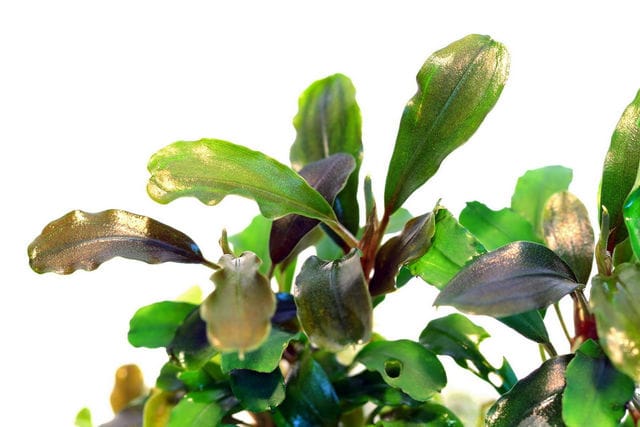
In 1858, Heinrich Wilhelm Schott established the genus Bucephalandra and described the first species, B. motleyana, from a plant from South Kalimantan. Odoardo Beccari later discovered a very small plant in Sarawak and described it in 1879 as a new genus, Microcasia (with the species M. pygmaea), because certain details of the inflorescences showed clear differences from Schott's description and illustration of Bucephalandra. In 1980, Josef Bogner found that the inflorescence characteristics on which Beccari based his new genus Microcasia can in reality also be found on the type herbarium specimen (in the Kew Herbarium) of B. motleyana. Schott had, however, described and illustrated the inflorescence of Bucephalandra incorrectly. So Beccari described Microcasia as a new genus in error, and the name is a synonym of the older name Bucephalandra (see Bogner & Hay 2000).
Further species were described up to 2000. Here is an overview of all Microcasia and Bucephalandra species names to date, as of July 2013:
| Name | Describer, year | Collector, year, collection site of the type | Links to photos of herbarium sheets |
|---|---|---|---|
| Bucephalandra motleyana | Heinrich Wilhelm Schott, 1858 | James Motley, South Kalimantan, probably near Banjarmasin (Boyce & Wong 2012) | http://apps.kew.org/herbcat/getImage.do?imageBarcode=K000291662 |
| Microcasia pygmaea, recombined by Boyce & Wong (2012): Bucephalandra pygmaea | Odoardo Beccari, 1879 | Odoardo Beccari, 1867, Sarawak, Sarikei Division, Julau, Sungai Entabai | http://ww2.bgbm.org/herbarium/view_large.cfm?SpecimenPK=97143&idThumb=297739&SpecimenSequenz=1&loan=0 |
| Microcasia elliptica | Heinrich Gustav Adolf Engler, 1879 | Odoardo Beccari, 1866, probably in the limestone/karst area of Mt. Penrissen, southwest Sarawak (Boyce & Wong 2012) | |
| Microcasia muluensis | Mitsuru Hotta, 1965 | Mitsuru Hotta, 1964, Sarawak, Miri, along the Sungai Payau from Sungai Melinau Paku to Rubang Payau, foot of Gunung Mulu | |
| Microcasia oblanceolata | Mitsuru Hotta, 1965 | Mitsuru Hotta, 1964, Sultanate of Brunei, Temburong District, surroundings of Labu, Bukit Peradayan | |
| Bucephalandra gigantea | Josef Bogner, 1984 | F.H. Endert, 1925, East Kalimantan, west of Koetai (= Kutai), Kiau River (originally identified as Piptospatha sp.) | http://apps.kew.org/herbcat/getImage.do?imageBarcode=K000291661 |
| Bucephalandra catherineae | Peter C. Boyce, Josef Bogner & Simon J. Mayo, 1995 | E.F. de Vogel & P.J. Cribb 1991, East Kalimantan, Apo Kayan, east of Long Nawan, Gunung Sungai Pendan, eastern mountain ridge | |
| Bucephalandra magnifolia | H. Okada & Y. Mori, 2000 | H. Okada & D. Komara, 1990, East Kalimantan, Bulungan, Long Bawan, Gunung Malim |
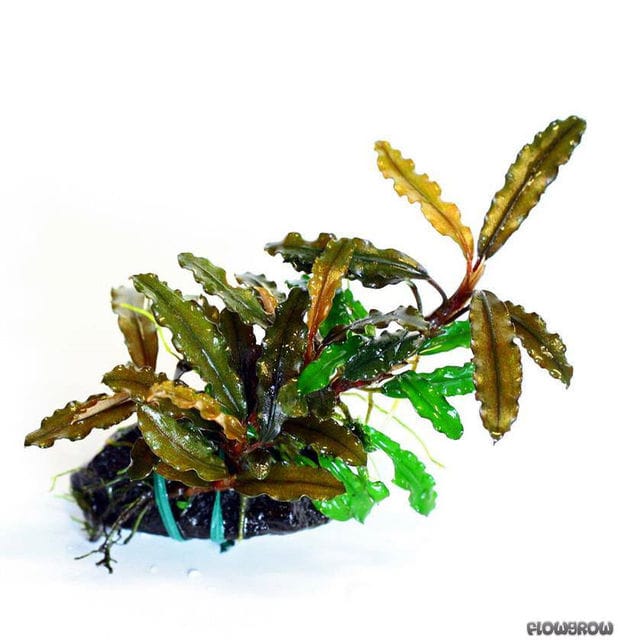
In the second-to-last revision of Bucephalandra (Bogner & Hay 2000), only two species are accepted: B. gigantea Bogner, a large-leaved plant up to more than 40 cm tall that has so far been found only once and is probably not in cultivation, and B. motleyana Schott as a very variable species widespread on Borneo, with all the remaining Bucephalandra and Microcasia species names as synonyms. This concept is adopted, for example, by Tomey (2004) and Kasselmann (2010). Aquarists in Europe first got to know under the name Bucephalandra motleyana the plants that Wim Tomey had brought back from West Kalimantan (see Tomey 2004). These plants, which have been cultivated for approx. ten years, are often regarded as “the species” B. motleyana. The many plants imported in recent years, on the other hand, are often presented on the internet as new, possibly still undescribed species. They are mostly designated as Bucephalandra sp. with an appended collection-site, descriptive or fantasy name, such as B. sp. “Bodok”, “Gunung Sumpit”, “Kapit”, “Kualakuayan”, “Melawi”, “Pancuraji”, “Riam Macam”, “Riam Seterap”, “Semuntai”, “Sekadau 1”, “Sekadau 2”, “Bukit Kelam / Sintang”, “Kedagang”, “Brownie Brown”, “Fine Edge”, “Velvet Leaf”, “Metallic Wave”, “Midnight Blue”, “Sexy Pink”, “Narcissus”, “Ulysses”, to name just a few. Dealers and collectors in Asia constantly create new names, of which by now around 200 can be found online (information from Tomasz Wastowski). Collection-site names are often misspelled; for example, “Kedagang” and “Kudakan” most likely refer to the place Kudangan in South Kalimantan, and “Pancuraji” and “Riam Macam” refer to the waterfalls Pancur Aji and Riam Macan in the Sanggau regency in West Kalimantan (information from Thomas Rudolph).
I wrote in the forum of www.flowgrow.de that all “new Bucephalandra species” in the aquarium hobby should also belong to the one species Bucephalandra motleyana, provided they a) have the genus characteristics of Bucephalandra and b) do not belong to the species B. gigantea.
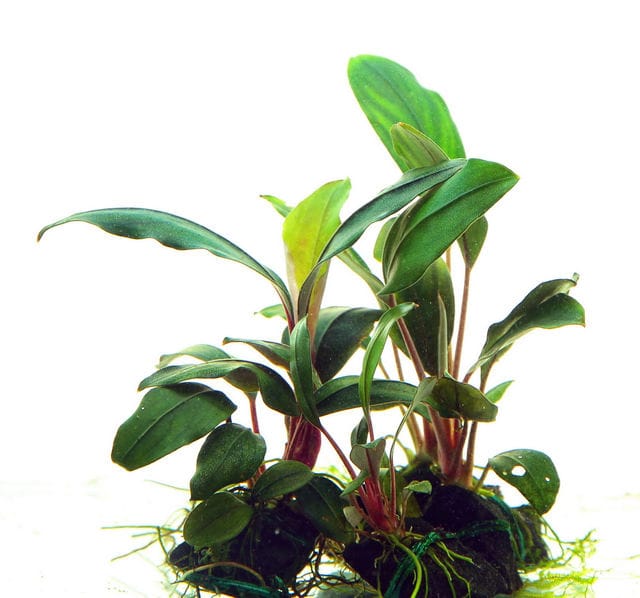
In fact, in Bogner & Hay's description of B. motleyana you find much of the range of variation that can be seen in the countless cultivated forms. Here are some of the characteristics according to Bogner & Hay (2000):
- Height 5-20 cm (some cultivated Bucephalandras, however, stay significantly smaller than 5 cm),
- Leaf blades (0.7-)5-7(-10) cm long and (0.3-)2-2.8 cm wide,
- Petioles 1-8 cm long and 2-2.5 mm thick, reddish, channeled on the upper side,
- Rhizome rather compressed, creeping with an ascending shoot tip, 3-10 cm long and 4-8 mm thick (thinner in some cultivated plants),
- Leaf shape variable, from linear through very narrowly oblanceolate and elliptic to obovate,
- Leaf blade base wedge-shaped, leaf tip pointed to blunt or round, with a thin, 1-2.5 mm long small tip, inflorescence stalk (peduncle) 2-13 cm long, reddish in color.
But you should not simply assign all cultivated Bucephalandras to B. motleyana. The most recent paper on Bucephalandra taxonomy is the one by Peter C. Boyce and Sin Yeng Wong (2012). In 2011 they rediscovered Microcasia pygmaea in nature approx. 145 years after Beccari, recognized it as a separate species and therefore recombined the species name into the genus Bucephalandra. They provisionally accept five species:
- B. gigantea Bogner,
- B. motleyana Schott (in the broad sense),
- B. catherineae P.C. Boyce, Bogner & Mayo,
- B. magnifolia Okada & Mori,
- B. pygmaea (Beccari) Boyce & Wong.
Boyce & Wong have not yet examined the Bucephalandra forms described as Microcasia elliptica, M. muluensis and M. oblanceolata as living, flowering plants, so they could not yet clarify whether they are separate species. For this reason, the authors have not recombined these names into Bucephalandra for the time being. They mention that at least two species occur in Gunung Mulu National Park (Sarawak): one, which most likely corresponds to Microcasia muluensis, is restricted to limestone, another to shale and sandstone.
Boyce & Wong (2012) also write that there are probably still quite a lot of undescribed species. One would think that this goes without saying given the very different appearance of the cultivated Bucephalandras, especially since the differences are apparently genetically fixed: they are not simply caused by different growing conditions (environmental plasticity) but are retained in cultivation under the same conditions. And one might perhaps hope that in the future there will one day be “proper” botanical names for the countless plants that currently have collection-site, descriptive or fantasy designations. It is not that simple, however. Apart from the very large-leaved B. gigantea, Boyce & Wong distinguish the species primarily by inconspicuous, small characteristics of the inflorescences that are rather hard to recognize. (Which characteristics these are in detail is listed further below.) Leaf characteristics play only a subordinate role here. Not that the scientists are unaware of the many differences between the plants in growth height, leaf shape, size and so on. On the contrary: both Bogner & Hay and Boyce & Wong have examined extensive Bucephalandra collections from the entire island of Borneo and emphasize the diversity of forms of these plants. So this wealth of forms is in itself nothing scientifically new. It is possible that many Bucephalandra herbarium specimens collected by botanists come from sites where plants for the trade were also collected later.
Nor is it the case that the leaf characteristics are dismissed as unimportant from the outset. The reason why Bogner & Hay, besides B. gigantea, accept only B. motleyana (and no subspecies or varieties either), despite all the differences, is this: when you look at many Bucephalandra populations together, there are many intermediate forms or gradual transitions in the vegetative characteristics (= characteristics of the plants without the flowers). The variation is continuous. Even individual plants from the same collection site can differ from one another. So the vegetative characteristics alone are poorly suited for delimiting taxonomic groups within Bucephalandra (except B. gigantea).
Bogner & Hay (2000) also do not use the variable inflorescence characteristics to delimit Bucephalandra species.
This is precisely the point, however, where Boyce & Wong (2012) arrived at new findings. In taxonomic work, mostly herbarium material is examined. Boyce & Wong, however, additionally examined many living Bucephalandra plants at the natural sites and in cultivation, and only thereby found that the plants can very well be divided into groups on the basis of flower characteristics. In dried Bucephalandra specimens in the herbaria, however, the inflorescences are often difficult to examine or poorly preserved. That is why Boyce & Wong make their taxonomic decisions only once they have examined the living plants and their three-dimensional spadix structure.
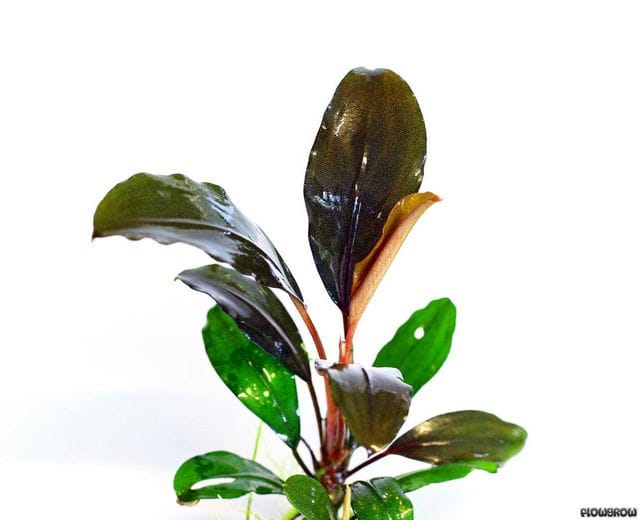
Bucephalandra species described in the future will probably also be distinguished mainly by details of the inflorescence. There will certainly be variation within these species too, even if perhaps not as much as in Bogner & Hay's description of B. motleyana. As Flair Wang (2012) writes, on the one hand differently looking B. forms can belong to the same species, and on the other hand very similar plants can belong to different species. This will certainly sound familiar to those who have ever dealt with distinguishing Cryptocoryne species.
Two new species names are already in use but have not yet been validly published: Bucephalandra akantha (see Wong & Boyce 2013) and B. belindae. Photos on the internet show as B. belindae a plant with very narrow-linear leaves with a wavy margin.
I will try to explain how the genus Bucephalandra is distinguished from other genera and how the individual species are distinguished from each other. To do so, I will go into more depth here and first write some general information about arum family plants and the tribe Schismatoglottideae.
Characteristics of Araceae
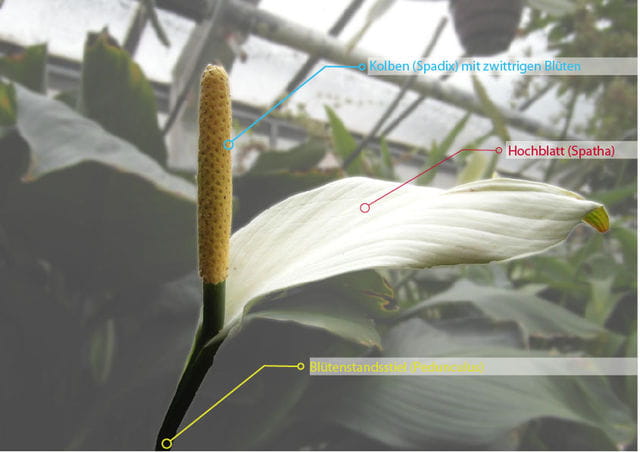
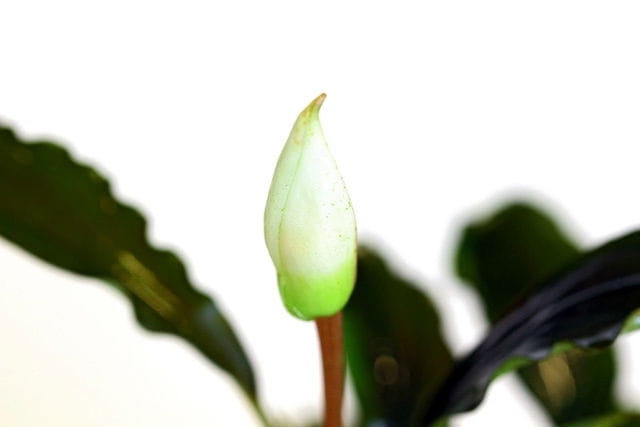
The flowering plant family Araceae (arum family, aroids) is very diverse and contains more than 3,000 species worldwide; it has its greatest species density in tropical America as well as on the mainland and islands of Southeast Asia (Mayo & others 1997). Aroids are known to aquarists especially through Cryptocoryne, Anubias and Pistia. Aroids are also a familiar sight for many through popular tropical ornamental plants such as Anthurium (flamingo flower), Dieffenbachia, Epipremnum (pothos), Monstera, Philodendron and Spathiphyllum (peace lily) as well as through some tropical crop plants such as Taro (Colocasia). But duckweeds, which are not exactly popular in the aquarium hobby (formerly family Lemnaceae, now subfamily Lemnoideae), have also been classified with the aroids for some time – among them the smallest flowering plants in the world (Wolffia). In Central Europe, apart from duckweeds, only a few other aroids occur, such as the lords-and-ladies (Arum maculatum) and the water arum (Calla palustris). Typical aroid inflorescences such as those of Anthurium (flamingo flower) or Anubias are often taken for a single large flower, but contain many tiny, inconspicuous, unstalked flowers. These sit on a spadix, which is located at the end of the flower stalk (peduncle). The fruits that develop from fertilized flowers on the spadix and contain the seeds are mostly berries. The spadix is surrounded at its base by an often conspicuous, petal-like bract (spathe). In simple cases such as Spathiphyllum, the spadix is covered with many hermaphroditic flowers of the same kind and is exposed.
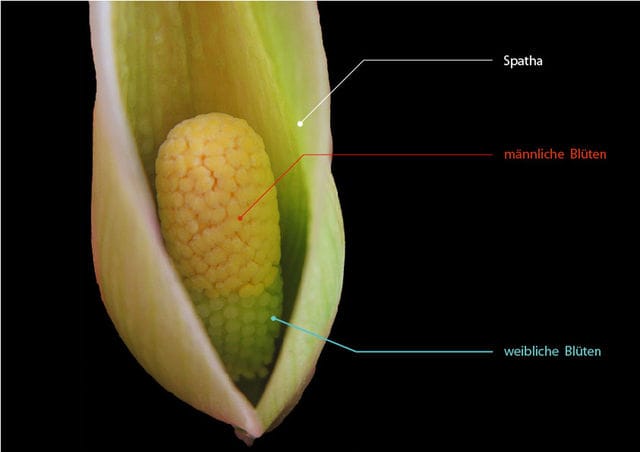
But especially in the subfamily Aroideae, the inflorescence is varied in many ways. Often the spadix has a zone with female flowers at the bottom and male flowers higher up. There can also be staminodes (in this case meaning flower-like but sterile organs), differently shaped spadix end pieces (appendices, singular: appendix), scent bodies or bare spadix areas. The individual flowers can be greatly reduced and, for example, consist of just one stamen or one ovary each. The spathe often hides the spadix more or less and can be formed as a kettle in the lower part. In Cryptocoryne, for example, the thin, delicate spadix cannot be seen from the outside. The varied forms of spadix and spathe are connected with pollination mechanisms. Often the pollinating insects, loaded with pollen from another inflorescence, are guided first to the female flowers, then to the male flowers that mature later and produce pollen.
Characteristics of Schismatoglottideae
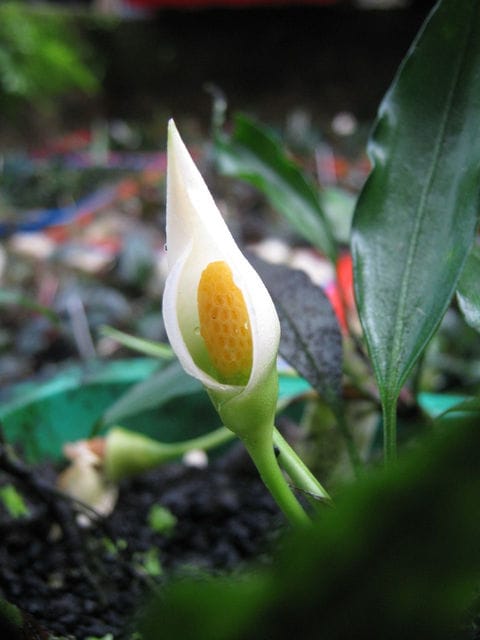
As already mentioned, Bucephalandra belongs to the tribe Schismatoglottideae. This aroid relationship group is distributed mainly in tropical Southeast Asia and has its center of diversity on Borneo. Most species of this group are counted in the eponymous genus Schismatoglottis; in addition there are a number of smaller genera: Apoballis , Aridarum, Bakoa, Bucephalandra, Furtadoa, Hestia, Hottarum, Ooia, Phymatarum, Pichinia, Piptospatha and Schottariella. Further genera may be distinguished in the future.
Most closely related to the tribe Schismatoglottideae is the tribe Cryptocoryneae with the likewise tropical Asian genera Cryptocoryne and Lagenandra.
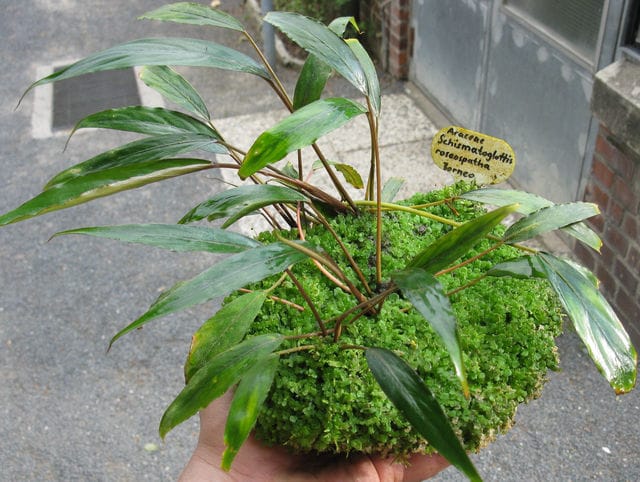
Formerly, three species from tropical South America were also counted in Schismatoglottis. Today they are in the genus Philonotion , and a new tribe has been established for them: Philonotieae. This South American group of species is considered, in terms of evolutionary history, to be the sister group of Schismatoglottideae + Cryptocoryneae (see Wong & others 2010). The last common ancestor of all these plants – including Bucephalandra, Cryptocoryne and Lagenandra – was therefore probably a Schismatoglottis-like plant. Very many species of the tribe Schismatoglottideae are rheophytes (plants adapted to frequent flooding with strong current, see below), but rather the species from the smaller genera. Most Schismatoglottis species, on the other hand, are “forest herbs”, herbaceous land plants on the floor of tropical forests. Various species such as S. pseudohatchii with conspicuously silvery-marked broad leaves are used as ornamental plants. But there are also some narrow-leaved rheophytes among them, such as the aquarium-suitable Schismatoglottis roseospatha.
In many Schismatoglottideae, the upper part of the spathe falls off during flowering, exposing the upper part of the spadix with the male flowers. Usually the upper part of the spadix also detaches later. The lower part of the spathe stays on the inflorescence and then envelops the ripening fruits (berries with many seeds). In Schismatoglottis (from Greek schisma “split, division” and glotta “tongue”), the spathe is constricted at the “predetermined breaking point” between the upper and lower parts of the spathe.
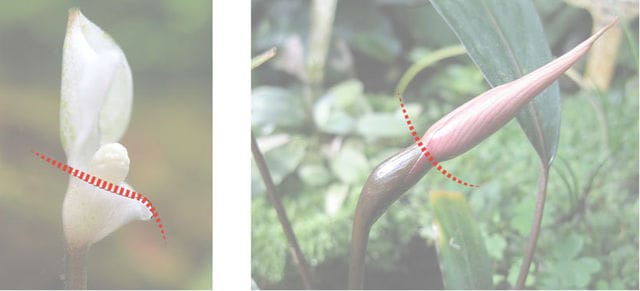
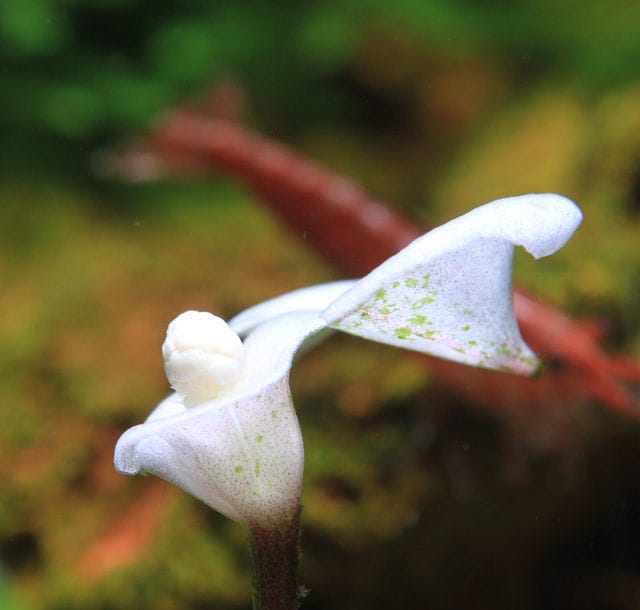
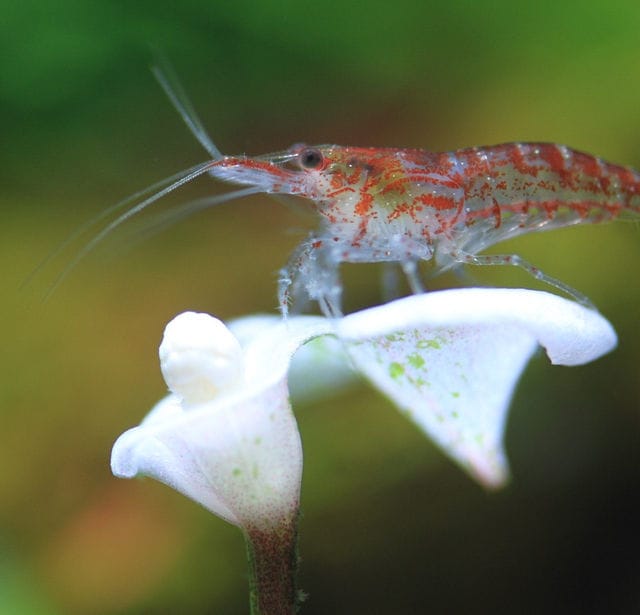
In various other genera such as Aridarum, Bucephalandra and Piptospatha, the spathe is not constricted, but in them too the upper part of the spathe detaches from the lower part during flowering. The lower part of the spathe, which remains on the rest of the inflorescence, enlarges and then looks like a cup or funnel. The fruits (berries) with the seeds develop in it.
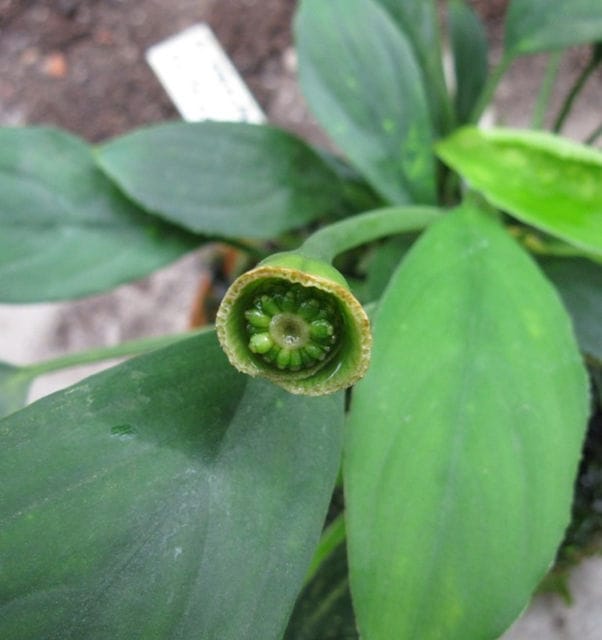
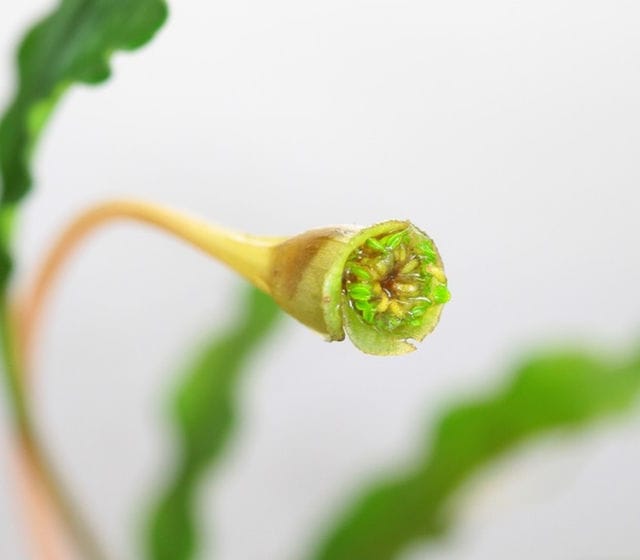
Such funnel-shaped infructescences can often be seen in photos of Bucephalandra and relatives at their natural sites. It is assumed that seed dispersal works by the “splash cup” mechanism (Boyce & Wong 2008b): splashing water or raindrops falling into the cup fling the pulp with the ripe seeds out.
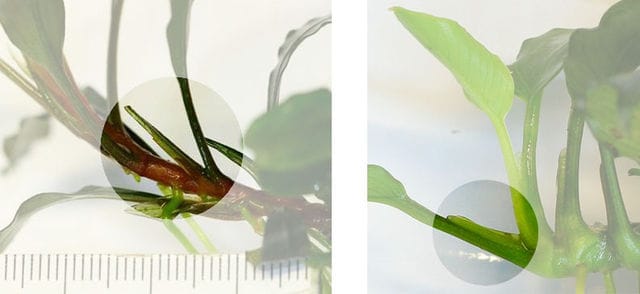
In many Schismatoglottideae (including Bucephalandra and Schismatoglottis roseospatha), the leaf sheaths have a special shape. They are detached from the petiole for almost their entire length and form a so-called ligular part. This envelops the youngest, emerging leaf like a bag. Between older leaves, these free leaf sheaths can be seen as stalk-like, pointed structures.
The upper surface of the leaf of Bucephalandra and Schismatoglottis roseospatha has many tiny but fairly conspicuous dots that look silvery under water. With a microscope you can see that they are stomata sitting on small elevations. They are also on the underside of the leaf, at a much greater density. In land plants, the stomata are mostly on the underside of the leaf (abaxial side), but especially in aquatic and marsh plants also on the upper side (adaxial side). Raised stomata (sitting on an elevation) are typical of hygrophytes (plants from permanently moist sites). The silvery sheen under water apparently comes from the air located directly behind the stomata in the intercellular spaces of the leaf tissue, which reflects the light.
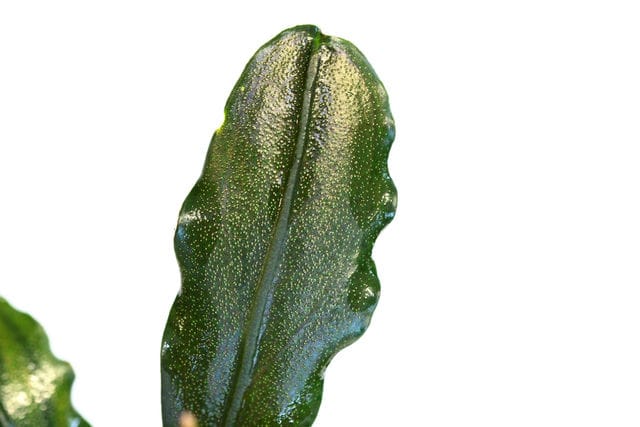
If you look closely, you can also discover such light dots (that is, stomata) on the underwater leaves of many other aquarium plants such as Anubias, Cryptocoryne, Hygrophila, Staurogyne and Pogostemon species; they are just mostly smaller and less conspicuous there than in Bucephalandra and relatives. Many true underwater plants, on the other hand, have only sparse stomata or none at all.
Distinguishing Bucephalandra from similar Schismatoglottideae
Bucephalandra plants can look very similar externally to some plants from related genera such as Aridarum, Hottarum and Piptospatha. The genera can really only be identified with certainty when the plants are flowering. For this you have to dissect the spadix free and look at it with a magnifying glass or a stereo microscope. Mature inflorescences are best, from the time when the spathe opens until shortly after the upper part of the spathe has fallen off. You carefully cut the spathe off from the base with a sharp blade and remove it with pointed tweezers until the entire spadix is visible. Massimo Iannella demonstrates this in a YouTube video: http://www.youtube.com/watch?v=WWN4PAzH5cA
To preserve them, you can place the inflorescences in 70% ethanol, for example.
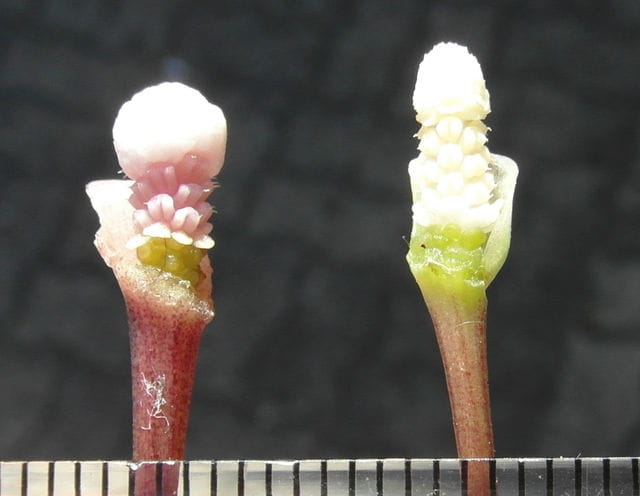
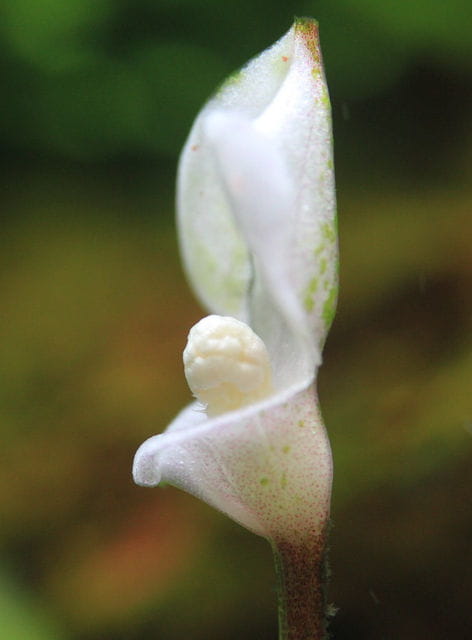
In all Schismatoglottideae, the female flowers sit at the bottom of the spadix and the male flowers farther up. In Bucephalandra, the individual flowers are extremely simplified; the female flowers each consist of only an ovary and the male flowers of one stamen each. At the top, the spadix ends in an appendix (“attachment”) densely covered with many staminodes truncated at the end. This appendix looks rounded to rounded-conical or blunt-cylindrical and is often whitish or cream-white in color.
Bucephalandra differs most clearly from other aroids in that flattened, scale-like staminodes sit on the spadix between the female and male flower zones. They clearly project above the female flowers. Because they sit in a gap (interstice) between the male and female flowers, they are also called interstitial staminodes.
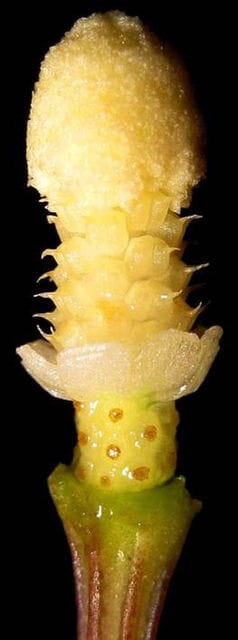
The stamen of the male flower has two swellings next to each other, the thecae (anther halves), in which the pollen develops. In Bucephalandra, each theca has a needle- or horn-shaped projection. At the tip of the two “horns” of a male flower, the pollen emerges as a droplet. The male flowers have been compared to the horned head of a cow or bull, hence the name Bu-cephal-andra (from Greek bous = cattle; kephale = head; aner, andros = man (Mayo, Bogner & Boyce 1997)).
Aridarum and Phymatarum also have horned thecae, but no scale-like staminodes. Aridarum can also have staminodes between male and female flowers, but these are then not scale-like but short, truncated and inconspicuous. In addition, the stamens of many Aridarum species are hollowed out at the front, and in this pit sit the thecae of the stamen with their “horns”. As a result, the male flower zone often looks somewhat like a honeycomb. In the stamens of Bucephalandra, by contrast, the thecae are bulging outward and do not sit in a pit.
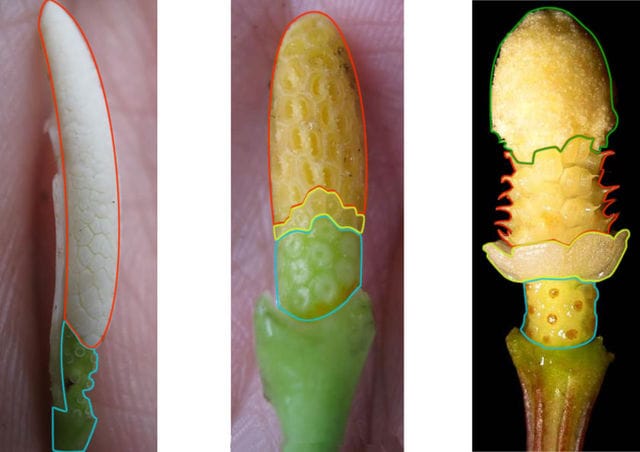
In Phymatarum, the spathe is narrowed between the male and female flower zones, as in Schismatoglottis. In Bucephalandra and Aridarum it is not narrowed. Other Schismatoglottideae in which the spathe also has no constriction, such as Bakoa, Hottarum, Ooia and Piptospatha, have no “horns” on the thecae of the male flowers, unlike Bucephalandra and Aridarum.
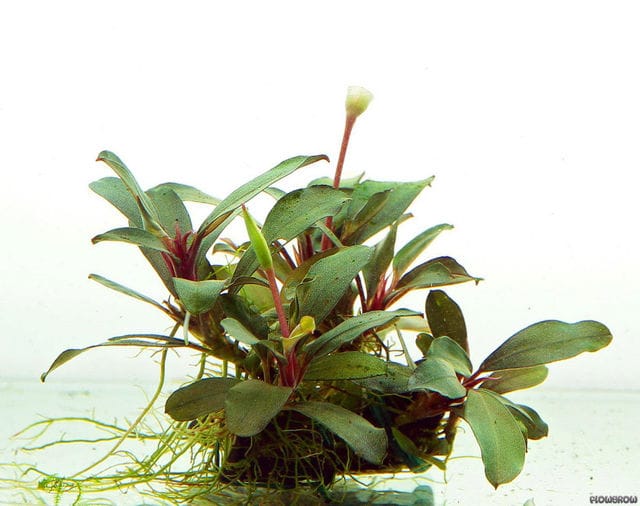
Arum family plants from Borneo therefore belong to Bucephalandra if the following characteristics occur in combination:
- unconstricted bract (spathe),
- conspicuous appendix at the end of the spadix, above the male flower zone, covered with many truncated staminodes,
- male flowers with two “horns”,
Distinguishing the currently accepted Bucephalandra species (as of 2014)
The inflorescence characteristics that Boyce & Wong (2012) use to distinguish species are:
- Surface texture of the staminodes sitting on the sterile end piece (appendix) of the spadix: warty (papillose) or smooth, with furrows, etc.
- Shape of the filament of the male flower, e.g. pyramid-, block- or band-shaped. Difficult to recognize; for this you have to look at the individual male flowers from the side.
- Position (insertion point) at which the two thecae sit on the filament of the male flowers.
- Length of the horns in relation to the length of the thecae on which the horns sit.
- Direction in which the horns of the thecae point in the later (male) flowering phase: obliquely upward or outward. At the beginning of the flowering phase, in all species both the horns and the scale-like staminodes are directed upward.
- Lower edge of the margin of the scale-like staminodes: clearly raised or not.
In the following table I have compiled characteristics from the Bucephalandra identification key and the description of B. pygmaea from Boyce & Wong (2012) as well as from the description of B. gigantea from Bogner & Hay (2000):
| B. gigantea | B. motleyana in the broad sense | B. magnifolia | B. pygmaea | B. catherineae | |
|---|---|---|---|---|---|
| Growth height | 40 cm and more | mostly much less than 25 cm (B. pygmaea: 1-3 cm) | |||
| Leaf blade, size | up to 25 cm long, 6-7 cm wide | significantly smaller, not over 20 cm long (B. pygmaea: (0.7-)2.5 cm long, 1-1.5 cm wide) | |||
| Leaf blade, shape | elliptic | no information (variable) | no information | elliptic-oblanceolate to slightly spatulate | linear-elliptic |
| Number of the stronger (primary) lateral veins on each side of the midrib | 16-20 | (0-)1-4, very weak (B. pygmaea: (1-)3-4) | |||
| Petiole | clearly differentiated, 15-20 cm long | no information (clearly differentiated) | no information (clearly differentiated) | clearly differentiated, 1.5-2 cm long | not clearly differentiated |
| Diameter of the rhizome | approx. 1 cm | less than 1 cm (B. pygmaea: 2-4 mm) | |||
| Surface of the staminodes of the appendix | warty | warty (papillate-tuberculate) | smooth, with a deep U- or T-shaped suture | smooth | smooth |
| Filament (of the stamen), shape in side view | no exact information (more or less truncated) | no information | oblique or asymmetrical pyramid | strongly flattened, band-shaped | diamond-shaped (rhomboid), block-like |
| Position on the filament where the thecae sit | underside | no information | no information | underside | outer end |
| Horns of the thecae | directed upward | no information | no information | as long as the associated theca, remain directed upward | much shorter than the associated theca, directed outward |
| Lower edge of the margin of the scale-like staminodes | no information | no information | no information | conspicuously raised margin | margin not raised |
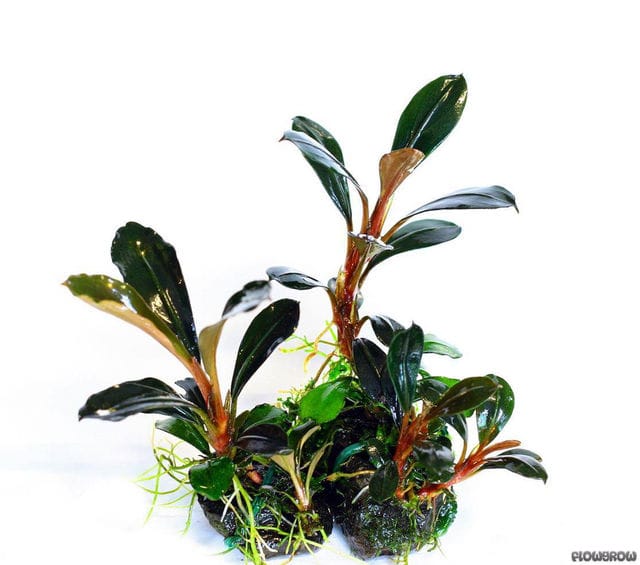
How can the botanical species classification now be used to distinguish cultivated Bucephalandras? At the moment probably only to a very limited extent; this may change with the description of further species. But even then, several cultivated forms will certainly fall under one species each. In case of doubt, it is still better to designate the plants again as undetermined species (Bucephalandra sp.) with the existing collection-site or trade names. What is certain, however, is that Bucephalandra sp. “Kapit” (= B. motleyana “Kapit”) belongs to Bucephalandra pygmaea. The species, originally described as Microcasia pygmaea, was first found in West Sarawak in what is now the Sarikei administrative division. In 1879 Beccari called it the smallest aroid (“La più piccola delle Aracee”), and indeed the plants stay quite small, at approx. 3.5 cm in height, both in nature and in cultivation (the smallest aroid and the smallest flowering plant of all is the dwarf duckweed Wolffia globosa). Typical inflorescence characteristics include the fairly smooth (not warty-rough) appendix of the spadix, male flowers with horns that remain directed upward and are about as long as the associated thecae, and the conspicuously thickened margin on the underside of the scale-like staminodes. Peter Boyce and Sin Yeng Wong collected B. pygmaea in August 2011 in the south of Sarawak, Kapit administrative division, Taman Rekreasi Sebabai. Their photos in the 2012 paper show the same plants and the same brown shale rock as in pictures that dealers and collectors have taken at the natural site of Bucephalandra sp. “Kapit”. The species occurs mainly on shale, more rarely on sandstone.
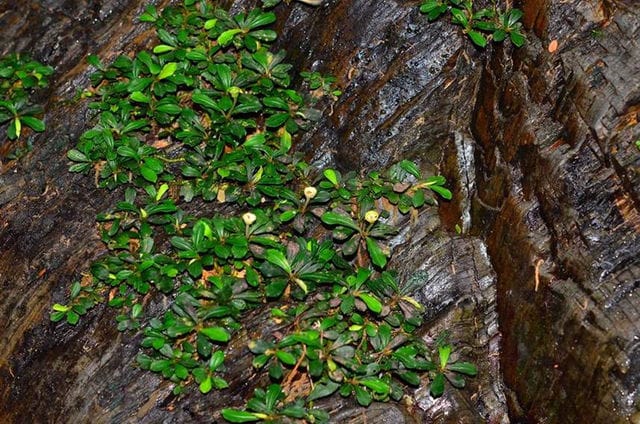
The leaves of B. pygmaea vary in leaf shape and color, and in the hobby several “Kapit” selections are named (“Kapit 1”, “Kapit 2”, “Red”, “Green”, etc.). If you want to continue to distinguish these, the botanical name is not sufficient, but in such cases you can append the existing non-scientific names in quotation marks. In my opinion it makes sense to keep using the collection-site name “Kapit”, because the species B. pygmaea was found not only there but also in Sarikei – so Bucephalandra pygmaea “Kapit 1”, etc.
Michael Lo found plants on the lower Rajang River near Kanowit (Sarawak, Sibu Division) that show the inflorescence characteristics of B. pygmaea but have much longer leaves (blog entry of 09/03/2012, http://junglemikey.blogspot.de/2012/09/bucephalandra-dark-velvet-is-actually.html ). He found them growing mostly submersed, together with Cryptocoryne striolata. Lo provisionally calls the plants from Kanowit Bucephalandra sp. “Dark Velvet”, and they are supposed to represent a new, as yet undescribed species related to B. pygmaea.
The name B. catherineae is used in the hobby for a cultivated Bucephalandra, but I do not know its inflorescence and therefore cannot judge whether the plant was identified correctly. In photos on the internet it looks like the plants designated B. sp. “Fake Catherineae” and “B. belindae”, with very narrow-linear, wavy leaves. In the broader-leaved B. sp. “Melawi”, the inflorescences appear to match the description of B. catherineae. The plant after which the species B. catherineae was originally described (that is, the type) has 1.5-3 mm wide, linear, very leathery leaves with a downward-curved, non-wavy margin (see Boyce, Bogner & Mayo 1995), unlike B. sp. “Melawi”. Bucephalandra sp. “Sekadau 1” (perhaps identical to “B. belindae”?) looks similar to “Melawi” but has narrower leaves. The appendix of the spadix looks warty-rough in “Sekadau 1”, which in the identification key of Boyce & Wong (2012) leads to Bucephalandra motleyana(!).
The case of Bucephalandra motleyana
As already mentioned, in the aquarium hobby Bucephalandra motleyana is understood primarily as the plants that Wim Tomey introduced to Europe from West Kalimantan about 10 years ago. This collection already contained different forms, but in the hobby they were only passed on as “the species” B. motleyana. Two selections have recently been designated B. motleyana “Brown-red” and “Brown-red narrow”. In his article in Aqua Planta, Tomey (2004) also presents a green-leaved form, but it apparently has not spread among aquarists.
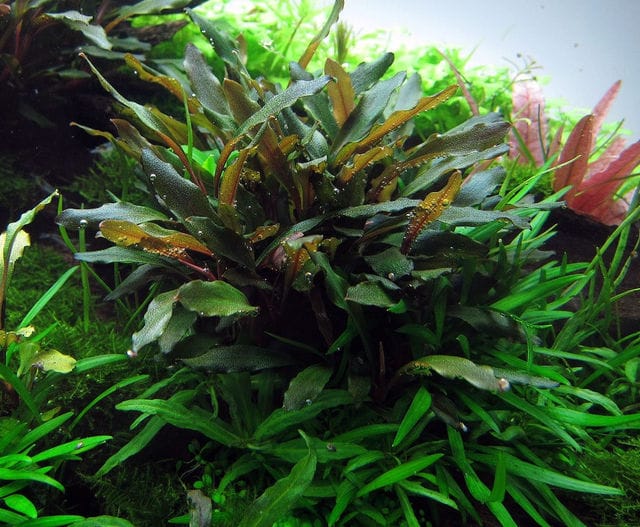
Tomey's plants, which in the hobby are often regarded as “the” B. motleyana, do correspond to the broad definition of B. motleyana by Bogner & Hay (2000), but at least “Brown-red” is, in my opinion, not B. motleyana in the sense of Boyce & Wong (2012). The appendix of the spadix is fairly smooth, not warty, and so the identification key in Boyce & Wong's paper does not lead to B. motleyana. I could not find out which species these plants from Tomey's collection belong to. But among the “new species” imported later in particular, there are some that fit B. motleyana better according to Boyce & Wong's identification key. For the time being, you can sort Bucephalandra forms under this name if they
- do not belong to B. gigantea, which is probably not in cultivation anyway (see leaf characteristics in the table above) and
- the appendix (the end of the spadix densely covered with truncated staminodes) does not have a rather smooth but a distinctly rough, warty-looking (papillate to tuberculate) surface.
This is the case at least for the large-growing B. motleyana “Pancuraji” (collection site Pancur Aji in West Kalimantan) and “Riam Seterap”, but also for the small, narrow-leaved B. sp. “Sekadau 1”. Perhaps also for various other forms that grow strong and large (“Gunung Sumpit”, “Sungai Ayak”, “Sekadau 2”, “Bodok”, “Semuntai”, etc.), whose inflorescences I have not looked at closely, however.
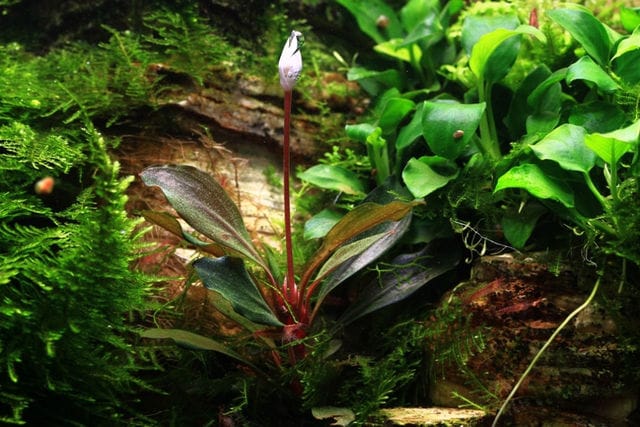
You have to keep in mind, however, that Boyce & Wong's concept of B. motleyana is only a provisional one. Under this name they group together various Bucephalandra populations, among which there may still be undescribed species. Cultivated forms that can for now be identified as B. motleyana possibly belong to such new species in the making.
“Typical” Bucephalandra motleyana in the narrowest sense may not be in cultivation at all. These are plants from South Kalimantan on which Schott described the genus and species. The photo of the holotype in the Kew Herbarium shows relatively large plants with rather narrow, oblanceolate, tapering leaves (see link in the table above). Boyce & Wong (2012) believe that the unknown collection site is probably in the surroundings of Banjarmasin, because the collector James Motley was at that time (until he was killed on May 1, 1859 in a local uprising at the beginning of the Banjarmasin War) superintendent of a coal mine in a place southeast of this city. They also note that this actual B. motleyana is quite likely a local endemic (a species restricted to a small area), and that they have not yet seen a (living) plant that convincingly corresponds to this species, even though the name B. motleyana is used almost everywhere in literature and on the internet.
The non-scientific names: necessary, but…
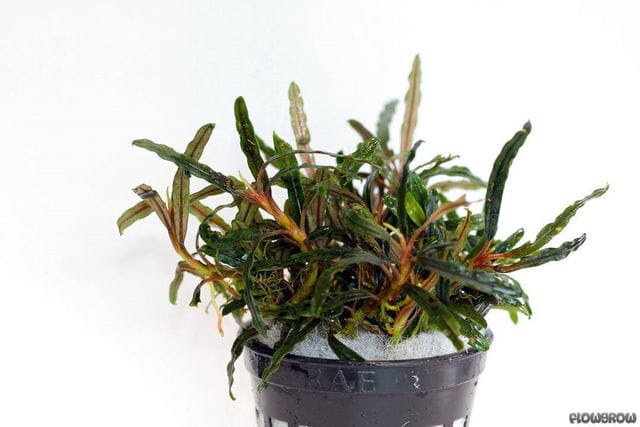
Aquarists often expect a scientific name to stand for uniform plants: “the species” or “the subspecies” so-and-so. But, for example, “the Java fern” (Microsorum pteropus) or “Cryptocoryne wendtii” are just as non-uniform as “the guppy” (Poecilia reticulata), and with varieties such as Cryptocoryne crispatula var. balansae there can also be variation and transitional forms to other varieties. Scientific taxonomy can never reflect the fine differences between individual, genetically fixed forms of a species entirely exactly, otherwise its taxa (described units) become indeterminable. But it is often precisely these differences without taxonomic value that are decisive, from the plant lovers' point of view, for the aesthetics and design value of the plants. Using Bucephalandra pygmaea as an example, I would like to express this: botanical species names cannot entirely replace the existing non-scientific designations (collection-site, descriptive, fantasy names) but can only supplement them. Even if different forms did not arise through breeding but are selections from nature, you could name them with a cultivar name in single quotation marks.
But however you name them, such units can only be identified if not just nice pictures but also reasonably precise descriptions and distinctions from similar plants have been published. This is not the case with many trade designations, and then it is often uncertain which plants exactly are meant and whether the same ones do not already exist under other names.
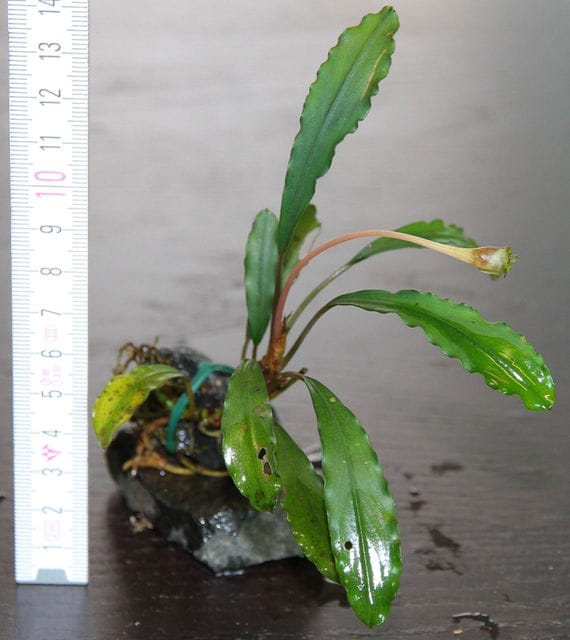
But the delimitation and identification of natural forms of the same species becomes all the more difficult or less possible the more of them come into cultivation – not only with Bucephalandra species but generally with variable species such as Java fern, Rotala rotundifolia or Cryptocoryne wendtii. The variability (modification) caused by different growing conditions also makes distinction harder. Then it also becomes increasingly clear to aquarists that the variation is continuous, and they can understand all the better why taxonomists put all the different forms into only one or a few species. Comparative cultivation (cultivation under the same conditions) is one way to pin down subtle differences and tell them apart from environmentally caused modification, but with such slow growers as Bucephalandra it is probably very time-consuming. Perhaps one day individual Bucephalandra clones (genetically identical plants) could be identified with “DNA fingerprinting”, as is done, for example, with fruit and rose varieties.
New names for Bucephalandra forms are certainly mostly assigned by dealers or plant collectors. Unfortunately, you probably cannot expect them to agree on the naming of plants that look the same. Different names for identical or very similar plants are unavoidable, as are different plants under the same collection-site designation (e.g. “Sintang”). If interested hobbyists want more order in the jungle of names for Bucephalandra forms, but also for other variable plant species, neither the trade nor science will do it for them of its own accord; they would have to take the initiative themselves and catalog and describe the plants with their countless trade names in a joint project. The botanists' scientific species delimitations as well as collection-site information from the plant collectors and dealers could at least offer rough orientation in this. Whether the “Japan Bucephalandra Fanatist Association” mentioned by Wang (2012) has perhaps already considered such a project?
Rheophytes
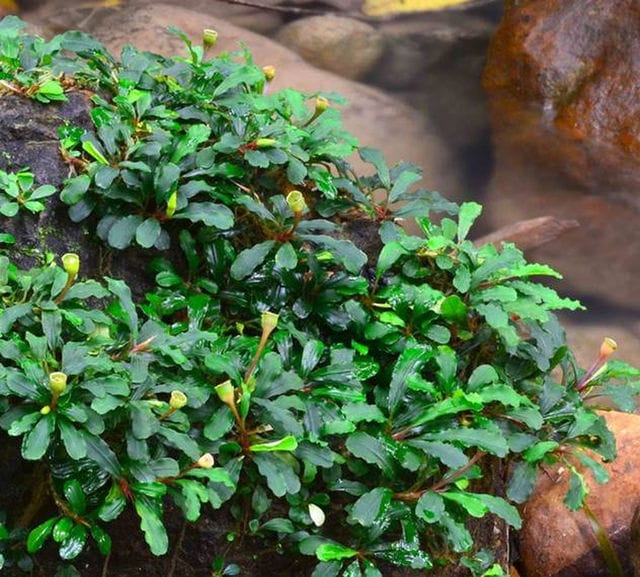
The natural sites of Bucephalandra motleyana are described vividly by Tomey (2004) and Wang (2012); impressive pictures of the habitats are shown, for example, by Michael Lo (“Jungle Mike”) on the page http://junglemikey.blogspot.com/. Bucephalandra mostly develops mat-like, dense stands on rocks and large stones in the high-water zone of streams and waterfalls in the tropical rainforest, in shade or partial shade. The roots of the plants form an extensive, dense mat that adheres very firmly even to smooth rock. Many side shoots form on the rhizomes, through which the plant propagates vegetatively. Tomey (2004) found a lot of accumulated organic material in the Bucephalandra mats – certainly a nutrient source for the plants in the rather nutrient-poor habitats. Bucephalandra grows on different types of rock, including limestone.
Rheophyte means roughly “river plant” or “current plant”. This life form is described in detail in the book “Rheophytes of the World” (Van Steenis 1981). Rheophytes grow in places with at least temporarily raging water current (at least 1-2 meters per second), that is, in and along streams and fast-flowing rivers up to the mean high-water line, in rapids and waterfalls. There, especially in the tropics, “flash floods” frequently occur after rainfall. Normal land plants cannot settle at such sites because they are torn away or damaged too much by the frequent flooding. Rheophytes are adapted to this habitat, for example by narrow, streamlined, leathery leaves, flexible petioles and stems that resist tension, as well as clinging roots or far-reaching roots in the stream gravel. Depending on how strongly the natural occurrence is restricted to this special habitat, facultative and obligate rheophytes are distinguished. Bucephalandra species belong to the latter.
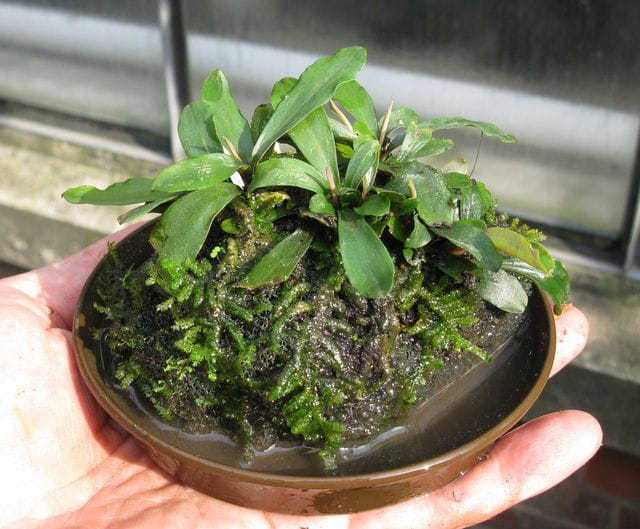
Some rheophytes are typical aquatic plants below the mean water line, such as the river water-crowfoot (Ranunculus fluviatilis) native to Germany, among other places, but predominantly they are semi-aquatic or land plants that are flooded only at high water or in the rainy season. Most rheophytic species occur in the tropics. They include both herbaceous plants and woody plants such as the oleander (Nerium Oleander), which grows in stony stream beds in the Mediterranean region, and the false heather (Cuphea hyssopifolia) from Central America. There are also many rheophytic fern species, especially on Borneo. Strange, extremely specialized rheophytic aquatic plants are the Podostemaceae (“river-weed family”); although they are flowering plants, they often look more like ferns, mosses, crustose lichens or seaweed. Many mosses occurring on stream stones can also be regarded as rheophytes.
Cultivation
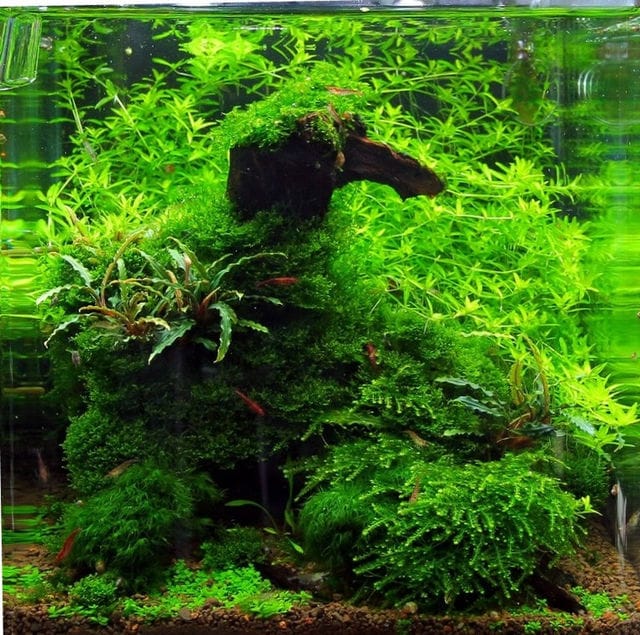
You might think rheophytes are generally difficult to cultivate because they would need the special natural growing conditions - alternation between flooding and drying out as well as strong current - in cultivation, too. But that often does not seem to be the case. Some classic, very easy-to-keep aquarium plants are rheophytes: Bolbitis heudelotii, Microsorum pteropus and Anubias barteri varieties. Like Bucephalandra and Schismatoglottis roseospatha, these are rather slow-growing plants with clinging roots that need little light. Although in nature these species are mostly submerged only temporarily, they grow permanently submersed in the aquarium, even in still water. And rheophytes kept emersed, especially the “dry” representatives cultivated as normal land plants such as the popular oleander shrub (Nerium), do not need to be flooded periodically in order to thrive.
It is actually astonishing that the “Buces” were discovered for the aquarium hobby only so late, even though plant-interested aquarists had often been traveling on the island of Borneo, especially because of the many Cryptocoryne species. If Bucephalandra plants were noticed at all: perhaps they were regarded as land plants of no interest to aquaristics anyway? Their aquarium career began in any case after Tomey (2004) had found them in the Hulu Sungai Landak river at water depths of up to 1.20 m.
Besides Bucephalandra and Schismatoglottis roseospatha, certainly further rheophytic plants from the tribe Schismatoglottideae are well suited as aquarium plants. In the forum of www.aquaticplantcentral.com, for example, Piptospatha species cultivated submersed have already been written about, but overall there is so far little to be found on this.
Detailed information on Bucephalandra cultivation would probably be better placed in an article of its own. Here is something on experience so far:
Bucephalandra can also grow in aquariums without carbon dioxide fertilization and in low light, but develops much better at least at medium light intensity and with a good CO2 and nutrient supply. Soft water is probably generally favorable, but some Bucephalandra populations also occur on limestone (I do not know which of the cultivated forms), and these may possibly tolerate a high carbonate hardness in the aquarium.
According to Tomey (2004) and Wang (2012), plants that have grown submersed in nature develop smaller leaves than emersed ones, but the Bucephalandras cultivated at Aquasabi have developed even larger leaves submersed than the old emersed ones, though at CO2 concentrations of around 20-30 mg/l and regular macro- and micronutrient fertilization via the water column. By comparison, the CO2 and nutrient supply underwater at the natural sites is probably very limited.
They are quite easy to care for in themselves, but not as robust as Anubias. They often respond to rapid changes in water parameters, similar to “crypt melt”, by shedding all their leaves. The bare rhizomes then slowly sprout again. Holey leaves also often occur in Bucephalandra.
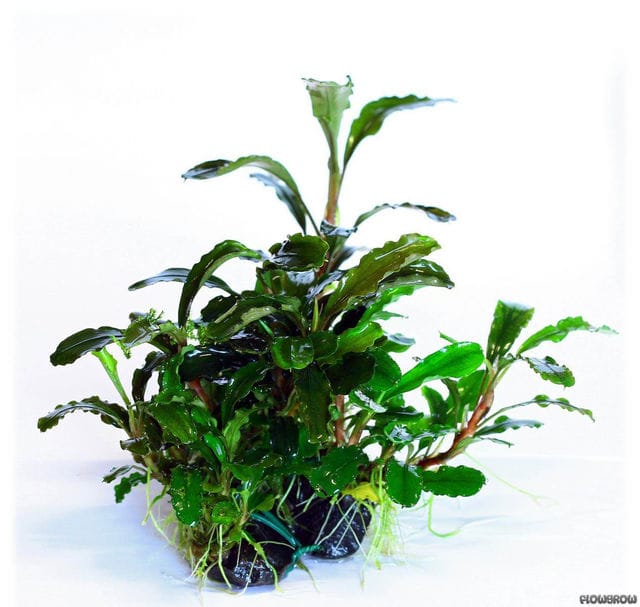
Bucephalandra attaches itself with its roots better to rock than to wood. Like Anubias and Microsorum, it should not be planted in the substrate, but the roots can penetrate deep into loose soil. Although Bucephalandra is generally considered extremely slow-growing, individual forms differ in growth rate. B. sp. “Bukit Kelam / Sintang”, possibly the least demanding form, grows about as “fast” as Anubias barteri var. nana, whereas B. pygmaea is very slow.
Propagation is easily possible by division, as with other rhizome plants. Cutting off the shoot tip promotes the formation of side shoots. I have now and then found tiny young plants on torn-off Bucephalandra roots. Adventitious shoots on roots are apparently not yet known in this genus, but they are in the related Ooia grabowskii.
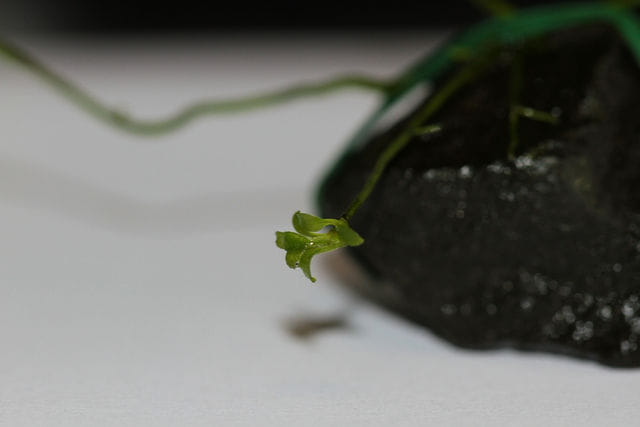
Especially in large-growing forms (“Gunung Sumpit”, “Sungai Ayak”, “Bukit Kelam / Sintang”, etc.), the rhizome grows upright, stem-like, under water. Forms with a rhizome that is rather creeping submersed and ascending at the tip are, for example, “Red-brown”, “Red-brown narrow”, “Riam Macan”, “Melawi” and “Sekadau 1”, probably also very small-leaved forms such as “Theia 6”.
The design potential of Bucephalandra has certainly not yet been exhausted. The plants show colors and color effects that are hardly known from other aquarium plants, at most from some cryptocorynes, for example a bluish shimmer and iridescent colors. As with Cryptocoryne, the special colorations tend to develop under water. Some forms apparently stay smaller than B. pygmaea and are likely to be the smallest aquarium-suitable epiphytes (apart from mosses); for example, B. sp. “Theia 6” has leaves only the size of a pinky fingernail (information from Tomasz Wastowski (“vasteq”) on www.flowgrow.de). I believe that the pictures of the natural Bucephalandra biotopes would offer very nice inspiration for use in aquascaping. The plants often flower under water, which adds to their appeal, but the inflorescences cannot be pollinated there. Flowering under water can also often be seen in Anubias barteri varieties, and in my opinion it is connected with the frequently changing water level in nature: inflorescences that have grown up submersed during high water probably also have a sufficiently large chance of falling dry and then being pollinated. Among the Bucephalandra forms there are evidently more or less diligent bloomers. The opening of the spathe and the shedding of the upper part of the spathe within minutes is the fastest process you can observe in Bucephalandra in the aquarium.
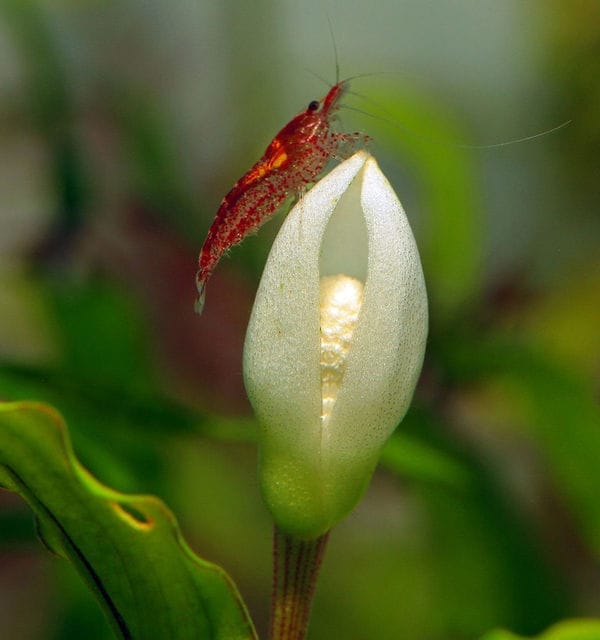
Boyce (1995) also mentions raising from seeds in emersed cultivated Bucephalandra. I have not found anything, however, on whether the flowers have to be pollinated artificially in cultivation for them to set seed. As with Anubias or Cryptocoryne, you would probably need inflorescences of different ages, because on the spadix the female flowers mature first and then the male flowers. In nature, Bucephalandra is pollinated by fruit flies of the genus Colocasiomyia (Wong & Boyce 2013).
For emersed cultivation, Boyce (1995) recommends small pots and coarse, permeable but water-retaining substrate, moist but not waterlogged, at high humidity in a closed container and a minimum temperature of 20 °C. See also the cultivation description by Tomey (2004). As can be seen on various websites, Japanese hobbyists apparently cultivate the plants emersed in a type of granulated earth substrate (aqua soil?). The plants can also grow in rock wool and nutrient solution, as is usual in aquatic plant nurseries, but are somewhat difficult in cultivation and prone to fungal infestation (information from Thomas Rudolph). In my impression, Bucephalandra is easier to keep submersed than emersed in the long run.
Threats?
The island of Borneo is known for its unique species richness as well as for rapid deforestation. That is why animals and plants of the tropical forests there – including the rheophytes growing in forest streams – are naturally generally endangered. Concrete cases of damage to or destruction of Cryptocoryne sites through logging, water pollution, establishing plantations, etc., or also through collecting plants away for the trade, have often been reported, but apparently nothing comparable has yet been published about Bucephalandra occurrences. Tomey (2004) does mention large-scale land clearing and water poisoning through gold and diamond prospecting in the vicinity of Serimbu, where Bucephalandra occurs. In the IUCN Red List database (http://www.iucnredlist.org/search, accessed on 07/30/2013), the genus has not yet been recorded. Apparently there is no protection status yet for Bucephalandra species either. How the degree of threat to organisms is assessed also depends on how taxonomists classify them. If many locally distributed Bucephalandra species are scientifically described one day, their potential threat will of course be rated higher than if only a few species that are fairly widespread on Borneo are distinguished.
The demand in Asia for these very slow-growing plants is probably still mostly met by collecting in nature. It would be good if as many Bucephalandra variants as possible were propagated in nurseries or in-vitro labs so that the natural populations are spared.
Collected plants may at least have a chance of survival in cultivation if their habitats are destroyed anyway. But scientists are only just beginning to study and understand many aspects of the biology of Bucephalandra – pollination biology, adaptation to special site conditions, phylogeny (evolutionary history) and dispersal history, genetic variation, speciation processes, etc. – and this will be possible in the future only if many of the wonderful stream biotopes with Bucephalandra and other rheophytes on Borneo are preserved.
Acknowledgments
For information I thank Josef Bogner, Peter C. Boyce, Tobias Coring, Marcel Dykierek, Thomas Rudolph and Tomasz Wastowski (“vasteq”). I thank Teck Song Wang for permission to use pictures from his blog (http://illumbomb.blogspot.de/). Many thanks also to Piet van Wijngaarden, from whom I received the Bucephalandra that had been collected by Wim Tomey in the early 2000s.
References
- Bogner, J. (2004): Schismatoglottis roseospatha Bogner (Araceae). - Aqua Planta 29 (3): 86-87.
- Bogner, J. & Hay, A. (2000): Schismatoglottideae (Araceae) in Malesia II – Aridarum, Bucephalandra, Phymatarum and Piptospatha. - Telopea 9 (1): 179-222. (http://www.rbgsyd.nsw.gov.au/__data/assets/pdf_file/0007/72772/Tel9Bog179.pdf , accessed on 10/06/2011)
- Boyce, P.C. (1995): Bucephalandra motleyana. – Curtis’s Botanical Magazine 23 (3): 131-134. (http://www.aroid.org/gallery/boyce/Bucephalandra%20motleyana%20-%20Boyce%201995.pdf, accessed on 07/25/2013)
- Boyce, P.C., Bogner, J. & Mayo, S. (1995): Bucephalandra catherineae, a new species from Kalimantan. - Curtis's Botanical Magazine 12 (3): 150-153. (http://www.aroid.org/gallery/boyce/Bucephalandra%20catherineae%20-%20Boyce%2C%20Bogner%20%26%20Mayo%201995.pdf, accessed on 07/25/2013)
- Boyce, P.C. & Wong, S.Y. (2008a): A Decade of Schismatoglottis Species. - The IAS Newsletter 30 (3): 1-7. (http://www.aroid.org/society/nl30-03.pdf , accessed on 10/06/2011)
- Boyce, P.C. & Wong, S.Y. (2008b): Studies on Schismatoglottideae (Araceae) of Borneo VII: Schottarum and Bakoa, two new genera from Sarawak, Malaysian Borneo. - Botanical Studies 49: 393-404 (p. 394). (http://www.aroid.org/gallery/boyce/Studies%20on%20Schismatoglottideae%20%28Araceae%29%20of%20Borneo%20VII%20-%20Schottarum%20and%20Bakoa%20-%20%5BBotanical%20Studies%20%28Taipei%29%2049%2C%20393-404%5D%20-%20Boyce%20%26%20Wong%202008.pdf , accessed on 07/25/2013)
- Boyce, P.C. & Wong, S.Y. (2009): The Aroids of the West Sarawak Limestone. - IAS Newsletter 31 (2) (http://www.aroid.org/society/nl31-02/ , accessed on 02/16/2012)
- Boyce, P.C. & Wong, S.Y. (2012): Studies on Schismatoglottideae (Araceae) of Borneo XX: Beccari’s «La Più piccola delle Aracee» (Microcasia pygmaea) recollected and transferred to Bucephalandra Schott. - Webbia 67 (2): 139-146. (http://www.aroid.org/gallery/boyce/Schismatoglottideae%20of%20Borneo%20XX%20-%20Bucephalandra%20pygmaea%20-%20%5BWebbia%2067%282%29%20139-146%5D%20-%20Boyce%20%26%20Wong%202012.pdf , accessed on 07/25/2013)
- Kasselmann, C. (2010): Aquarienpflanzen. 3rd edition. - DATZ Aquarienbuch, Ulmer Verlag, Stuttgart.
- Lo, Michael: Jungle Mike‘s secret gardens. (Blog) (http://junglemikey.blogspot.de/ , accessed 06/26/2013)
- Mayo, S.J., Bogner, J. & Boyce, P.C. (1997): The Genera of Araceae. – Royal Botanical Gardens, Kew, UK. (http://cate-araceae.myspecies.info/sites/cate-araceae.myspecies.info/files/Mayo%20et%20al%201997%20ARACEAE.pdf , accessed on 07/25/2013)
- Tomey, W.A. (2004): Bucephalandra motleyana Schott – ein Rheophyt als Aquarienpflanze? (translator: H.W.E. van Bruggen) - Aqua Planta 29 (3): 88-97.
- Van Steenis, C.G.G.J. (1981): Rheophytes of the World. – Sijthoff & Noordhoff, Alphen aan den Rijn.
- Wallach, B. (2007): Strömungsliebende Pflanzen. Rheophyten im Aquarium. - Aquarium live October / November 2007.
- Wang, F. (in cooperation with Crimson Taiwan) (2012): „Mysteriöse“ Pflanzen von Borneo. - Amazonas No. 39, January/February 2012.
- Wang, T. S. („illumbomb“): (2011): Spathes of Bucephalandra vs. Aridarum vs. Bakoa. - illumbomb’s cryptocoryne blog (10/26/2011). (http://illumbomb.blogspot.com/2011/10/spathes-of-bucephalandra-vs-aridarum-vs.html, 11/20/2011)
- Wong, S.Y. & Boyce, P.C. (2013): The role of the interstice staminodes of Bucephalandra Schott (Araceae: Schismatoglottideae). – IAS Newsletter 35 (2): 11-12. (http://www.aroid.org/gallery/boyce/Role%20of%20interstice%20staminodes%20in%20Bucephalandra%20-%20%5BNewslett.%20Int.%20Aroid%20Soc.%20%2035%282%29%2011-12%5D%20-%20Wong%20%26%20Boyce%202013.pdf)
- Wong, S.Y., Boyce, P.C., bin Othman, A.S. & Pin, L.C. (2010): Molecular phylogeny of tribe Schismatoglottideae (Araceae) based on two plastid markers and recognition of a new tribe, Philonotieae, from the neotropics. - Taxon 59 (1): 117-124.