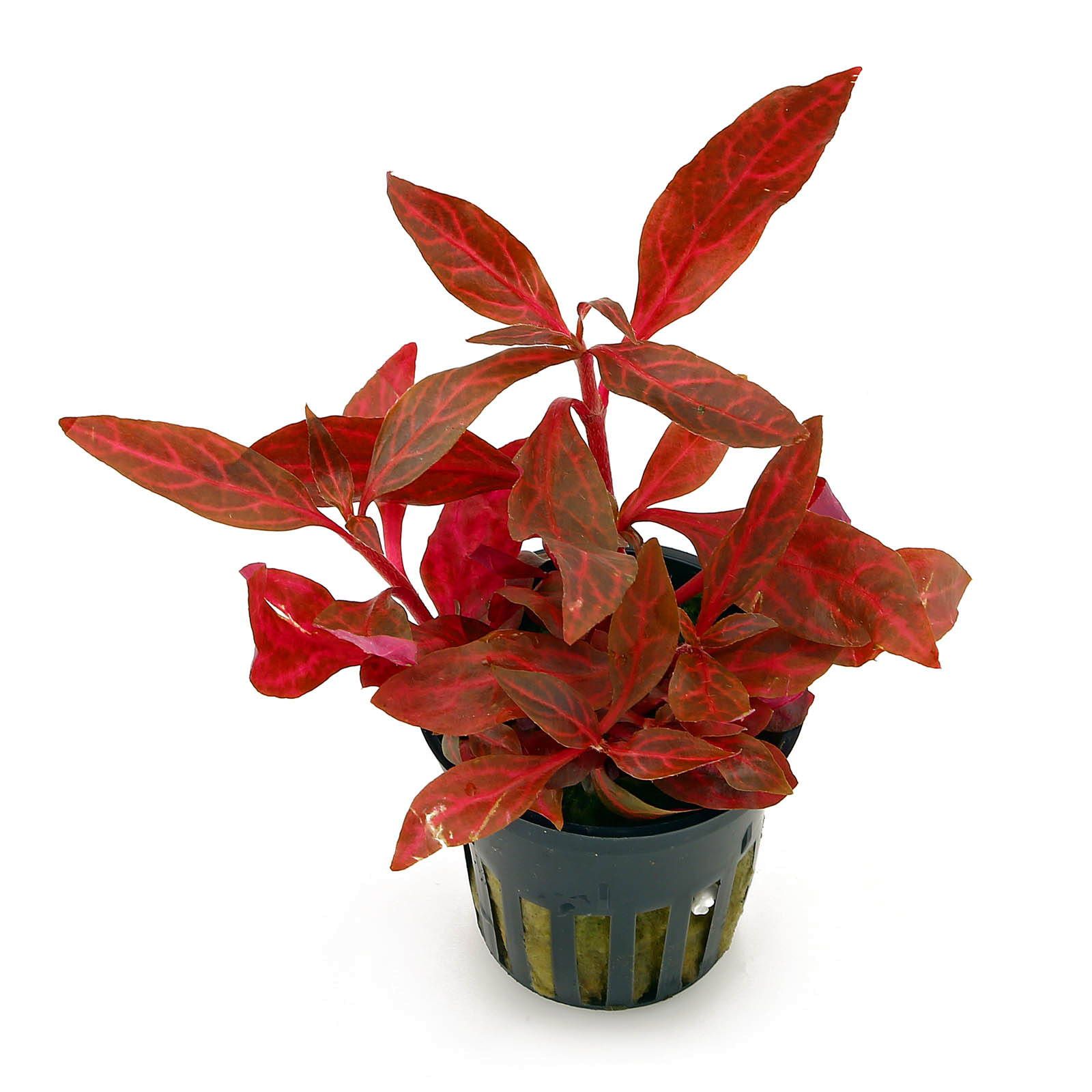
 Alternanthera
For more than 50 years, various plants of the genus Alternanthera have been popular aquarium plants. These relatively large-leaved, upright-growing stem plants were first introduced from South America under trade names such as "Telanthera osiris" and "Telanthera lilacina" and have enriched the aquarium flora ever since with strong, often brown-red to red-violet shades.
Parrot leaves
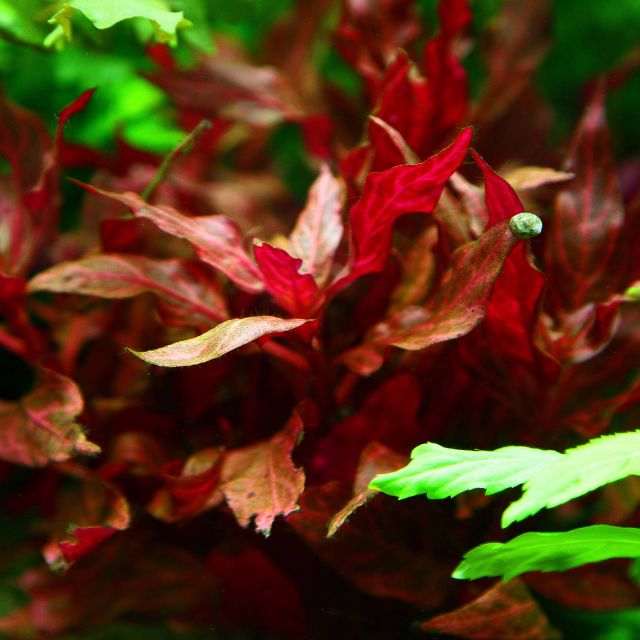
Alternanthera reineckii 'Rosanervig'
These so-called parrot leaves suitable for aquariums do not, however, belong to different species but are merely different forms of a single, highly variable species: Alternanthera reineckii. It is native to swampy, temporarily flooded locations in southern South America; as an amphibious plant, it can grow both above water (emersed) and submerged (submersed).
In fact, the genus Alternanthera in the amaranth family (Amaranthaceae) is far more diverse still. Of the roughly 80 species in the tropics and subtropics of the world, however, only a few occur wholly or partly in water; most are "normal" land plants. These are herbaceous or semi-shrubby, creeping to upright, annual or perennial plants. The leaves are arranged oppositely on the stem. The tiny, inconspicuous flowers sit in head-like or spike-like inflorescences in the leaf axils.
Various species are problem weeds in the tropics, and some are also used as vegetables or medicinal plants. Variegated cultivars, for example of Alternanthera bettzickiana or A. sessilis, have long been known as ornamental garden plants. Such conspicuously colored parrot leaves occasionally make it into the aquarium trade, but unlike A. reineckii they are not suitable as submersed-growing aquarium plants.
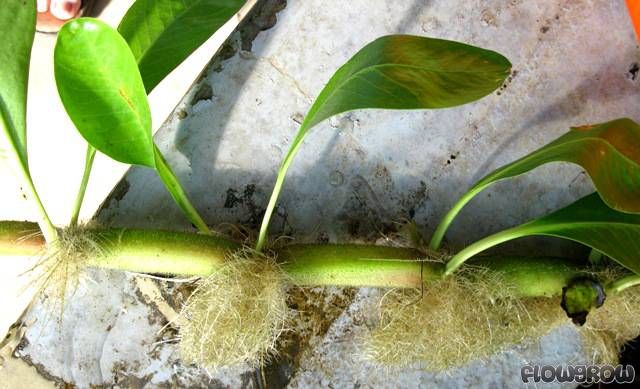
Alternanthera aquatica, image source: Flowgrow.de
A curiosity among the aquatic plants of the genus is Alternanthera aquatica from South America. It floats on the water; its hollow stems are conspicuously thickened between the nodes and serve as floats. This large, vigorous Alternanthera is at most suitable as a floating plant for very large, open aquariums or water basins in greenhouses.
Variants
The variants of Alternanthera reineckii differ in leaf size, shape and coloration. Like most other aquarium plants, they usually come onto the market in the emersed form (land form) and at first often hardly show the strong colors that they develop later underwater. Depending on the form, the leaf coloration can range from medium or olive green to purple or brown-red.
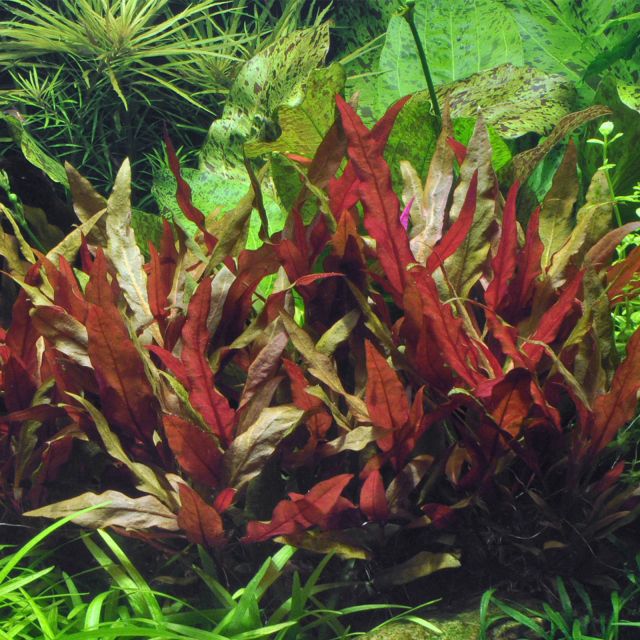
Some cultivars are particularly well known and also frequently found on the market. Alternanthera reineckii 'Rosaefolia' (also referred to as 'Rosa' or 'Pink', see picture above) has narrow, lanceolate leaves that can be brown-red on top and deep dark red underneath.
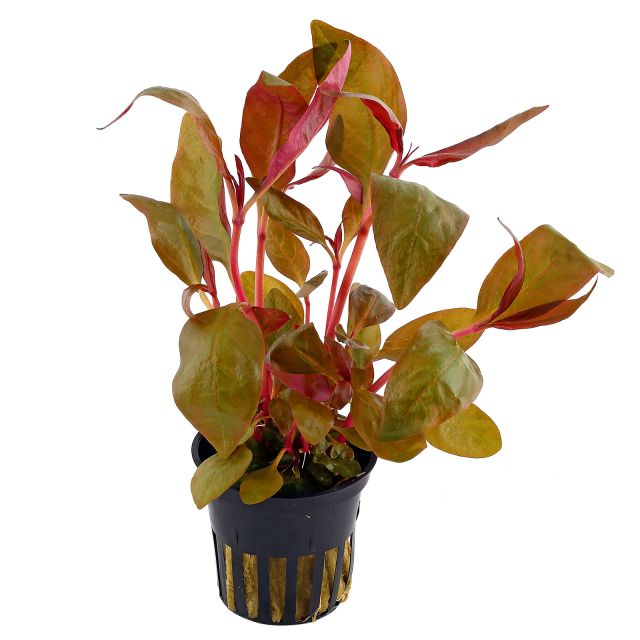
Emersed Alternanthera reineckii 'Lilacina'
The leaves of A. reineckii 'Lilacina' (also called 'Lila' or 'Purple') are larger, up to about 6 cm long and 2 cm wide, with an olive green upper side and a red-purple underside.

Alternanthera reineckii 'Cardinalis' - in Vitro XL
A. reineckii 'Cardinalis' develops somewhat smaller, oval leaves with a wavy margin and strong shades of red. This quite tall and fast-growing parrot leaf variant is best suited as a group in the midground to background and forms a strong contrast to green plants, for example similar-looking but light green Hygrophila variants.
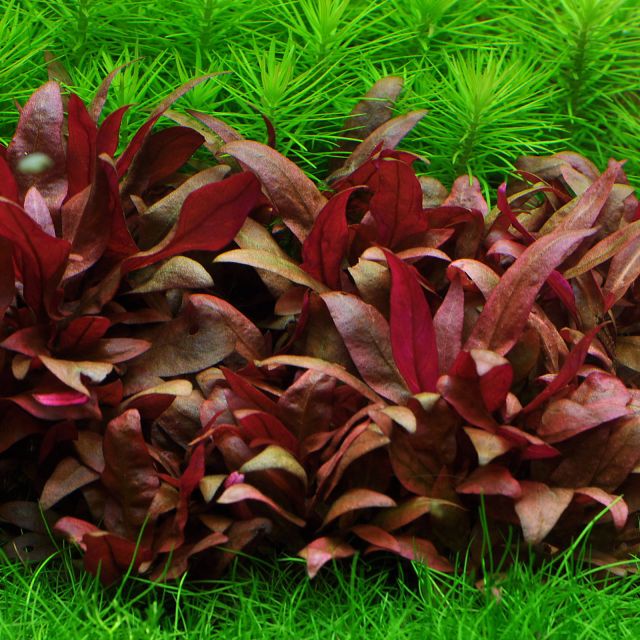
Since the 2000s, A. reineckii 'Mini' or 'Rosaefolia Minor' (see picture) has been known, a relatively small-staying, very bushy-growing, dark red to brown-red form. It is notable that as an emersed plant it grows about as large as the other forms, with long, stretched internodes (stem sections between the nodes). Only underwater does it develop its typical compact shoots with short internodes and many side shoots. As one of the few red plants suitable for the foreground, 'Mini' offers interesting design possibilities. Its low growth is maintained if it is trimmed back regularly. In the midground too, especially in a smaller aquarium, it sets a strong color accent.
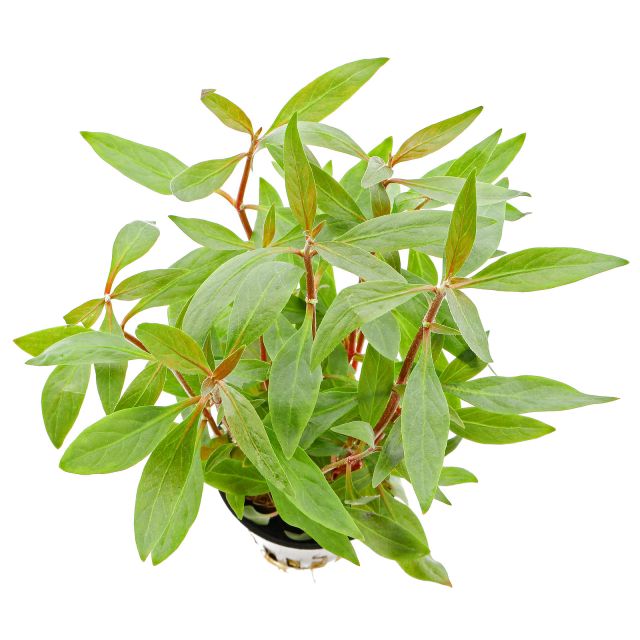
Alternanthera reineckii 'Mini' in emersed form.
Some Alternanthera reineckii forms are hardly available on the market anymore. For example, the "small parrot leaf", often referred to as the "nominate form" of A. reineckii, develops leaves only 2 cm long and 1 cm wide and grows relatively slowly. It has been known for a very long time and is not to be confused with A. reineckii 'Mini'. Depending on light intensity, the underwater leaves are green to light reddish with a red underside. A. reineckii 'Grün' or 'Green' also seems to have disappeared from the market. The green, elongated underwater leaves of this cultivar have a wavy margin.
Keeping
The forms of Alternanthera reineckii are moderately demanding aquarium plants that develop best with rather strong lighting, CO2 supplementation and balanced macro- and micronutrient supply. They are not suitable for weakly lit tanks or those without CO2 fertilization. Parrot leaves should have an open location not shaded by other plants and, as a group, should not be planted too densely. As typical stem plants, they are propagated by cuttings. It is best to place several stems of different lengths into the substrate with a little space between them.