 Moss Vacuum for the Aquarium
Trimming moss pads in the aquarium is a care task that unfortunately always produces a lot of trimmings. Many tiny moss bits then drift through the aquarium, sometimes settle in other places and keep growing there. To avoid this, there are a few little tricks, which we would like to show you.
Cutting moss during the water change
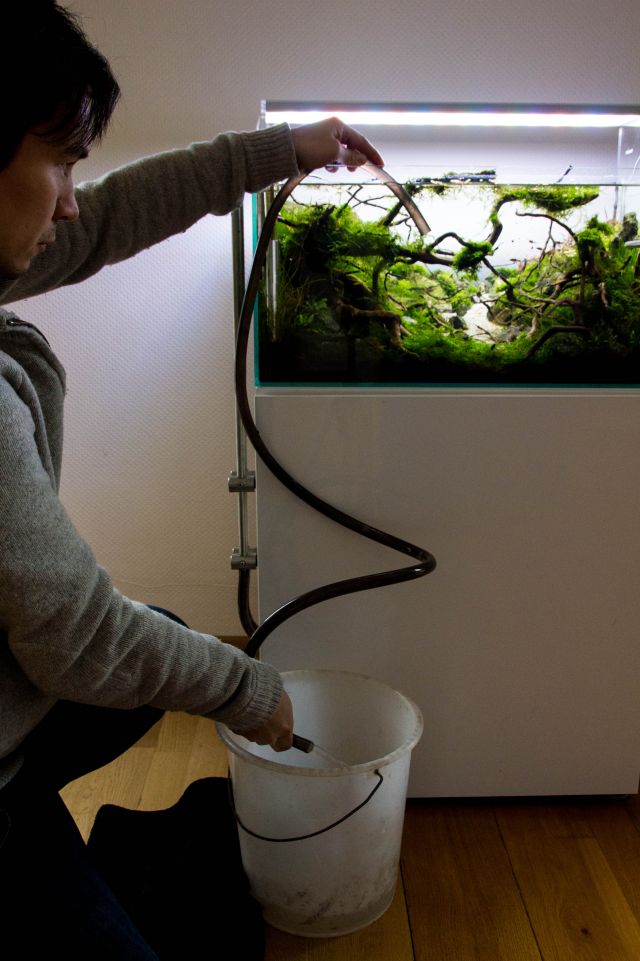
Trimming moss in your aquascape can be combined excellently with a water change if you do it the fairly classic way with a hose, which you use to draw the water out and lead it into an external container such as a bucket. To reduce the current and thus prevent individual moss particles from drifting away, you should first switch off all pumps and filters. Now, as usual, draw the old water out with the hose and let it flow into the bucket. Now a little multitasking is called for: one hand cuts the moss, while the other holds the hose and, as a "vacuum cleaner", sucks up the trimmings in the immediate vicinity and leads them into the bucket. Here you should always keep an eye on the fill level of the bucket, and also on the seating of the hoses. You do need a certain amount of attention so that it does not accidentally lead to a flood.
Trimming moss by hand
When moss pads in the aquarium are to be thinned out, simply plucking them off by hand is sometimes a good method. This does not create small bits through cutting; instead, almost exclusively larger connected shoots or plant stands are removed. Overall, this method is a very clean way of working, but also not always the right choice, depending on how the planting should look afterwards. For a more extensive and even trim, using scissors is probably the better method after all.
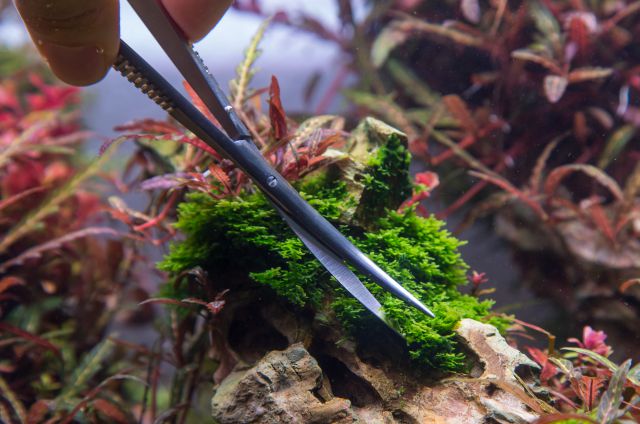
The moss vacuum
Trimmings can be removed particularly effectively with an underwater vacuum cleaner. Detritus or other unwanted residues can also be removed from the aquarium in a targeted way with it - and without any major loss of water. For this, an external filter that is no longer needed can be used, which you modify a little. Many fine-pored media such as filter foam, filter floss or fleece are suitable as filter material. You can equip the filter with them so that it holds back the fine particles well. In addition, the filter inflow and outflow are prepared a little. The filter outflow is fitted with the bend and the filter intake basket. This way you can simply hang it over an aquarium pane. The intake basket slows down the outflowing water strongly in its flow and spreads it out. This is intentional, because too strong a current in the aquarium during trimming can cause plant remains to be distributed through the aquarium with it. This is to be avoided. We therefore take the simple solution here of just using the intake basket for the filter outlet.
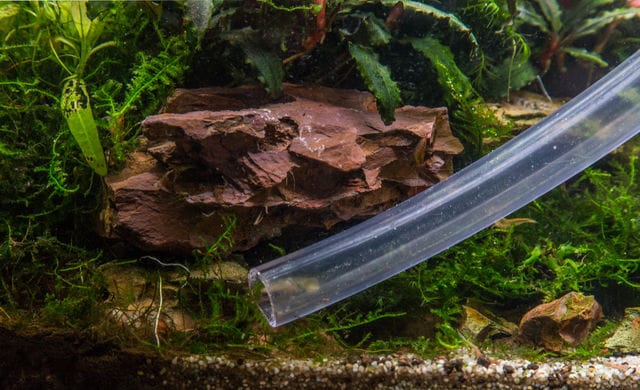
The filter inflow is simply fitted with the hose. Through the open end of the hose, you can then suck up the moss remains with one hand, while the other plucks the moss in the aquarium or trims it with scissors. Even one-handed operation is possible if you fix the end of the hose with a rubber band to the hand that does the trimming.
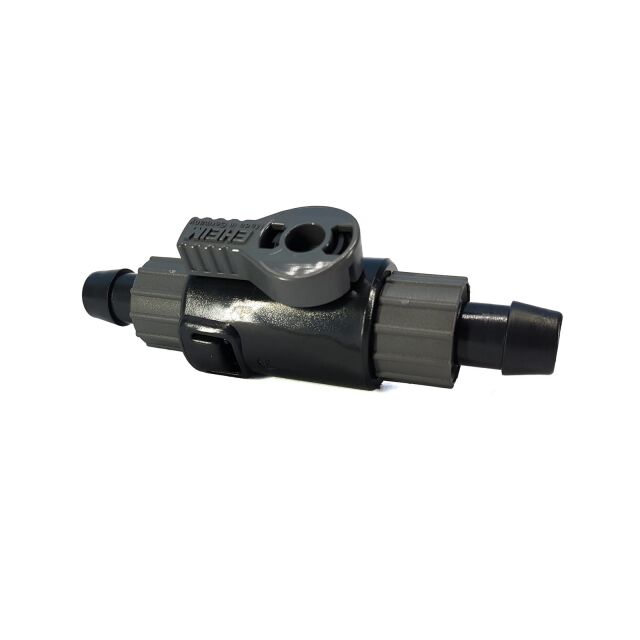
To be able to regulate the water flow and thus the strength of our vacuum cleaner, it is recommended to install a valve or a shut-off valve in the hose line.
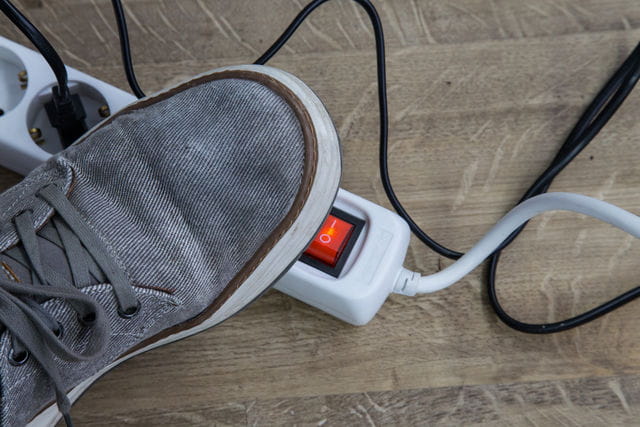
Since most filters do not have an on/off switch, but this function can be very helpful when "vacuuming", the simplest solution would be to plug the filter's power plug into a power strip that has a separate on/off switch. You then connect the power strip to the electrical circuit. Ideally, you can then even switch the filter on and off with your foot, if the switch on the power strip is easy to reach and operate. The advantage is that you have both hands free to do the work on the aquarium.
Putting the moss vacuum into operation
To get the prepared external filter running, it should first be filled with enough water. The intake basket together with the pipe bend, which is connected to the filter outflow, is simply hung over a pane of the aquarium. The loose end of the hose of the filter inflow is now held underwater in the aquarium and the filter is then started. Once enough water reaches the pump head, the remaining air will escape through the outflow and the moss vacuum is ready for use.