 Setting up an aquarium cabinet
An aquarium cabinet is not just a stand for the aquarium; it is also storage space for accessories and houses important aquarium equipment such as the external filter and the CO2 system. In this article, we show you how to organize a cabinet well so that the inside does not sink into chaos.
What goes inside the aquarium cabinet
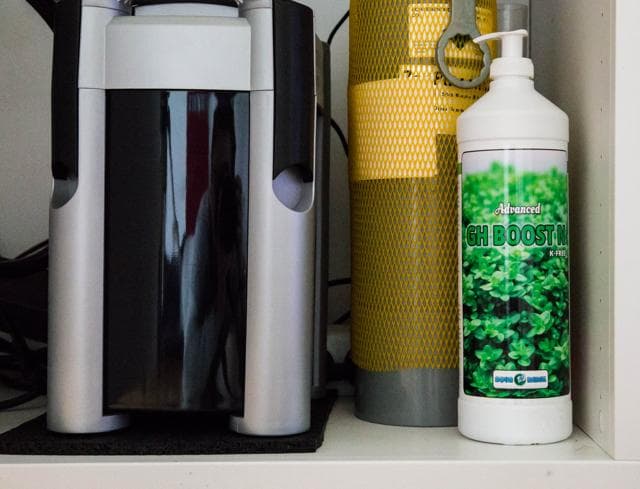
First and foremost, the cabinet of an aquarium holds the equipment that has been moved outside to make room in the tank itself. So if no internal or hang-on-back filter is installed, external filters are usually used, which are connected to the aquarium by hoses. This type of filter can be hidden perfectly in a cabinet.
CO2 systems are used above all in planted aquariums, and the CO2 cylinders in particular are quite heavy and can take up a lot of space. These can therefore also be stored well in the cabinets, which are, by the way, called cabinets in aquascaping jargon, invisible to the eye.
If you use an external filter, it is even possible to integrate an external heater via its circuit. Here, too, the heater can be stowed away in the cabinet, allowing more design freedom and less visible equipment in the aquarium.

In high-performance planted aquariums, a steady supply of nutrients is crucial for the healthy growth of the aquatic plants. For this, various liquid fertilizers are usually added, and their bottles can also be stored well in the aquarium cabinet. In the case of automated fertilization, the dosing pump can even be placed here as well.

Of course, other external aquarium equipment can also find its place in a cabinet, keeping it out of the viewer's sight and thus leaving a tidy impression. This includes, for example, UV-C clarifiers or diaphragm pumps for aerating an aquarium.
Aquarium accessories
Other aquarium accessories, fish food, tools (aquascaping tools), fish nets and care products, which otherwise often stand loose around or on top of the aquarium, can also find their place in a cabinet. Behind a closed door they are invisible, yet still easy to reach for daily work on the aquarium. A small raised shelf in the cabinet can be very useful here for storing light, frequently used items neatly.
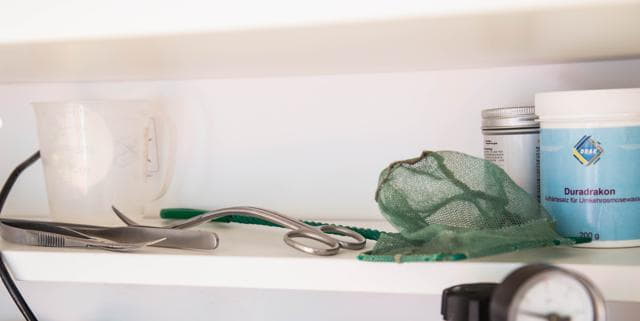
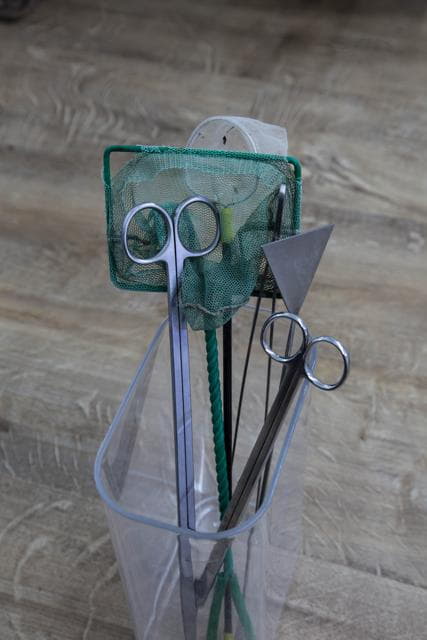
Tools that often get wet can also be stored very well upright in a tall container. These include, for example, scissors, tweezers and fish nets. Because of their upright position in the container, the items drain very well and you save yourself the constant drying.
Safety considerations
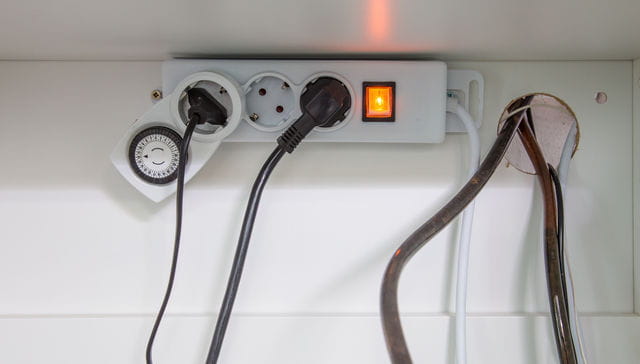
True to the motto "water and electricity don't mix", you should avoid possible contact between these two components in the cabinet as well as you can. A good precaution is therefore not to leave power strips lying on the floor but to mount them raised on the back or side wall of the cabinet.
Reducing noise
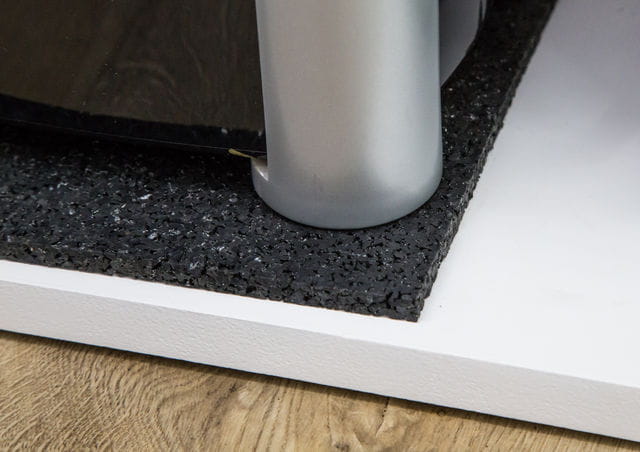
External filters and diaphragm pumps in particular can produce a certain noise level. A cabinet already reduces the noises inside it thanks to its closed construction, but sometimes this can still be optimized a little. We have written a separate article here that deals with exactly this topic. Since external filters are usually used in a cabinet, an effective measure is a mat made of, for example, foam rubber placed under the filter. This reduces the transmission of so-called impact noise and of the filter's vibrations to the floor of the cabinet.