 Saving energy with your aquarium
This article was updated on September 28, 2022.
Operating an aquarium requires many kinds of technical components that of course consume energy in the form of electricity. These include above all filter equipment, heaters, the aquarium lighting and further technical accessories. In every area there is certainly some potential for savings that can be implemented skillfully and easily. We give a few tips on this.
Aquariums and their lighting
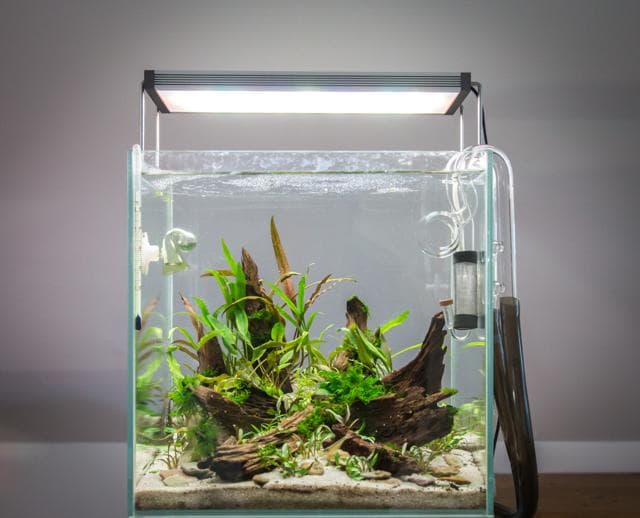
Aquariums of all kinds are usually lit during the day with a lighting period of 6 to 12 hours. If your aquarium still has old lighting systems such as fluorescent tubes, metal halide lamps (HQI) or compact fluorescent tubes, now would be the time to consider switching to energy-saving LEDs. A new purchase may cause costs at first, but the performance and lifespan of modern LED lamps ensure a quick payback. LEDs with a high lumens-per-watt output are particularly energy-saving. For corresponding savings, at least 120 lumens per watt should be available. Some manufacturers such as daytime even offer LED lighting with a ratio of 180 lumens per watt.
The lamp of an aquarium usually only shines for a few hours during the day, so it counts less toward the base-load consumption of aquariums. There is potential for savings here by shortening the lighting period or doing without pure lighting effects such as moonlight.
If you have several lamp units that can be controlled individually, or even LED controllers or dimmers, electricity can also be saved by reducing the light output. The brightness is then simply dimmed down, or only a few lamp units are used. Of course, reducing the duration and intensity of the aquarium lamps should be done in line with the needs of the inhabitants and aquatic plants. More demanding aquarium plants in particular can change their coloring under less light or show a light deficiency. Reddish plants in particular sometimes turn green then. A light deficiency can be recognized by very long internode distances in stem plants. Dramatic damage to the aquatic plants is not to be expected here, though; that happens rather in complete darkness.
Heaters

Ornamental fish from tropical regions such as South America or Africa often need higher temperatures than room temperature. Aquariums are often heated to temperatures between 24 and 28 °C. This is normally done with thermostat heaters. Aquarium heaters can be set to a certain desired temperature and keep the aquarium water at the set temperature. To achieve this, thermostats are built into the thermostat heaters that can measure the temperature in the aquarium and switch the heating on only when the temperature falls below the set value.
Thermostat heaters for aquariums often have fairly high wattage ratings, which might put you off in terms of energy use. It should be noted, though, that such heaters do not run continuously (provided that their output matches the aquarium size and is not undersized).
To save energy on the aquarium heating, it is worth considering lowering the set temperature by a few degrees. Of course, this should be matched to the needs of the aquarium inhabitants such as ornamental fish and invertebrates. A certain "night setback" can also come into play here. In nature, too, the water cools down at night, so it would be an idea to switch the heater off at night. It can sometimes be coupled to the same timer as the aquarium lighting. So that it does not cool down too much during the dark phase, you should factor the spatial conditions and insulation into the calculation. If the room in which the aquarium stands cools down too much at night (for example in winter), a night setback might not be appropriate. As already mentioned, though, it depends heavily on the stock and its hardiness and flexibility.
Experience shows that open aquariums consume considerably more heating energy than those with a closed cover, since the heat can escape upward. To save a little electricity (and, incidentally, also water that needs topping up because of reduced evaporation), it would be worth considering running the aquarium with a cover that fits the model.
The "insulation" of an aquarium can also sometimes have an effect on heating requirements. Aquarium pads are often also called thermal pads and help to reduce heat loss through the base plate. You could also take the topic further and insulate the side walls and the back wall of the aquarium as well, for example with polystyrene boards. This would, however, also result in visual losses; the aquarium would then no longer look as attractive, and the view through the insulated panes would of course no longer be there. If it is not a living room aquarium but rather breeding or holding systems in the "fish cellar", which mostly stand on metal racks anyway, this kind of insulation might be worth considering.
Of course, for energy-saving reasons you can also choose an aquarium setup and stock that need rather lower temperatures. This is then referred to as a coldwater aquarium. In it you can keep, for example, goldfish or native fish species that tolerate cooler temperatures. We presented a selection of so-called coldwater plants in more detail in this article.
Filter equipment
The filter is the technical heart of an aquarium for keeping the biological balance in equilibrium and the pollutant load low. It is therefore not really recommended to switch off the filter to save energy. The aquarist can, however, consider choosing a particularly energy-efficient filter when buying a new one. The decisive factor here is the power consumption in watts. Depending on the model and manufacturer, there are certainly differences in output, which then affect the electricity costs. Because: the filter runs 24 hours a day, so continuously. Even small differences in wattage can have a big effect here. The lowest possible consumption also spares the aquarist's wallet.
The filter should also be designed to suit the stock and the aquarium. If there are many fish in the aquarium, a large filter volume is an advantage; the Oase BioMaster, for example, is recommended here. For an aquascape or planted aquarium this is not really needed; a small filter volume is enough here, and what matters more is sufficient flow for nutrient transport. Here you should pay more attention to the turnover rate. This is usually given in liters per hour.
For the filter to run well, the aquarist should make sure there is good flow and clean the filter together with hoses and piping regularly. This does not save electricity directly, but it prevents loss of performance.
Aquarium and photovoltaics
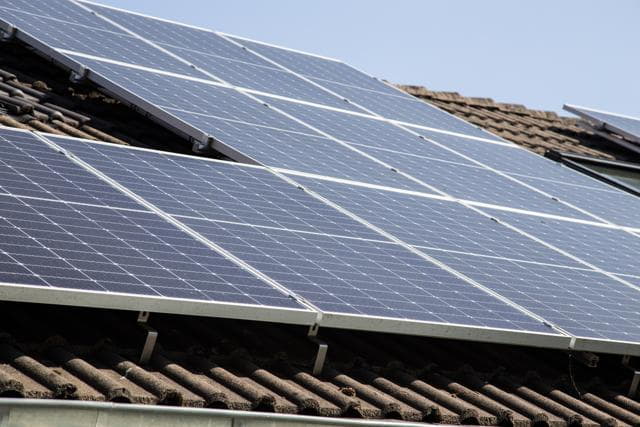
If the aquarium owner is thinking about getting a PV system, it is a very fitting combination for operating an aquarium . Aquariums with filters and heaters do have a certain base load, but peaks then arise during the day from the aquarium lighting. This often follows the example of nature and is often set by timer so that it switches on over the course of the day. Many aquarists also often simulate daylight curves with LED controllers, with dimming phases in the morning and evening hours and a peak around midday. This conveniently also corresponds to the usual output curve of a photovoltaic system, especially if it faces south. In this way, the power peaks of an aquarium can be absorbed very well by a PV system. The self-consumption of the solar power is thereby increased and has a positive effect on the balance of a PV system.