 The KH-pH-CO2 table
Because of the so-called lime-carbonic acid equilibrium, there is a relationship between the pH value, the CO2 content and the carbonate hardness (KH) of water. These values are often summarized in a table. Here we show you what it is all about.
The lime-carbonic acid equilibrium
The so-called lime-carbonic acid equilibrium refers to the chemical equilibrium between carbonic acid, or carbon dioxide, and calcium carbonate (CaCO3). When this balance is present, an aqueous solution no longer contains any free carbonic acid. It is then neither able to dissolve lime nor, on the other hand, to precipitate lime.
The so-called free carbonic acid is present almost entirely in the form of CO2; only a small portion of approx. 0.7% reacts with water (H2O) to form hydrated carbonic acid H2CO3:
CO2 + H2O ↔ H2CO3
Depending on the pH value of the water, carbonic acid forms or decomposes into other substances. The following reaction equation is relevant here:
H2CO3 ↔ H+ + HCO3-
So carbonic acid can decompose further into H+ ions and hydrogen carbonate (HCO3-). The latter can in turn decompose in a next step into H+ ions and carbonate:
HCO3- ↔ H+ + CO32-
As already mentioned above, these reactions depend strongly on the pH value of the water. If few H+ ions are present, meaning the pH value is rather high, considerably more carbonates and hydrogen carbonates (CO32- and HCO3-) are formed. If, however, there are more H+ ions in the water, the pH value is lower. The reaction then runs more in the other direction and more carbonic acid forms, and ultimately considerably more CO2 (and water).
Biogenic decalcification
Hydrogen carbonates (HCO3-) are readily soluble in water, but carbonates (CO32-) are considerably less so. These combine with the calcium ions dissolved in the water and can then precipitate as lime (CaCO3). In the aquarium, such a lime coating can sometimes be seen, for example as whitish deposits on plant leaves or other decoration. This usually happens when the aquatic plants carry out biogenic decalcification, which is caused by a CO2 deficiency, meaning there is hardly any free CO2 left. The plants then obtain the carbon they need from the hydrogen carbonate in the water. As a result, the pH value rises and the mass ratio shifts toward carbonate. When the solubility limit of carbonates and calcium in the water is reached, they then precipitate as a solid (lime), which forms these visible coatings on the plant leaves.
Carbonic acid and its forms
Carbonic acid can dissolve lime (CaCO3) and convert it into calcium hydrogen carbonate [Ca(HCO3)2]. This often occurs in an aquarium that is fertilized with CO2 but also contains calcareous stones as decoration. The carbonic acid from the CO2 supply breaks down the lime inclusions in the stones. As a result, both KH and GH of the water rise, and ultimately the pH as well.
The CO2 incorporated in carbonates is also referred to as bound carbonic acid. Semi-bound carbonic acid is the portion of CO2 that is bound in hydrogen carbonate [Ca(HCO3)2].
Together with the free carbonic acid (here CO2), a total of three different forms of carbonic acid are therefore possible, which can also coexist. As mentioned, this depends on the pH value.
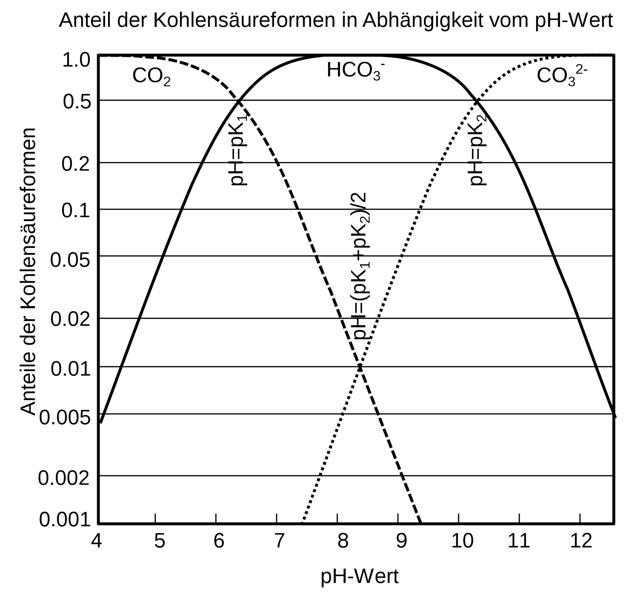
Image author: Johannes Kalliauer - Own work via Wikimedia Commons, License: CC BY-SA 4.0, Source.
The simultaneous occurrence of two forms is in this case called the "associated" carbonic acid of the other form. In the aquarium hobby, the content of hydrogen carbonates in the water is often expressed as carbonate hardness (KH). Proceeding from this, the corresponding amount of CO2 is regarded as "associated" or defined as the "associated carbonic acid".
Hydrogen carbonates would continue to decompose if the matching free "associated" carbonic acid in the form of CO2 were not present. It can therefore also be said that the water is in lime-carbonic acid equilibrium when the amount of free carbonic acid corresponds to the amount of associated carbonic acid. In this balance, no further excess CO2 is present.
If the concentration of free associated carbonic acid is too low, lime can therefore form in the form of precipitates. The hydrogen carbonates then become unstable and decompose further into carbonates, which can then form lime with the calcium present in the water.
If, however, more free than associated carbonic acid is present, the water is lime-aggressive and strives to return to the state of equilibrium by dissolving lime.
The KH-pH-CO2 table
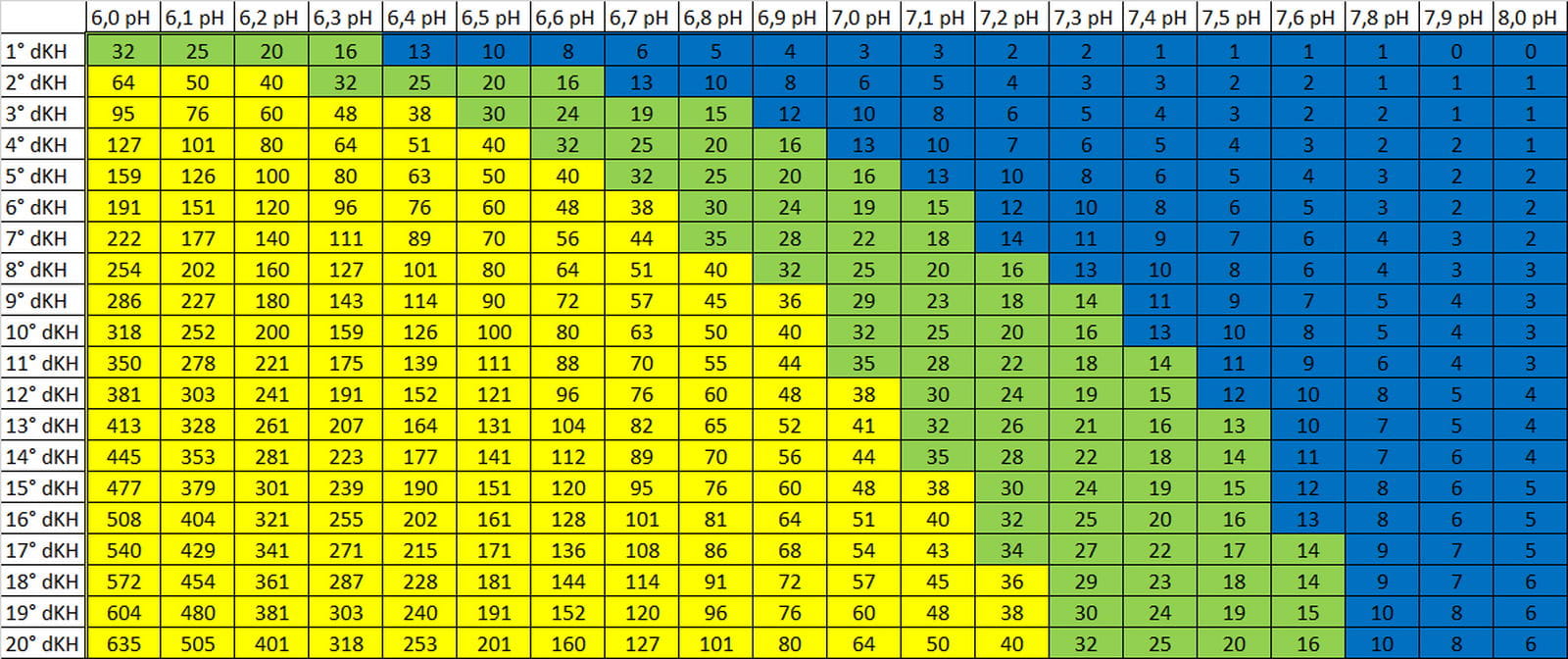
Based on the relationships described above, the following table can be drawn up. Depending on a particular pH and KH, you can read off the CO2 value here.
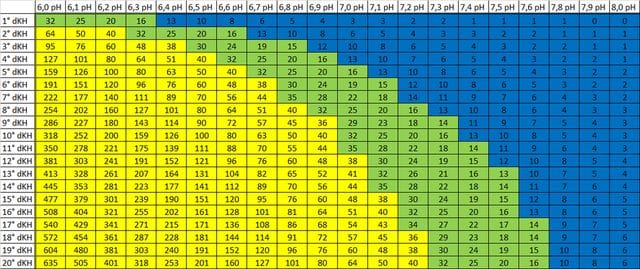
The CO2 content is also color-coded, in a way similar to the color scheme of a CO2 drop checker, designed so that it makes sense for the growth of aquatic plants. Sufficient CO2 concentrations are shown here with a green background. Blue means too little carbon dioxide for aquarium plants, and a yellow color stands for a CO2 concentration that is too high, which could sometimes cause problems for the aquarium inhabitants.
Using the table in the aquarium hobby
The all-important question for the aquarist is, of course, to what extent can this table be used in practice? First of all, it should be mentioned that this is a purely theoretical construct in which other factors have no influence on the parameters pH, KH and CO2. In an aquarium, however, things can look quite different, since the aquarium water contains other substances that can influence these parameters. Above all, besides carbonate hardness there are other buffer systems that can stabilize the pH value. These include above all humic substances and phosphates, which can occur more or less in an aquarium as a rule. Phosphate often gets into the water through aquarium fertilizers but also as a breakdown product of fish excretions; humic substances get in, for example, through introduced driftwood, other natural materials such as peat, alder cones and, of course, humic substance products.
These other elements in the water can distort the relationship of pH, KH and CO2 and thus influence the values in the table. Many aquarists use the table incorrectly and use it as a test for determining the CO2 content in real time. For this, the KH and pH values determined by liquid drop test are used to then calculate the CO2 value from the table. In reality, though, it looks quite different because of the other interfering factors. To determine the CO2 concentration independently, a so-called drop checker with test reagent is needed. For this, the test solution has a fixed KH that is independent of the aquarium water, which then displays a reliable result.
The KH-pH-CO2 table is therefore not completely useless after all, since it offers a first point of reference and a rough guideline for how the associated water parameters stand, at least in theory. The table is a good starting aid especially for setting up a pH controller. It is just that this table should rather not be used as a direct CO2 test.