 Emptying an aquarium
At some point the time comes: an aquarium has to be emptied. There can be several reasons for this, such as a move, a redesign or even giving up an aquarium and the hobby. The reason why an aquarium has to be emptied is not that decisive; here we show you the best way to go about emptying the tank.
Planning
As a rule, an aquarium is still in full operation. That is to say, all equipment such as filter, heater, light and possibly the CO2 system is still running, and the stock is in the aquarium, as are the aquatic plants. The substrate and decoration are also still in the tank. It is now important to proceed step by step, so that it is as stress-free a time as possible, above all for the inhabitants.
Switching off the equipment
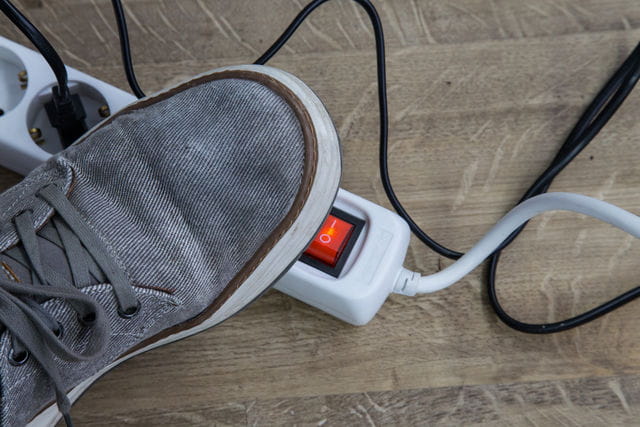
Since the water level in particular is going to be lowered, the first thing to do is to switch off connected equipment so that no malfunctions occur. This includes in particular the heater of an aquarium and the filter equipment or other pumps. You can also switch off the CO2 system and close the cylinder valve. Other equipment such as UV-C clarifiers, dosing pumps or sterilizers can be switched off now. The aquarium lighting, however, could still be useful for catching animals and working in the aquarium so that you can see enough. It can therefore stay switched on. However, quite a bit of room to move above the tank is necessary. The aquarist should therefore make space here and, for example, hang pendant lamps considerably higher. If you have several clip-on lights, all but one can be removed here. It is advisable to push the lamp far to the back to get as much room as possible. Lamps may also have to be removed completely for a while. An alternative would then be to set up a small work light outside the aquarium.
Catching the stock
Catching the aquarium inhabitants is certainly the undertaking that demands the most time and patience. Of course, it depends very much on what kind of animals are in the aquarium. You can proceed quite well step by step and first catch the creatures that are very easy to catch. You can start, for example, with the freshwater snails that you see right at first glance. Apart from those, there are certainly still a few specimens hidden in the aquarium that you will come across later. If snails are on a glass pane, it is best to pull them off upward along the pane or try to loosen them from the pane by gently twisting them back and forth.
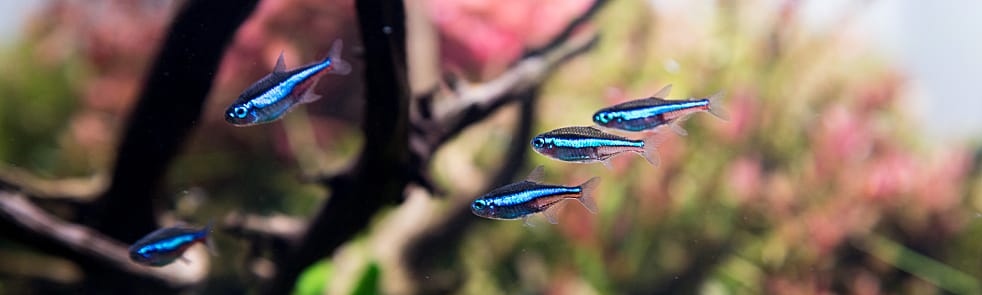
You can also already catch the fish species that are not shy and are bold. This includes slow and larger fish that easily end up in the net. Animals that hide quickly or disappear into the thicket can be caught better later.
Removing the hardscape
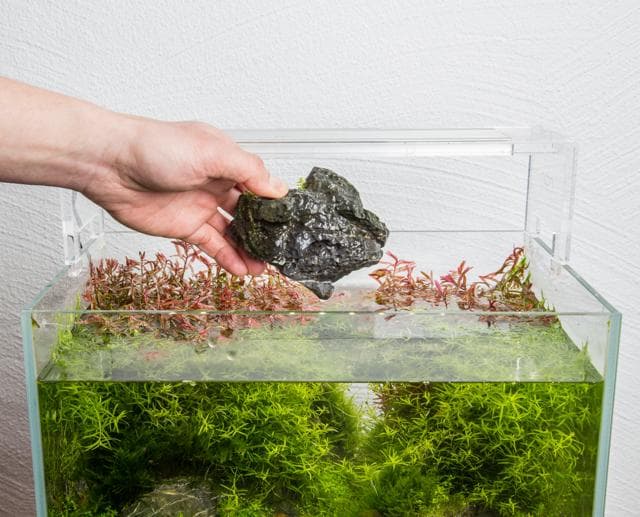
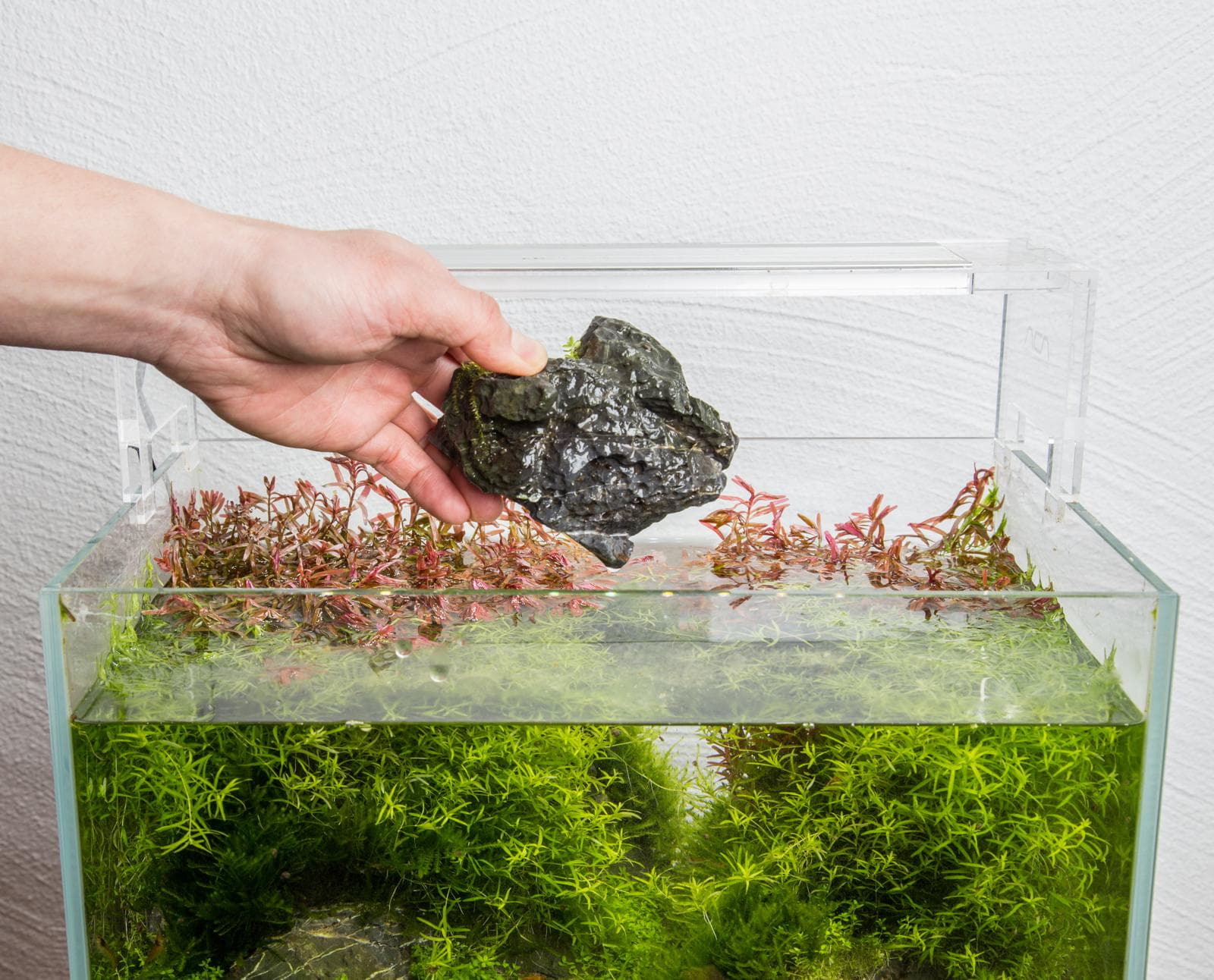
To gradually take away the cover from the shy animals, a good deal of planting and decoration can be removed little by little. This includes primarily connected hardscape structures made of stones, driftwood and attached epiphytes and mosses. Loose stones and driftwood can also be removed. When taking out the hardscape, it should be checked carefully for snails clinging to it. They can also hold on very well hidden. Sometimes, after most of the interior has been removed, you can try another round of catching the animals. Often only the species that live in very large numbers in the substrate zone (such as dwarf shrimp) and those that now seek their hiding place in the plants remain. If you then go on to remove aquatic plants along with their roots, you should proceed very carefully so that large areas of substrate are not set in motion abruptly, burying animals beneath them or causing startled reactions. If you lift such a plant cushion to the water surface, it is advisable to shake it off well so as not to accidentally remove animals hidden in it or clinging to it. A good trick otherwise is to dip the plant cushion straight back into the water once more after taking it out. Often the creatures in it then let go and swim back into deeper water zones.
Removing the aquatic plants
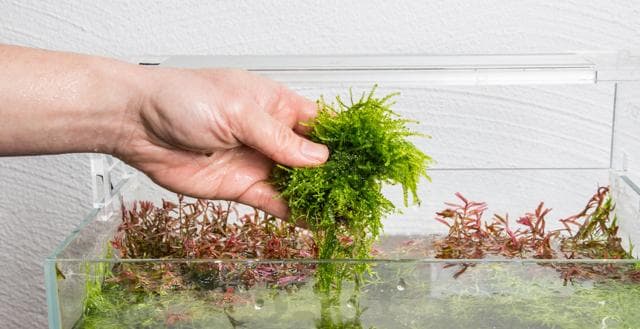
At the latest now, with the removal of aquarium plants, larger amounts of detritus are very likely to be stirred up as well, which clouds the view heavily. Catching animals now becomes considerably more difficult. On the one hand, you should practice patience here and wait until the detritus has settled and the view has cleared again. On the other hand, the situation can now be used to siphon off some water (together with detritus). That clears the view a little, and in addition you are already removing some water (which is our main goal after all). Furthermore, the room for the fish to move is also restricted, which likewise makes catching them easier.
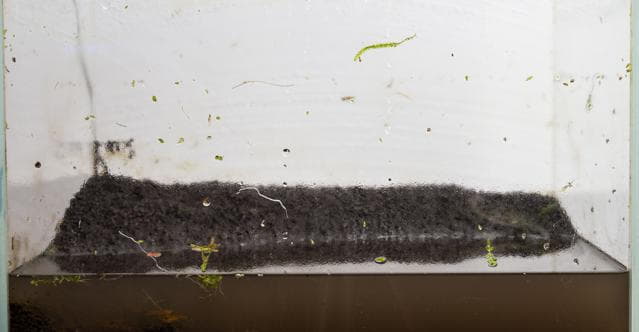
Once the hardscape and planting have been largely removed and the water level lowered considerably, the remaining animals have only little cover left. It is then quite easy to catch the remaining specimens. By rearranging the substrate, you can now restrict the remaining water zone even further by layering the substrate higher at the back and very low at the front. In aquascapes or planted aquariums this is often already the case anyway. You can now carefully lower the water level so far that the substrate at the back already sticks out of the water while enough water is still present at the front. When draining the water, you should proceed very carefully so that no animals suddenly end up high and dry. For siphoning off the water, it is worth fitting the end of the hose with a filter guard so that no animals are sucked in.
Netting the animals
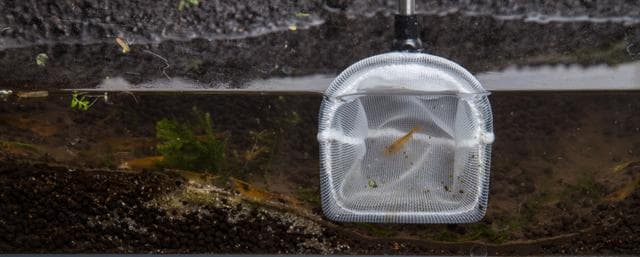
If the catching efforts keep stirring up detritus and thereby limiting visibility, it is worth taking small breaks in between until the view is clear again. With some patience and a few catching rounds, it should be possible to catch the stock completely this way. By the way: you will be amazed at how many dwarf shrimp you have found. Netting them will also be the most work in the end if you also want to catch juveniles and baby shrimp. For this it is best to use a really fine shrimp net.
Removing the substrate
Once the stock has been completely removed from the aquarium, the next step is to get the remaining substrate out of the tank. There are, in principle, two approaches for getting the substrate out well.
Siphoning off the substrate
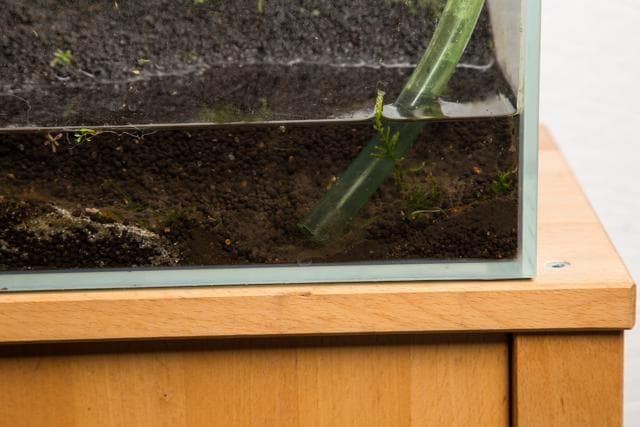
A fairly glass-friendly option would be to siphon off the substrate. This is particularly well suited to smaller aquariums filled with softer and finer substrate (that is, soil or sand). Here the substrate can simply be siphoned off with a hose. The prerequisite, of course, is that enough residual water remains in the tank for this. If necessary, you can otherwise pour some (waste) water back in so that the flow is maintained. The substrate is then simply emptied into a bucket.
Removing the substrate by hand
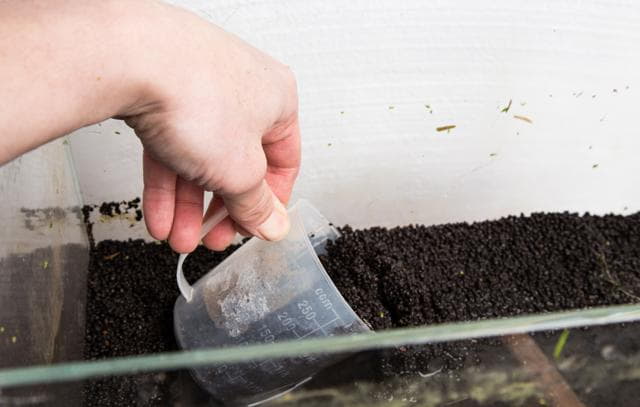
The classic option otherwise would be to scoop the substrate out by hand after lowering the water level as far as possible. Smaller containers can also be used for this. Since you often shovel along the glass panes, contact with the substrate can sometimes cause scratches on the glass. You should therefore proceed very carefully here. Soil is relatively soft, but with gravel and sand the risk is higher, since the particles are harder and firmer.
Cleaning the aquarium
Once the tank is almost completely emptied, the cleaning work can now begin. We have described how to do this in more detail in this article.