Glabrous Anubias


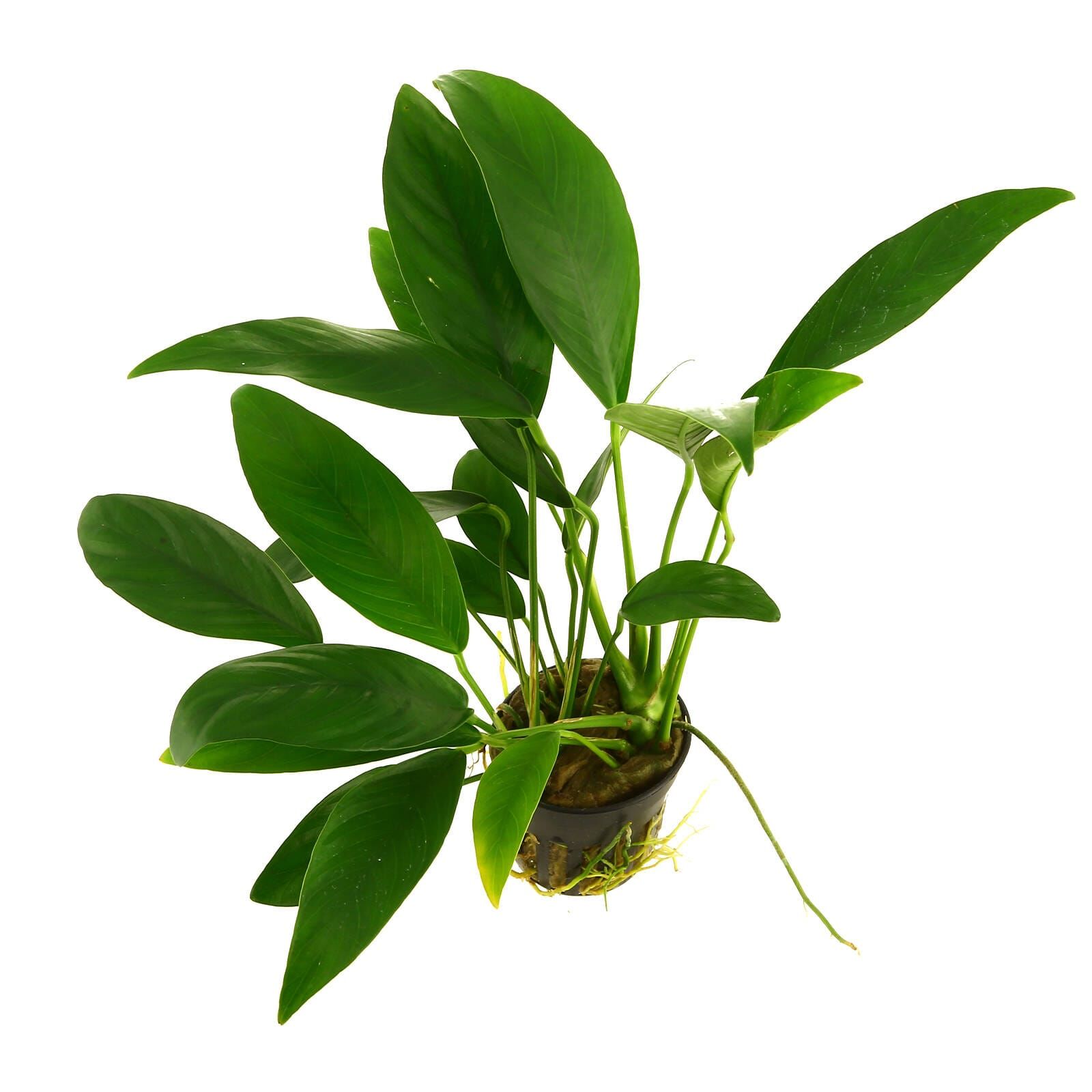
Anubias barteri var. glabra
Glabrous Anubias
- Medium-sized Anubias
- Robust, undemanding
- Interesting lanceolate leaf shape
- Also suitable for smaller tanks
Curbside delivery: This item ships by freight carrier and is delivered to the curb only, not to your door or into your home. The carrier will call you in advance to schedule a delivery date. Learn more about freight delivery
Customers also bought


Item question
We’re here for you!
Please enter your question and e-mail and we’ll contact you as soon as possible. It usually takes us up to 24 hours during business days to respond.
Thank you for your question!
Thank you, we’ll get in touch!
Close window
You already sent us a question.
Please wait a few minutes
Description
The Glabrous Anubias, A. barteri var. glabra, is native to West Africa and grows there on rocks in the flood zone of rainforest streams. There are different forms of the glabra variety, which have more or less elliptical to lanceolate leaves. Our plant is a form with more upright, elliptical, pointed, somewhat asymmetrical leaves. It differs from the form Anubias barteri var. glabra "Minima", which has narrower and more horizontal, somewhat wavy leaf blades.
The plant grows to a height of around 15 - 20 cm, the leaf blades are at least 11 cm long and 3.2 cm wide. It is often mislabeled in the trade, for example as Anubias barteri var. angustifolia or "Anubias congensis", which otherwise refers to Anubias afzelii.
Anubias barteri var. glabra is just as undemanding and robust as other Anubias barteri forms. It is primarily a perching plant and attaches itself to the hardscape (rock, driftwood) with its roots, but can also be attached to the substrate (but do not bury the rhizome!). Temperatures between around 22 and 26 °C are ideal. The plant needs little light, but develops better with moderate lighting. It has no particular requirements in terms of water chemistry, but develops best with a complete supply of nutrients via the water column. The addition of CO2 is also very beneficial to its growth, but is not absolutely necessary. Propagation takes place by dividing the rhizome.
Anubias barteri var. glabra is a recommended, robust plant for hardscape planting that is also suitable for low-light tanks. With its firm leaves, it is not eaten by herbivorous fish and is suitable for cichlid tanks. Like all Anubias, it also grows emersed in humid terrariums and paludariums.
How many plants do I need?
General information
Please choose a variant to see more information.
| Item no. |
|
| EAN | |
| Weight | |
| Shipping weight |
Questions and answers about Anubias barteri var. glabra
You have questions about this product? Ask other customer or our support team about this product!
Customer reviews
One review
| 5 Stars(0) |
|
| 4 Stars(1) |
|
| 3 Stars(0) |
|
| 2 Stars(0) |
|
| 1 Star(0) |
|
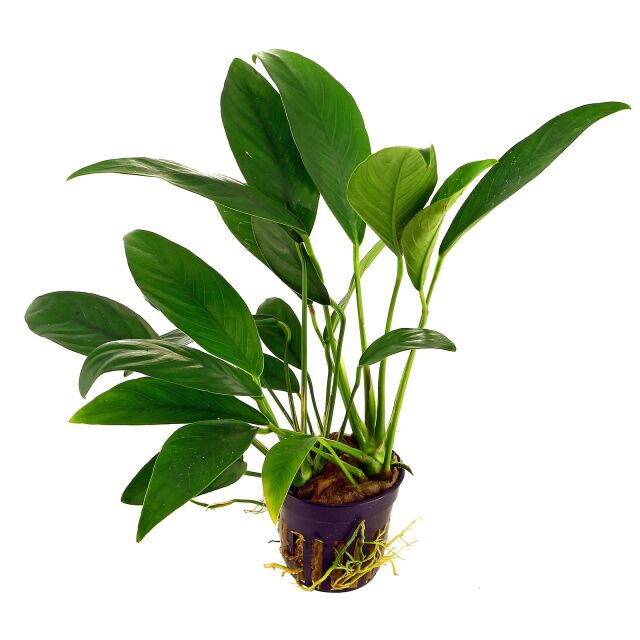
I received a rather small but healthy specimen. According to Aquasabi support, this varies depending on the season and other factors (for me, end of March). (read more)
Show original
Bisschen kleines Exemplar
Ich hab ein recht kleines aber gesundes Exemplar geliefert bekommen. Laut Aquasabi Support variiert das je nach Jahreszeit und anderen Faktoren (bei mir Ende März). Im Topf waren allerdings zwei separate Pflanzen.
Similar products


